


If you’ve been a real estate investor for a while, your portfolio is likely at least 2-3 properties, with plans to grow. Conventional mortgage requirements aren’t necessarily designed for further growth. If you have an irregular income profile or high debt-to-income ratio, you only have limited access to the funding you need to scale.
That’s why DSCR loans have become a popular choice among investors in recent years. DSCR loans give borrowers flexibility by allowing them to finance properties based on the property’s income potential. But that doesn’t mean conventional loans are obsolete. When you stack up DSCR loan vs conventional loan, you’ll find that they each have areas they’re particularly good at.
At Defy Mortgage, we’re experts at providing both DSCR loans and conventional loans. While our focus is on non-QM loans, our full roster of 75+ loan solutions includes both traditional and non-traditional loans. Each of our non-QM programs is fully customizable to fit your specific needs and goals. With over 100+ combined years of experience in the DSCR lending space, we’ve put together this guide to help you come to an informed decision if you’re choosing between DSCR loans and conventional loans.
Let’s go through what you’ll learn from this article:
TL;DR
- DSCR loans qualify you based on property cash flow, while conventional loans qualify you based on personal income, credit, and DTI.
- DSCR loans can be faster to qualify for, especially for self-employed borrowers or investors with complex financials.
- DSCR loans have no property limits, unlike conventional loans which restrict borrowers to a maximum of 10 financed properties per Fannie Mae and Freddie Mac guidelines, and allow LLC ownership, making them ideal for scaling a rental portfolio.
- Unlike DSCR loans, conventional loans can finance primary residences and second homes.
- Smart investors often use both: DSCR for rapid acquisitions, conventional loans for refinancing into lower rates.
- Defy Mortgage’s DSCR program stands out with 85% LTV purchase SFR only, minimum FICO 640, DSCR down to 0.75, flexible options, loan amounts up to no hard maximum loan limit, and fast closings (as little as 14 days).
DSCR Loans vs Conventional Loans: What is best for me?
Choose DSCR Loan if you:
- Are self-employed or have an irregular income
- Are a real estate investor who wants to use rental income to qualify for the loan
- Own investment properties already
- Are purchasing an investment property
- Need to close in under 30 days
- Are looking for alternative income documentation methods for qualification
- Want to scale your portfolio quickly
- Prefer LLC ownership structure
- Investor Example: Ashley, self-employed real estate investor in Ohio.
- Credit Score: 760
- Current Properties: 6 rentals (hitting conventional loan limits)
- Annual Income: $180K (but varies significantly on tax returns)
- New Target: $500K duplex generating $3,800/month rent (1.15 DSCR)
- Down payment: Looking for up to 70% LTV
- DSCR Loans are best for: Real estate investors, self-employed, fast acquisitions, rental properties, portfolio scalers
Choose Conventional Loan if you:
- Have W-2 income and clean tax returns
- Are buying a primary residence or second home
- Want a lower down payment
- Plan to hold the property 10+ years
- Own fewer than 1 financed properties
- Are a first-time home buyer
- Aren’t planning on renting out your investment property in the next year
- Conventional Loans are best for: W-2 employees, primary residences, long-term holds, first-time home buyers
DSCR Loans vs Conventional Loans: What Are the Core Differences?
For growing real estate investors, the core differences between a DSCR loan vs conventional loan are vital to long-term investment success. Both financing tools have their own underwriting standards that shape how easily you can qualify, how much you can borrow, and which investment strategies they best support.
How DSCR Loans Work
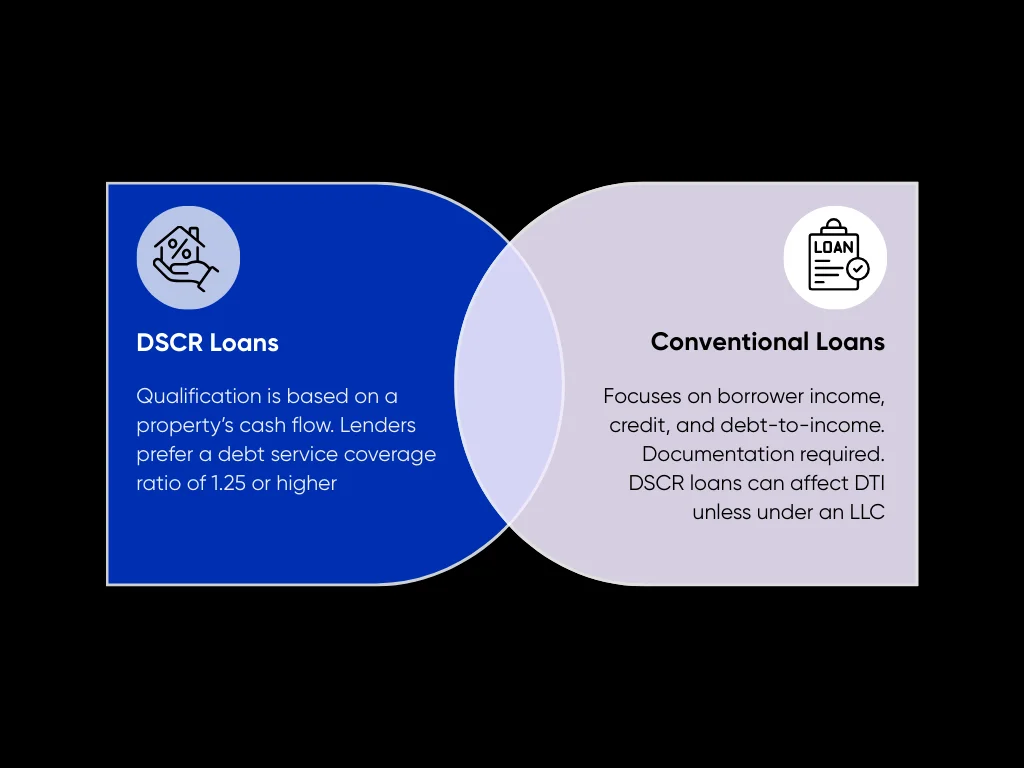
DSCR stands for Debt Service Coverage Ratio. A debt service coverage ratio loan (DSCR loan) qualifies based on a property’s cash flow potential relative to its debt obligations. Lenders consider a property’s annual net operating income (NOI), which is its income after deducting operating expenses, and its annual total debt service (TDS), which includes debt payments, home insurance, taxes, HOA fees, and other periodic dues. NOI is divided by TDS to arrive at the debt service coverage ratio.
For a detailed look at how DSCR is calculated, check out DSCR Loans: The Complete Guide (2025).
How Conventional Loans Work
Conventional loans qualify based on the borrower. Your income, credit history, debt load, financial stability, and other factors are all factored into your ability to repay the loan. This is why conventional lenders require meticulous documentation, including your tax returns, W-2s, paycheck stubs, proof of income, employment history, etc. Alternative forms of documentation are often not acceptable.
The Fundamental Trade-Off: Ease of Qualification vs. Cost & Terms
| DSCR loans | The lender also considers a property’s capacity to generate income for DSCR loans; this aligns with investors whose W-2s often do not represent their full financial picture. |
| Conventional loans | If the traditional income verification methods do reflect your entire financial picture, conventional loans can have better rates and terms than DSCR loans, sometimes by 0.5%- 2%. |
Qualification Requirements: Who Gets Approved and Why
The core differentiator between DSCR loans and conventional loans reflects the trade-offs that we mentioned earlier. With DSCR loans, the property is the main focus of the underwriting, while with conventional loans, the borrower’s credit profile is the focus.
Comparison Table: DSCR Loan vs Conventional Loan
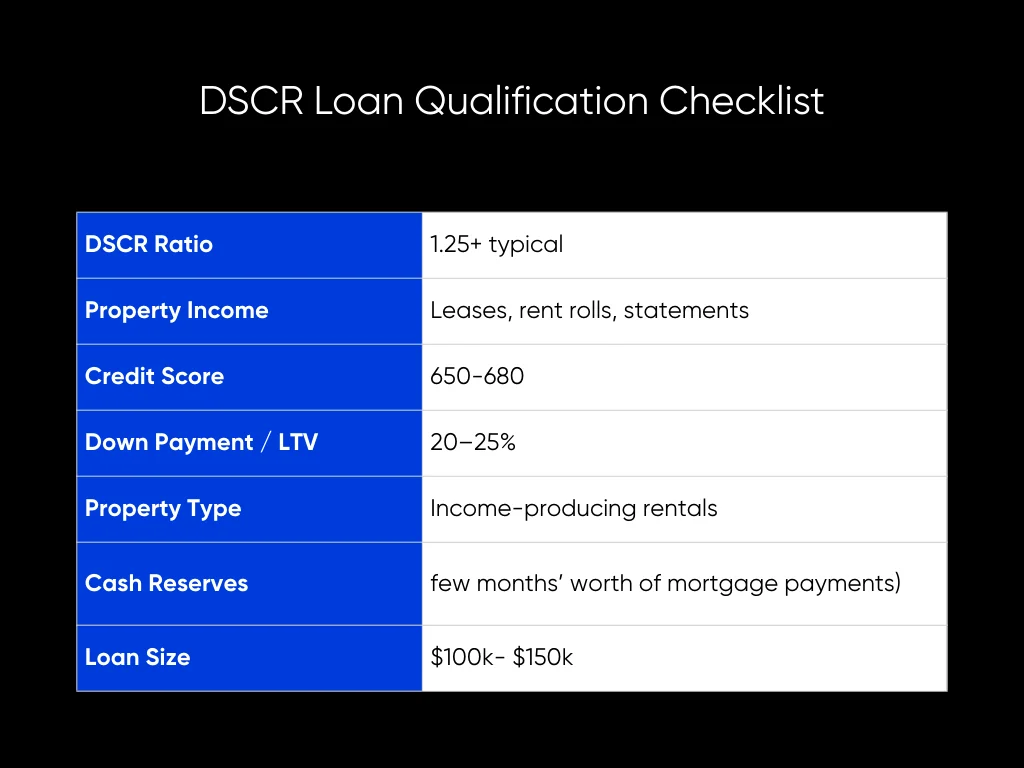
DSCR Loan Qualification Checklist
With a DSCR loan, the lender focuses primarily on the property’s income-generating potential. That can be a huge advantage if your personal income documentation is irregular or if you own multiple properties already. Typical requirements include:
- DSCR minimum ratio: Most lenders require a ratio where property net operating income (NOI) sufficiently exceeds the annual debt service. Many set the minimum around 1.25. At Defy Mortgage, however, our minimum can be as low as 0.75, with flexible options opening up for borrowers with 740+ FICO. However, our best rates and terms unlock at DSCR >= 1.000.
- Property income: Provide evidence of rental income in the form of leases, market rent data, rent roll, property management statements, and other relevant property documentation.
- Credit score: While DSCR loans tend to be more flexible than conventional mortgages, a decent credit score is usually still required. Many lenders expect a minimum of around 650-680. At Defy Mortgage, our minimum credit score is 640. A higher credit score unlocks perks like higher LTVs and loan amounts.
- Down payment / Loan-to-Value (LTV): Because DSCR loans carry additional risk for lenders, they often require a higher down payment. LTVs typically go up to 75%-80%, so prepare 20-25% of the property’s value as a down payment. At Defy Mortgage, however, we go up to 85% LTV for borrowers with 740+ FICO and DSCR >= 1.000 (max loan amount $1.5M), lowering your down payment to 15% if you are looking to purchase an SFR only. LTV’s for our rate-and-term and C/O refinance options are at 80%.
- Property type: The property typically needs to be an income-producing rental (single-family or small multi-unit), not owner-occupied. Defy Mortgage’s allowable property types for DSCR loans are:
- Cash reserves: Some lenders may require you to show reserves (e.g., a few months’ worth of mortgage payments). At Defy Mortgage, we require a minimum of 3 months’ reserve.
- Loan size minimums: Some DSCR lenders may impose minimum loan amounts, typically $100k-$150k. Defy Mortgage’s minimum is $75k, giving additional flexibility to smaller-scale investors.
Conventional Loan Qualification Checklist
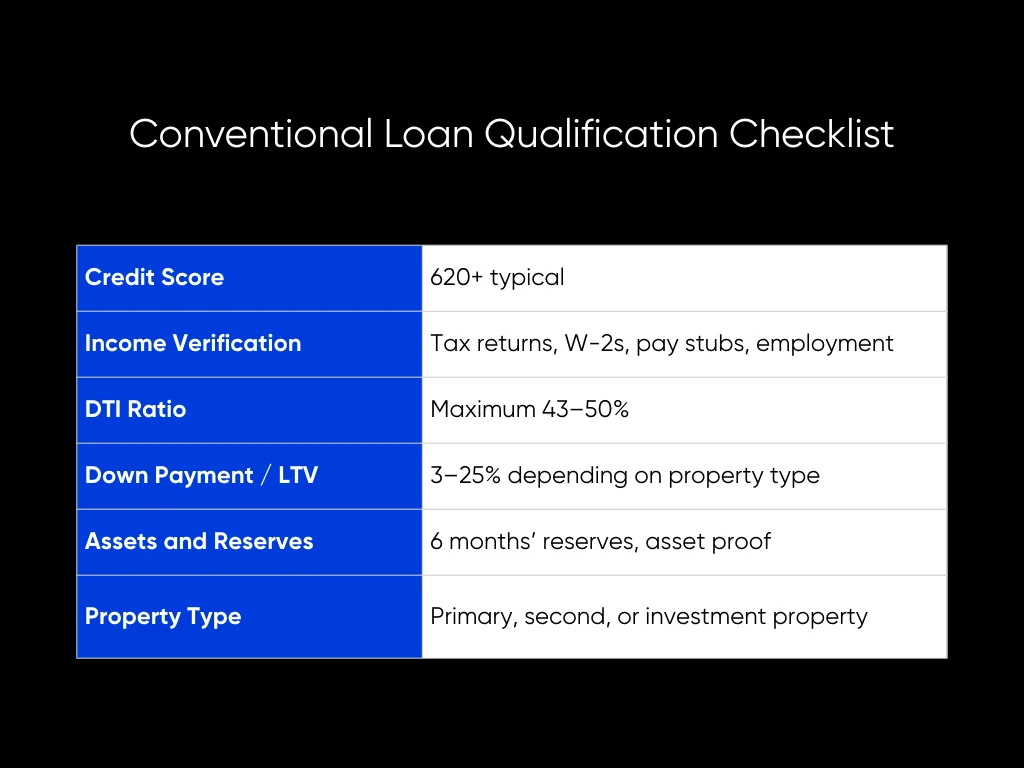
Conventional loans focus on the borrower’s overall financial profile. If you meet traditional mortgage standards like steady income, clean credit, and manageable debt, these loans can offer competitive rates and straightforward documentation. Typical requirements include:
- Credit score: The minimum enforced by Fannie Mae and Freddie Mac until November 16, 2025, was 620. Some lenders may set it higher, and now that the required minimum has been lifted, some may even set it lower.
- Personal income verification: Lenders usually require tax returns, W-2s or pay stubs, employment history, or other proof of stable, recurring income over time.
- Debt-to-Income (DTI) ratio: Lenders calculate the ratio of all your monthly debt payments (existing mortgages, credit cards, loans, and the proposed conventional mortgage) to your gross income. Maximum allowable DTI is usually 43%, although some may allow 50% depending on your other financials.
- Down payment / Loan-to-Value (LTV): While conventional loan down payments can be as low as 3-5% for owner-occupied homes, investment properties are treated with additional scrutiny. Average down payments can be as high as 25% for borrowers with the minimum credit score of 620.
- Asset documentation & reserves: Financing an investment property with a conventional loan often requires a minimum of 6 months’ reserve. Some conventional lenders may also ask to see asset documentation to verify your ability to cover future payments and unexpected expenses.
- Property type: Unlike DSCR loans, conventional loans can also serve as primary and second home loans as well as investment properties.
DSCR Loan vs Conventional Loan: Interest Rates, Fees, and Total Investment
Aside from qualification, another key difference between DSCR loans and conventional loans is their cost profiles.
Example Scenario Cost Comparison Table
Disclaimer: The figures below are provided for illustrative purposes only and are based on assumed property value, credit profile, DSCR, interest rates, and estimated fees. Actual loan terms, rates, payments, and closing costs may vary depending on lender guidelines, borrower qualifications, property details, and market conditions.
To illustrate how costs can vary in real life, let’s say you want to purchase a home worth $400,000 single-family home in TX. With 740 FICO and DSCR = 1.000, your costs for a 30-year fixed loan will be:
| DSCR Loan | Conventional Loan | |
| Down payment | 15% ($60,000) | 15% ($60,000) |
| Loan amount | $340,000 | $340,000 |
| Interest rate (fixed) | 6.25% (As of September 21, 2026) | 6.14% (Avg TX rate as of December 15, 2025) |
| Estimated Monthly Payment (P + I only) | ~$2,500 | $2,100 |
| Closing Costs & Fees (appraisal, origination, etc. – 3-6% of amount for both loan types) | $10,200 – $20,400 | $10,200 – $20,400 |
| Total cash upfront | $70,200 – $80,400 | $70,200 – $80,400 |
| Total mortgage payments over 30 years | $793,884.07 | $756,027.68 |
Although DSCR loans can often cost more than conventional loans, they have several advantages that make them well worth the added cost, which are: faster closings, LLC ownership permissions, no cap on the amount of properties that need funding, alternative income verification methods, foreign national options for international investors, and more.
DSCR Loan vs Conventional Loan: Which is Better for You?
Choosing which type of loan you need is a question of establishing your goals. Start by figuring out what you need right now vs what you plan for down the road. Consider the advantages of each to arrive at the best choice for your current use case.
DSCR Loan Advantages
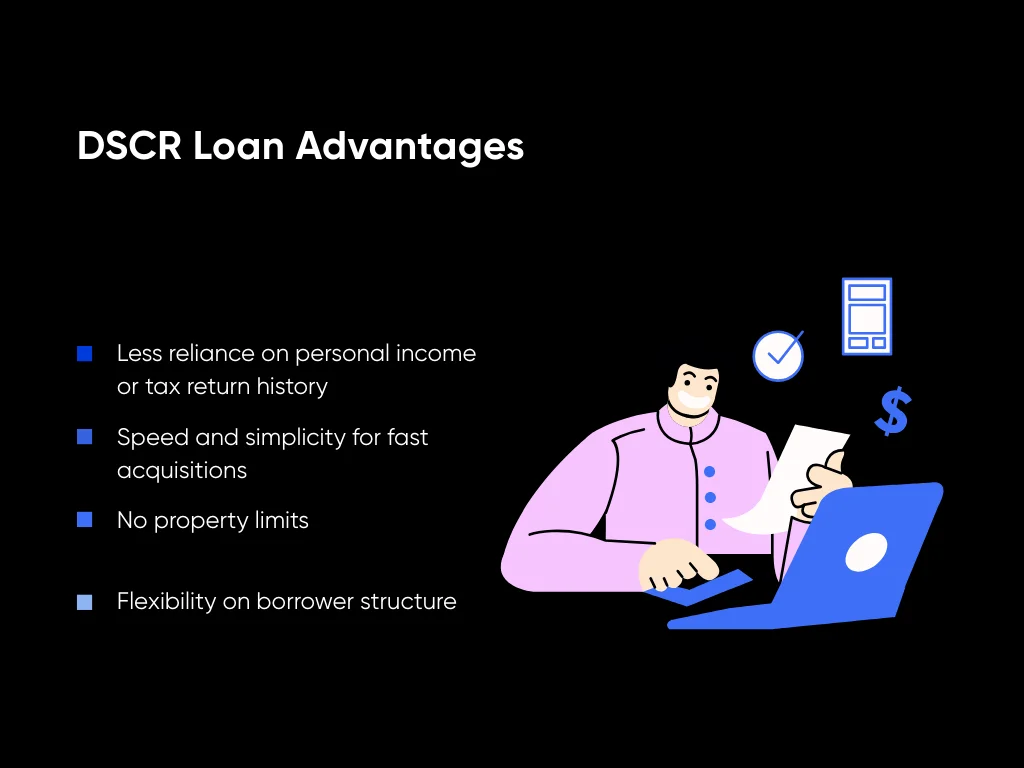
For investors who want flexibility, speed, and growth potential, DSCR loans offer clear advantages:
- Less reliance on personal income or tax return history: DSCR loans bypass personal income verification and evaluate rental income potential instead. This makes DSCR especially valuable for self-employed investors, freelancers, small business owners, and other investors whose income is variable or seasonal.
- Speed and simplicity for fast acquisitions: Because DSCR underwriting is focused on property income rather than deeply analyzing personal income documentation, they often close faster. This is a major advantage in competitive markets.
- No property limits: Since each property is evaluated on its own cash flow, you can often acquire more rentals than with conventional underwriting, which places a maximum of 10 actively financed properties on each borrower.
- Flexibility on borrower structure: DSCR loans often allow purchases under entities like LLCs (depending on the lender), which can make ownership easier to scale, manage, or later sell, especially when building a large rental portfolio.
These advantages all come into play in investment scenarios where cash offers and quick closings win deals.
Imagine you’re buying a short-term rental property listed for $450,000 in a competitive vacation market. The seller is receiving multiple offers and favors homebuyers who can close quickly. With conventional buyers having to wait 30-45 days on average, in some cases even 60, they can get beaten out by a DSCR loan borrower who can close in as little as 14 days with Defy Mortgage.
Because you can close faster than the average buyer, you might negotiate a price reduction, considering this seller is eager to sell quickly to a borrower who’s already pre-approved. This can potentially allow you to offer $10,000-$20,000 lower than the seller’s asking price.
That’s up to $20,000 that can go to other investments that can increase your overall cash flow, such as renovations or even another acquisition. Depending on the circumstances, the added income from that reinvestment can not only offset the higher costs of DSCR financing but potentially even afford you a higher income than if you went with conventional financing alone.
Conventional Loan Advantages
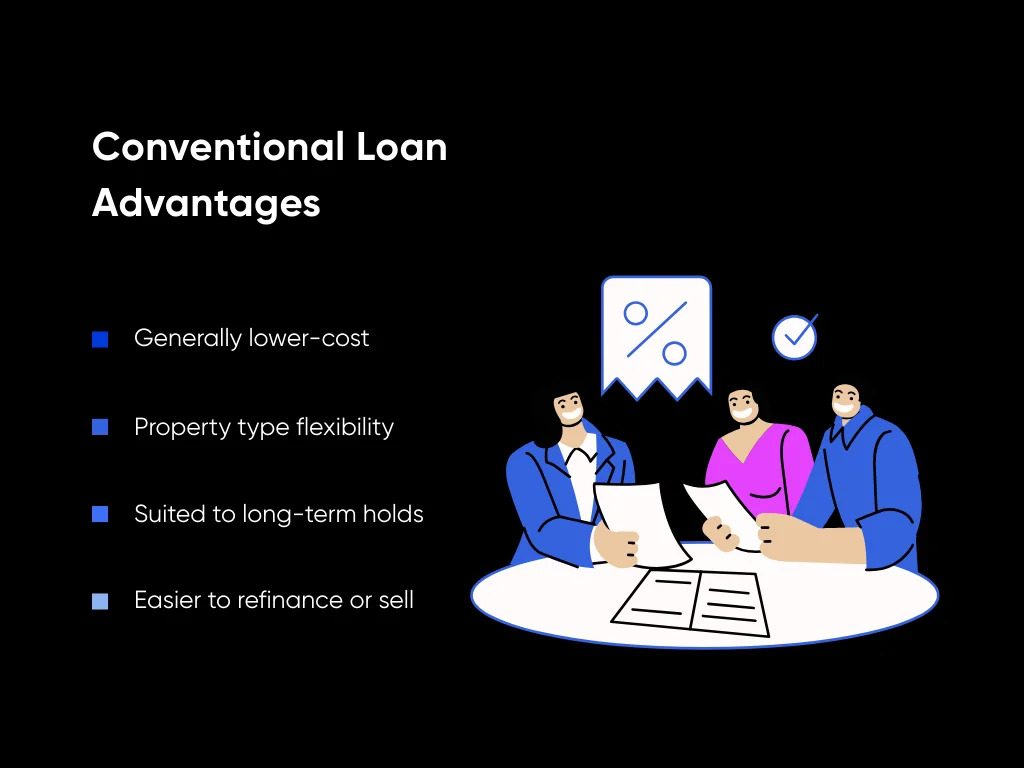
That’s not to say conventional loans are obsolete. For many long-term investors or homeowners, conventional still makes sense over DSCR loans, with advantages such as:
- Generally lower-cost: As we’ve discussed above, conventional mortgages often come with lower rates, especially for well-qualified borrowers. Over a 10-30 year hold, this can translate into significant savings on interest, especially if high house appreciation is a factor.
- Property type flexibility: DSCR loans can only be used to finance investment properties. Conventional loans can be used to purchase primary residences and second homes, often at lower rates and down payments, opening up strategies like house hacking and capital gains tax exemption on the sale of primary homes.
- Suited to long-term holds: If your strategy is holding a property without the intention to rent it out, a conventional loan lets you benefit from lower rates, maximizing your return on equity.
- Easier to refinance or sell: Conventional financing is well-understood and widely accepted. This makes a conventionally financed home more attractive to traditional buyers and lenders if you decide to sell or refinance during the life of the loan.
These advantages make them more suited to long-term hold strategies where rate differences compound significantly over 10-30 year periods. For example:
Say you buy a $450,000 single-family home with a conventional loan, whose rate will be up to 2% lower than DSCR pricing. Over the first decade alone, that rate difference can add up to tens of thousands in interest savings (see above table). If your strategy involves buying and holding long-term, this simply makes more economic sense than purchasing with a DSCR loan.
The effect is compounded if you intend to use the home as a primary home. This unlocks down payments as low as 3% and capital gains tax exemption, allowing you to write off up to $250,000 from your government dues when you finally sell. Note that you will have to purchase private mortgage insurance (PMI) if your down payment is lower than 20%.
DSCR loans still make more sense if you intend to grow a large portfolio of rentals, but conventional loan perks keep it a mainstay in most investors’ toolkits.
Hybrid Portfolio Strategies
Some smart investors use both DSCR and conventional loans to full effect in situations where each one excels. Here’s how:
- DSCR for quick acquisitions and initial scaling: Since DSCR loans are quick, easier to qualify for, and have no property cap, you can use them to buy up properties fast as soon as opportunities arise, giving you the best pick of the crop, far ahead of competing borrowers relying on conventional financing.
- Conventional for refinancing: Once a property is stabilized, you may refinance under conventional terms to lock in lower rates, reduce costs, and improve long-term returns.
- When to Refinance from DSCR to Conventional: Consider refinancing after: Property has 12+ months of stable rental history, your personal income documentation has improved, you want to lock in lower rates (potential savings: 0.5-2%) and the property is fully stabilized and cash-flowing well.
Essentially, DSCR loans are your foot in the door, your quick-reaction solution to exploit the best opportunities before anyone else can, and conventional loans are your tool to stabilize the investment and maximize its output for you.
Making Your Final Decision on DSCR Loans with Defy Mortgage
Choosing between a DSCR loan vs conventional loan is all about matching the lending structure to your investment model. When it comes to DSCR loans, Defy Mortgage’s offering has some standout features that make us the clear go-to:
- Max Loan Amount: no hard maximum loan limit+
- Min Loan Amount: Down to $75,000 (most lenders only go down to $150K)
- Max LTV (Purchase SFR): Up to 85%
- Max LTV (Cash-Out & R/T Refi): Up to 80%
- Min FICO: As low as 640
- Reserves: Minimum 3 months
- DSCR Flexibility: Down to 0.75 DSCR options available
- flexible DSCR options: Available for borrowers with 740+ FICO (max amount $1M, max LTV 75%)
- Cash-in-Hand Limit: Unlimited, pending LTV
- Gift Funds: Allowed
- Credit Requirements: No tradeline options available
- LLC Ownership: Allowed
- Seasoning: Options for no seasoning
- Property Types:
- SFR
- 2-4 unit multifamily
- PUD
- Townhome
- Row Home
- Site-Built Condo
- Modular Home
- Warrantable & Non-Warrantable Condos
- Co-ops
- Condotels
Options for foreign nationals are available as well. Our DSCR loans are available all throughout the US, with the exception of the following states: AK, AZ, ID, MI, MN, NV, NJ, ND, OR, SD, UT, VT, VA.
We also offer plenty of other alternative financing options:
- Bank statement loans: Directly prove your income using 12-24 months of bank statements. Max 90% LTV (80% for cash-out), up to no hard maximum loan limit loan amount. Min FICO as low as 640.
- P&L loans: Prove income using business profit-and-loss statements. Qualify with as low as 640 FICO. Up to 90% LTV (80% cash-out), no hard maximum loan limit max loan amount.
- Asset depletion loans: Use your liquid assets, such as savings, money market, and retirement accounts, to stand in for your regular income. Up to 80% LTV, max loan amount no hard maximum loan limit. Min FICO: 640.
- Foreign national loans: Access the lucrative US housing market with competitive terms even without a US credit score or SSN. Up to 70% LTV for purchase and R/T refi, $3M max loan amount.
- Interest-only loans: Maximize cash flow by deferring principal payments for 5, 7, or 10 years. Available for purchase, R/T refi, and cash-out. Max amount: no hard maximum loan limit. Max LTV: 90% (80% for cash-out).
Conclusion
The choice between a DSCR loan vs conventional loan isn’t simply a question of rates and closing costs, but also long-term returns and tactical advantages. DSCR loans offer speed and scalability, while conventional loans offer standard rates and predictable terms. Both have their own use cases, and using them in the right scenarios can help you optimize cash flow, minimize friction, and maximize growth across your entire portfolio.
If you’re ready to finance your next real estate investment with a DSCR loan, Defy Mortgage is here to assist you every step of the way. Simply schedule an appointment with us on our site or call us at (615) 622-1032, and a dedicated Mortgage Consultant will be with you to help you through every step of the process.
And if you’re a mortgage broker, we’ve got something for you too. Defy TPO gives brokers access to fast turn times, competitive pricing, and a full suite of non-QM programs designed specifically for investor borrowers. With these tools at your disposal, you can serve more clients, close tougher deals, and grow your pipeline without adding complexity to your workflow. Curious to see how it all works? Send us your pricing scenarios, and we’ll show you.
FAQs
Can I get a DSCR loan with bad credit?
Yes, DSCR loans are available with credit scores as low as 640 at Defy Mortgage, compared to 620 for conventional loans.
Do DSCR loans require tax returns?
No, DSCR loans do not require personal tax returns. Qualification is based on the property’s rental income potential, not your personal income documentation. The key phrase here is that alternative income documentation is permitted for DSCR loans, rather than just traditional income verification methods
Is DSCR a conventional loan?
No, DSCR and conventional loans are two distinct loan types. Conventional loans are standard loan products offered by lenders. DSCR loans, on the other hand, are non-qualifying mortgages, which are more flexible than conventional loan products.
What are the main differences between a DSCR loan and a conventional loan?
The biggest difference between DSCR vs conventional loan is how you qualify:
DSCR loans: Qualify based on the property’s rental income relative to the mortgage payment (the debt service coverage ratio). Your personal finances and employment history play a much smaller role.
Conventional mortgages: Qualify based primarily on your personal financial profile. This includes your income, employment history, tax returns, and DTI (debt-to-income).
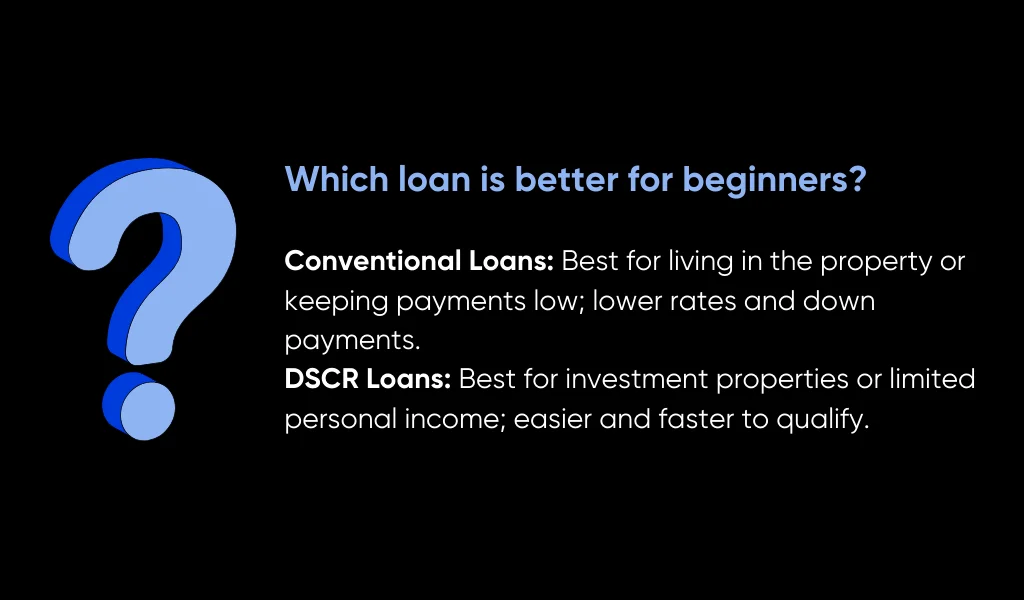
Which loan is better for beginners?
The answer to that depends on your strategy:
Conventional loans: Are better if you’re planning to live in the property, house hack, or keep payments as low as possible. Interest rates and down payments are typically lower, especially on primary residences.
DSCR loans: Can be better if you’re buying specifically for investment and don’t qualify well using personal income. DSCR loans tend to be easier and faster to qualify for.
Can I use DSCR and conventional loans together?
Absolute. In fact, many investors end up using both at some point. A savvy investor uses both to full effect:
- Conventional loans: For a primary residence (works especially well if you’re considering house hacking) or for refinancing into a more stable loan once your investment stabilizes
- DSCR loans: For situations where conventional loan requirements, property limits, and slower closing times can hamper your strategy.
Using both loans in circumstances where they shine the most lets you maximize growth and profit.
What are the Pros and Cons of DSCR Loans?
Pros
- Easier qualification (property income-based)
- Specifically for investment properties
- Faster closings
- Useful for self-employed borrowers
- LLC ownership allowed
- No hard limit on number of financed properties
Cons
- Can have higher interest rates than conventional loans
- Can require stronger property cash flow
How do costs compare between DSCR and conventional loans?
Conventional loans generally have lower interest rates and closing costs. Over a 10–30 year hold, even a small rate difference can compound into significant interest savings. However, while DSCR loans are typically priced higher, you also get easier qualification with alternative income verification methods, faster closings, LLC options, and no cap on the number of properties you can finance.
What Defy Mortgage Does and Doesn’t Originate
Defy Mortgage originates DSCR loans (single-family and 2–4 unit), Foreign National DSCR, Bank Statement loans (12- and 24-month), P&L loans, Asset Depletion loans, Interest Only options, Foreign National loans, Full Doc (FNMA/FHLMC agency) loans, cash-out refinances, and Smart Equity closed-end fixed-rate second mortgages.
Defy Mortgage does not originate FHA, VA, or USDA loans, reverse mortgages, first-time homebuyer programs, or construction loans. Where this page discusses those products, it does so for educational purposes and refers to products offered by other lenders.