
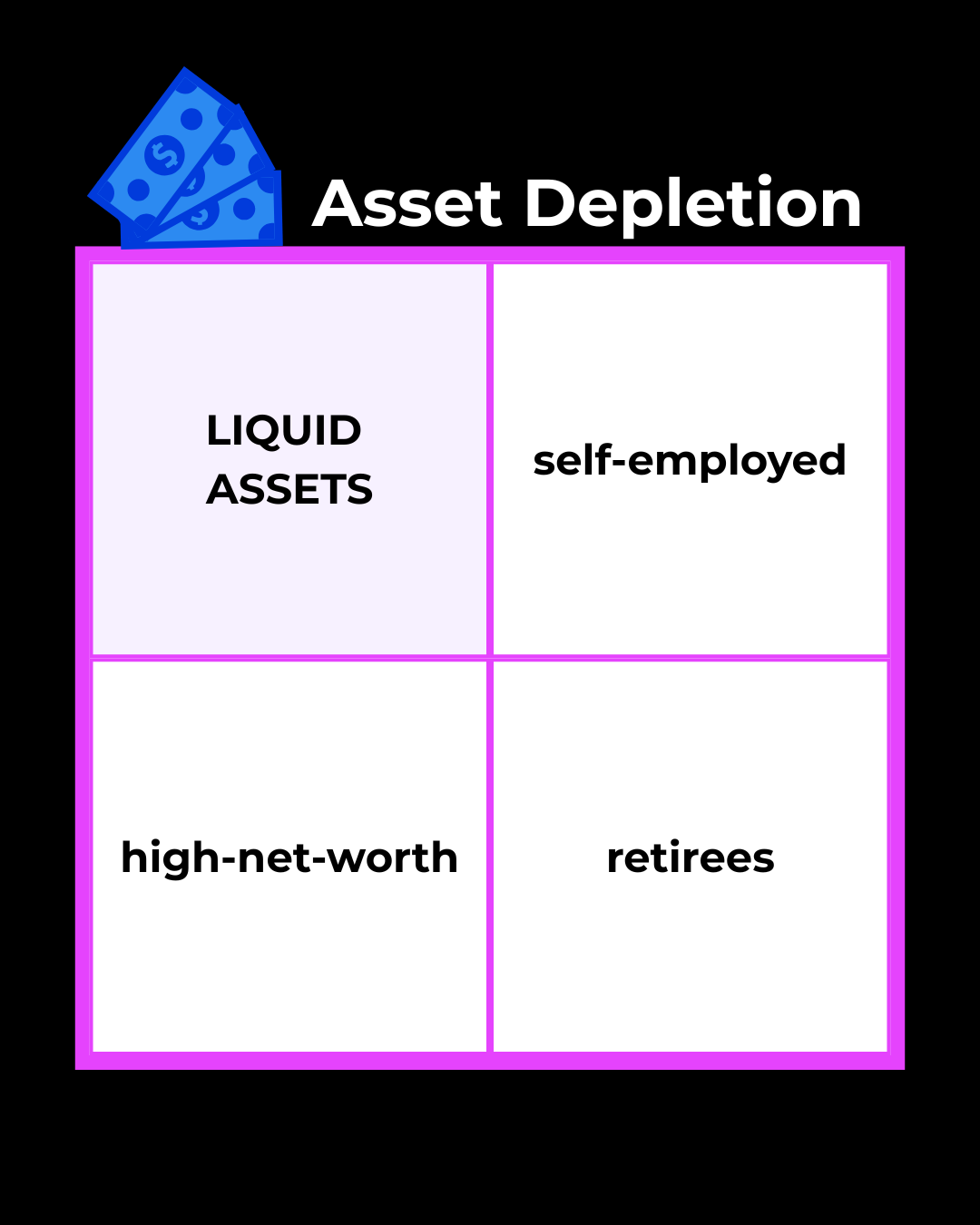

Asset Depletion Loans

Great option for high-net-worth, self-employed, or retired individuals with substantial liquid assets looking to purchase or refinance.

  • Up to 80% Loan to Value (LTV)
  • Max loan amount up to $6M
  • Min FICO score down to 640
  • Primary & second home
Graphics Instagram Post 45 copy 4 | Defy Mortgage

Traditional income not your thing? Let's talk liquid assets

Defy Mortgage Asset Depletion Loan Options

  • Max Loan Amount: Up to $6M
  • Max LTV (Purchase & R/T Refi): Up to 80% 
  • Min FICO: 640 minimum
  • DTI Requirements: Usually a max DTI of 43% (35% ideal)
  • Loan Types: Purchase and Rate/Term Refinance available for Primary and Secondary  Properties (see our Refinance Page to learn more about Refinances on a general sense)
  • Liquid Assets: Yes, all assets must be liquid.
  • Occupancy: Primary and Second-home
  • Loan Affordability: Affordability is based on the total value of your liquid assets divided by as little as 60 months.
  • Property Types: Single Family, Vacation Home, Condominium (Warrantable & Non-Warrantable) and 2-4 Units
  • Income Documentation: 
    • Eligible assets typically include one’s most liquid assets:
      • Savings and checking accounts up to 100%
      • Money market accounts (exchange rate)
      • Investment portfolios: stocks, bonds, mutual funds and other securities up to 80% of the current market value
      • Retirement accounts: IRAs and 401k up to 70% (depending on age of borrower

Important Note: The specific max LTV, loan amount, and DTI will vary based on qualifying factors. 

For those looking to qualify for a home loan based on their liquid assets, not their income.​

Asset Depletion Loans with Defy Mortgage

  • Loan Eligibility: Determine loan eligibility based on liquid assets from your investment and bank accounts, not your income.
  • Loan Affordability: Affordability is based on the total value of your liquid assets divided by as little as 60 months.

Still unsure of exactly what you need? No worries. JUST ASK US!

Everything to know about Asset Depletion Loans

The system wants your pay stubs. But what if you could qualify for a mortgage based on your liquid assets instead—the wealth you’ve actually built, not the income someone else controls? For those who’ve cracked the code, the answer is Asset Depletion loans. 

Asset Depletion Loan FAQs

An asset depletion mortgage is a type of loan designed for individuals who have substantial liquid assets but lack a traditional source of income. The total value of the liquid assets, divided by the total months to pay, is essentially considered as the borrower’s monthly income when determining eligibility and terms. Asset depletion mortgages, also known as asset dissipation mortgages, fall under the category of non-QM (non-qualified mortgage) loans. These types of loans aren’t required to meet the strict requirements set by the Consumer Financial Protection Bureau (CFPB) and are typically much more flexible for individuals who don’t fit the mold of conventional loan requirements. 

Borrowers with substantial liquid assets but little to no documented income, such as:

    1. Retirees who have built a significant nest egg but no longer have a regular paycheck.

    1. Self-employed individuals with fluctuating income but considerable savings or investment portfolios.

    1. High-net-worth individuals who prefer to rely on their wealth rather than traditional income to qualify for a loan.

    1. Heirs or beneficiaries with considerable savings from an inheritance or other sources of liquid assets.

The evaluation of your assets depends on the type of liquid asset. Let’s break down how each asset type is counted:

  • Cash: Since cash is already liquid, 100% of the value can be directly translated to the hypothetical income when determining eligibility. For money market accounts, the going exchange rate for all moneys at the time of underwriting is typically used.
  • Stocks, bonds, and other securities: Up to 80% of the current market value.
  • Retirement accounts:  Up to 70% of the funds, provided that the borrower is of the appropriate age to withdraw these funds. 

It’s important to note that lenders differ in terms of what percentage of each asset they consider as qualifying income. For example, some may be open to using more than 70% of a retirement account. It's also important to note that your assets MUST be liquid.

  1. Prepare your asset documentation: Ensure you have significant assets in accounts like savings, investments, or retirement funds that can be used to qualify for the mortgage. Remember that different lenders value assets in different ways, and that more volatile assets like stocks are likely only partially valued.
  2. Shop around for a lender: Once you’ve assessed your situation and prepared documentation, the next step is to research and select a specialized lender. Asset depletion loans aren’t widely available, so the best way to quickly find lenders who offer them is to focus on non-QM lenders (like Defy!).
  3. Pre-approval and application: After you’ve arrived at a shortlist of a few ideal lenders, it’s advisable to get pre-approved with each of them to find out the preliminary amount and rate they’re willing to offer you. If you’ve found a lender whose pre-approval estimates best fit your needs, you can begin the application process with them.
  4. Underwriting and closing: During underwriting, the lender will verify your asset documentation and assess other factors like credit history and debt-to-income ratio. If approved, the lender will provide a loan estimate and closing disclosure detailing the loan terms, interest rate, repayment period, monthly payments, and closing costs. Review these documents carefully. At closing, you'll sign the final paperwork and pay any required closing costs.

Unfortunately, asset depletion loans are only for primary and secondary residences. If you wish to finance an investment property, consider a DSCR loan which can offer highly competitive terms if your property can make several times its annual debt obligation per year.

Yes. Most lenders let you use more of your retirement account if you’re at or near retirement age. Typically, those already receiving their pension (or those above 59 years and 6 months of age) can use up to 70% (some lenders even go up to 100%) of their retirement account assets for an asset depletion loan, while those under can only use up to 50%. 

Both types of mortgages are based on the market value of the assets. However, with asset-based lending, borrowers typically have to transfer ownership of the asset to their lender to secure the mortgage. 

With asset depletion, you keep full control of your assets. The lender just considers your liquid assets as income to see if you can afford the loan.  


Have more questions on Asset Depletion loans? We are here to help. Hit us up!

When you're ready, so are we.

State Licensing

Defy Mortgage is licensed in the following states: Alabama (AL), California (CA), Colorado (CO), Florida (FL), Georgia (GA), Tennessee (TN), and Texas (TX)

.