


What “Non-QM” actually means — in 90 seconds
Non-QM stands for Non-Qualified Mortgage. The category covers every mortgage product that sits outside the Consumer Financial Protection Bureau’s Ability-to-Repay rule’s qualified mortgage definition — which means anything that doesn’t fit conventional Fannie Mae / Freddie Mac underwriting boxes.
In practice, that’s most of the products investors and self-employed borrowers actually use:
- DSCR loans — qualify on rental property income
- Bank statement loans — qualify on 12-24 months of business or personal deposits
- P&L loans — qualify on CPA-prepared profit and loss
- Asset depletion loans — qualify on liquid asset balances
- Foreign national loans — qualify with no US income or credit
- Interest-only loans — preserve cash flow with delayed amortization
- Jumbo Non-QM — above-conforming loan amounts with alt-doc qualification
- 1099 / gig income loans — qualify on contractor income without W-2
If you’re a borrower who needs one of these, you’re a Non-QM borrower. If you’re a broker who places these deals, you need a Non-QM lender that actually executes — wholesale.
Quick reference — which Non-QM lender fits which scenario
| If you need… | Strong candidates | Defy’s position |
|---|---|---|
| Multi-product Non-QM under one roof (DSCR + bank statement + asset depletion) | Defy, Angel Oak, A&D | Direct lender, all products in-house |
| DSCR specifically (rental property investor) | Defy, Angel Oak, Griffin, A&D | 85% LTV, 0.75 DSCR floor, 80% on STR |
| Wholesale (you’re a broker placing the deal) | Defy TPO, Angel Oak, A&D | Direct wholesale relationship with the operating lender |
| Jumbo Non-QM ($3M+) | Defy, A&D, Angel Oak | Up to $6M+ depending on scenario |
| Foreign national | Defy, A&D, Angel Oak | Yes, with specific LTV and reserve overlays |
| Self-employed / 1099 owner-occupied | Defy, Angel Oak, A&D, Griffin | Bank statement to 90%, P&L alternative |
If you’d rather just talk through your scenario, our team gives a 5-minute deal-fit review on your actual deal — direct lender for borrowers, Defy TPO for brokers.
Best Non-QM lenders for 2026 — quick answer
- Best overall program flexibility: Defy Mortgage (multi-product Non-QM, direct lender)
- Best wholesale scale: Angel Oak (largest Non-QM wholesale operator)
- Best jumbo Non-QM ($3M+): A&D Mortgage
- Best for fix-and-flip-to-rental transition: Kiavi or Lima One
- Best for portfolio investors (10+ properties): CoreVest
- Best for DSCR-only focus: Visio Lending
- Best for credit-event scenarios: Athas Capital
Why one of these fits over the others depends on your specific deal — property type, DSCR ratio, FICO band, loan purpose. The rest of this guide explains how to match the lender to your scenario instead of trusting a generic ranking.
What is a Non-QM lender?
A Non-QM lender offers mortgage programs that qualify borrowers using alternative documentation instead of standard Fannie Mae / Freddie Mac agency underwriting rules. Common Non-QM products include DSCR loans (qualify on rental property income), bank statement loans (qualify on deposits), P&L loans, asset depletion loans, foreign national mortgages, and 1099/gig income loans. The “Non-Qualified Mortgage” designation refers to whether the loan meets the CFPB’s Qualified Mortgage safe-harbor definition — not whether the lender is unregulated. All Non-QM lenders operate under Dodd-Frank, the Ability-to-Repay rule, RESPA, TILA, and state licensing requirements.
Who this guide is for
- Real estate investors looking to finance rental property outside conventional limits
- Self-employed borrowers and business owners whose tax returns don’t reflect cash flow
- Foreign national investors buying US property
- Borrowers needing jumbo financing with alternative income documentation
- Mortgage brokers placing Non-QM deals who need a reliable wholesale partner
- Borrowers who’ve been declined conventionally and don’t know whether Non-QM is the answer
If you’re a W-2 borrower with two years of clean tax returns and a conforming loan amount, Non-QM probably isn’t your product — conventional will serve you better on rate. Non-QM is built for everyone outside that box.
Three mistakes that kill Non-QM deals (and how to avoid them)
After 25 years originating Non-QM, the patterns are consistent. The deals that die are rarely undone by underwriting math — they’re undone by structuring mistakes that happen before underwriting even sees the file. Three mistakes account for most of them.
Mistake #1: Picking the wrong product within Non-QM
Most borrowers and a surprising number of brokers treat “Non-QM” as one product. It isn’t. It’s seven or eight distinct programs, each with different qualification logic, different LTV caps, different rate tiers, and different documentation requirements.
A self-employed borrower with strong cash flow and significant tax write-offs has at least four Non-QM paths: bank statement (qualifies on deposits), P&L (qualifies on CPA P&L), DSCR if the property is a rental (qualifies on property income), and asset depletion if there’s significant liquidity (qualifies on asset balances). Each path produces a different qualifying income, a different LTV ceiling, and a different rate. The “right” product is the one that produces the best outcome on the specific scenario.
We see this every week: a borrower routed into bank statement when P&L would have produced a cleaner underwrite, or routed into bank statement when DSCR was the actual product because the property is a rental. The income is real. The product choice is wrong. The deal either dies or closes at lower leverage than it should have.
Fix: Before you commit to a Non-QM lender, confirm which specific product fits your scenario. The lender that’s best for DSCR isn’t necessarily best for bank statement, and vice versa.
Mistake #2: Treating the headline rate as the actual rate
Every Non-QM lender publishes a rate sheet that shows the best-case scenario rate. That number applies to a specific borrower profile — usually 740+ FICO, 75% LTV, 1.25+ DSCR (for DSCR loans) or 12-month strong deposits (for bank statement loans), on a single-family standard property.
Your actual rate is determined by five variables on top of that baseline:
- FICO band. The spread between a 740 borrower and a 660 borrower is 150-200 bps on the same exact deal.
- LTV. Every step up — 70% → 75% → 80% → 85% — carries a rate premium.
- Documentation tier. Full doc < 24-month bank statement < 12-month bank statement < P&L < no doc. Less documentation = higher rate.
- Property type. SFR is the cheapest tier. STR, condotels, non-warrantable condos, 5-9 unit all step up.
- Loan purpose. Purchase < rate-and-term refi < cash-out refi.
As of mid-May 2026, headline Non-QM rates for the top-of-matrix borrower sit in the low-to-mid 6s (per Freddie Mac’s Primary Mortgage Market Survey, the 30-year fixed is at 6.36%). Every deviation moves your rate up.
Fix: Get a quote on your actual scenario, not the headline rate. The right comparison is “what rate does Lender A offer on my deal vs. what rate does Lender B offer on the same deal.” Headline-to-headline comparison is meaningless.
Mistake #3: Confusing “Non-QM offered” with “Non-QM specialist”
Many retail mortgage banks technically offer Non-QM products through correspondent relationships or limited internal programs. That’s different from a lender that specializes in Non-QM as the core business.
The difference shows up at underwriting. A retail bank’s Non-QM file gets handed to an underwriter who closes 80 conventional deals for every Non-QM file. Their reflex is the conventional box — and Non-QM files routinely get questioned on items conventional underwriting flags but Non-QM specifically allows (LLC vesting, bank-statement income, sub-1.0 DSCR, foreign national qualification, etc.).
The result is files that should fund at 80% LTV repriced to 70%, files that should close in 21 days dragging past 45, and structural questions on closing day that should have been resolved at application. The product was “offered” but the execution wasn’t there.
Fix: Work with a lender (or, if you’re a broker, a wholesale partner) where Non-QM is the core business, not a side product. The underwriter who sees 100 Non-QM files a year knows the program. The one who sees five doesn’t.
The top Non-QM lenders — operator evaluation
Twelve lenders worth knowing about. This is direct-lender operator evaluation — what we see on competing files, what closes consistently, what doesn’t.
Defy Mortgage — direct lender, multi-product Non-QM specialist
Best for: investors and self-employed borrowers needing multiple Non-QM products from one direct relationship; brokers needing reliable wholesale execution.
- Direct lender (retail + wholesale via Defy TPO)
- Products: DSCR, bank statement, P&L, asset depletion, foreign national, jumbo Non-QM, interest-only, 1099, Smart Equity (closed-end second)
- DSCR floor: 0.75; bank statement: 12 or 24 months; LTVs up to 85% (SFR purchase) / 90% (bank statement OO)
- FICO floor: 640 (bank statement) / 640 (DSCR)
- Foreign national, LLC vesting standard
- Closing speed: 14–21 days typical
Defy was built specifically for Non-QM as the core business. Investors and self-employed borrowers get a direct lender relationship across the full product range. Brokers get Defy TPO — the same operating lender, wholesale channel. The advantage of single-shop multi-product Non-QM is that complex files often need product flexing mid-process (DSCR to bank statement, P&L to asset depletion), and that flexing is instant when one lender holds every program.
Where Defy may not be the best fit:
- Borrowers prioritizing the absolute lowest rate over program flexibility — conventional agency execution will usually price better if you qualify
- Institutional investors seeking large blanket portfolio structures across 30+ properties — CoreVest is purpose-built for that scale
- Borrowers with recent severe credit events (recent BK, foreclosure within 24 months) — lenders like Athas Capital specialize in that profile and may produce better outcomes
- Straightforward vanilla DSCR files at 75% LTV with 1.25+ DSCR and 740+ FICO — pricing tends to be similar across several large Non-QM lenders for this profile; the choice usually comes down to execution speed and AE relationship
For everything else — sub-1.0 DSCR, 85% LTV, STR at 80%, foreign national, multi-product files, lower-FICO investor scenarios, Defy TPO wholesale — that’s the program we built.
Angel Oak Mortgage Solutions — largest Non-QM wholesale player
Best for: brokers placing standard Non-QM deals, borrowers with strong files across multiple Non-QM products.
Angel Oak is one of the largest Non-QM lenders nationally with broad product depth across DSCR, bank statement, and asset qualifier programs. Primarily wholesale — your borrower experience depends on the broker between you and the lender. Strong on standard scenarios; the wholesale model adds an execution layer on edge cases.
A&D Mortgage — large Non-QM, jumbo strength
Best for: LLC vesting, jumbo Non-QM (>$5M), borrowers with strong scenarios across multiple Non-QM products.
A&D offers broad Non-QM product depth with particular strength on jumbo and LLC files. DSCR with 80-85% LTV typical. Primarily wholesale execution. Solid choice for scaling investors with clean files.
Griffin Funding — heavy DSCR marketing, retail-direct
Best for: straightforward DSCR scenarios where a direct-lender relationship matters and you don’t need program edge cases.
Griffin markets aggressively in DSCR with retail-direct execution. Less flexible on complex Non-QM scenarios (sub-1.0 DSCR, 85% LTV on non-standard property types). Good for standard rental files.
NewRez (formerly New American Funding Non-QM)
Best for: straightforward Non-QM where retail execution and brand familiarity matter.
Large retail/correspondent player. Non-QM is one of many product lines. Best on standard scenarios; less flexibility than Non-QM specialists on edge-case files.
CrossCountry Mortgage
Best for: borrowers in markets where CrossCountry has a strong local branch presence.
Conventional-first retail bank with Non-QM available through certain branches. Execution varies materially by loan officer. Best if you have a strong local LO relationship; less consistent through national channels.
Athas Capital Group
Best for: borrowers needing flexible structuring on credit-event scenarios.
Smaller Non-QM player with reputation for working with recent credit events (bankruptcy, foreclosure, short sale). Higher rate tier reflects the higher-risk borrower profile.
Kiavi (formerly LendingHome)
Best for: fix-and-flip-to-rental transition investors, repeat investors wanting digital processing.
Bridge + DSCR under one roof. Strong on the fix-and-flip side, decent DSCR program for the transition. Less flexible on complex Non-QM scenarios outside DSCR.
CoreVest
Best for: portfolio investors with 10+ properties, cross-collateralized structures.
Institutional and high-volume investor focus. LTVs typically 75-80%. Overbuilt for 1-3 property investors; right call for portfolio operators.
Lima One Capital
Best for: bridge-to-DSCR specialist investors.
Similar positioning to Kiavi. Bridge + DSCR under one roof. Stronger on the fix-and-flip side than pure DSCR.
Visio Lending
Best for: dedicated rental property investors, especially in landlord-friendly markets.
DSCR-focused. Narrower product range than larger Non-QM specialists but strong on what they offer. Good for straightforward long-term rental files.
Truss Financial Group
Best for: straightforward long-term rental DSCR deals.
Narrower product range. Fine for clean DSCR files; less useful for complex Non-QM scenarios.
What to actually evaluate when picking a Non-QM lender
The five things that determine whether your deal funds, in order of materiality:
- Does the lender specialize in your specific product? A multi-product Non-QM specialist serving DSCR + bank statement + P&L + asset depletion will outperform a single-product DSCR-only lender if your scenario needs flexibility. The reverse is true if your file is dead-simple DSCR.
- Wholesale vs. retail-direct. If you’re a borrower, retail-direct usually produces cleaner execution on complex files (no broker translation layer). If you’re a broker placing deals, wholesale relationships are how you operate — Defy TPO, Angel Oak, A&D are the major Non-QM wholesale players.
- Closing speed claims vs. actual track record. Every lender quotes 14-21 days. Some deliver it. Some consistently miss by 50%. Ask the LO or AE: “What’s your average days-to-close on closed loans in the last 90 days?” The honest answer is what matters.
- Program-specific LTV and DSCR/FICO floor caps. Verify on your actual property type and use case. “85% LTV” doesn’t mean 85% on a 6-unit. “0.75 DSCR floor” doesn’t mean every sub-1.0 file funds.
- Single-relationship multi-product capacity. If your file might flex products mid-process (DSCR → bank statement, or P&L → asset depletion), a single-lender relationship spanning the full product range avoids the start-over restart that happens with single-product specialists.
For brokers: choosing a wholesale Non-QM partner
If you’re a broker placing Non-QM deals, the lender evaluation question is different from the borrower-side question. You’re choosing an operating partner who has to perform consistently across many of your files, not just one.
The wholesale-specific evaluation criteria:
- AE (account executive) responsiveness. The AE is your day-to-day relationship. Fast, clear, decisive AE support is more valuable than 25 bps of rate.
- Scenario desk access. Can you get a structural answer on a complex file in hours, not days? Wholesale Non-QM means you’ll have edge-case scenarios constantly. The lender’s scenario desk turnaround time determines how many deals you can close.
- Pricing engine access. Real-time pricing without callback delay. Self-serve scenario quoting saves hours per deal.
- Operating consistency. What you got from the lender on the last 10 files is what you’ll get on the next 10. Lenders with inconsistent execution kill broker pipelines.
- Product breadth. A wholesale partner with DSCR + bank statement + P&L + asset depletion + foreign national + jumbo means most of your Non-QM pipeline funds with one relationship.
Defy TPO is built specifically for brokers placing Non-QM deals. Same operating lender as Defy direct, dedicated wholesale channel, broker-direct AE coverage, full product range. The platform was built from scratch — no Encompass, no Calyx, no legacy LOS — so brokers price, submit, and track deals end-to-end on a single workflow:
- Quick Pricer — price any scenario instantly. Real-time pricing, no callback delay.
- TRINITY — AI broker help desk. Guideline questions answered 24/7, no call required.
- Flash Submit — submit a deal in 2 minutes. Close in 14 days.
- Broker Sign-Up — onboard in under 100 hours.
If you’re looking for a wholesale Non-QM partner with the program breadth to handle most of your pipeline under one relationship, that’s the pitch.
How Non-QM rates compare to conventional
Non-QM carries a structural premium over conventional, reflecting the alternative documentation and broader risk tolerance. The premium varies by product and borrower profile.
| Product type | Typical rate range (mid-May 2026) | Premium over conventional |
|---|---|---|
| Conventional 30-year fixed | ~6.36% (Freddie PMMS) | baseline |
| DSCR investment property | Low-mid 6s to high 7s | +50 to +150 bps |
| Bank statement (12-month) | High 6s to low 8s | +75 to +200 bps |
| P&L (CPA-prepared) | Mid 6s to mid 7s | +50 to +150 bps |
| Asset depletion | Mid 6s to mid 7s | +50 to +150 bps |
| Foreign national | High 7s to high 8s | +150 to +250 bps |
| Sub-1.0 DSCR | Add 50-150 bps to standard DSCR | additional premium |
| Jumbo Non-QM | Similar to product tier + jumbo overlay | +25-50 bps over standard |
Rates as of mid-May 2026. Actual rate depends on FICO, LTV, DSCR ratio, property type, loan purpose, and lender. Get quotes on your specific scenario.
For a borrower who can qualify conventionally, conventional usually wins on rate. For everyone else — most active investors past 2-3 properties, most self-employed borrowers, all foreign nationals — the Non-QM premium is the cost of being able to close at all. Often worth it; sometimes the only option.
Common questions
What’s the difference between Non-QM and subprime?
Different categories. Subprime referred to loans made to borrowers with damaged credit on terms that often didn’t make sense for the borrower’s ability to repay — a pre-2008 category. Non-QM is regulated under the Dodd-Frank Ability-to-Repay rule and uses alternative documentation methods (deposits, P&L, asset balances) to verify ability to repay. The borrowers are usually self-employed, foreign nationals, or real estate investors with strong cash flow that doesn’t show on tax returns — not borrowers with damaged credit.
Are Non-QM lenders regulated?
Yes. All Non-QM lenders operate under the same federal regulatory framework as conventional lenders — Dodd-Frank, Ability-to-Repay rule, RESPA, TILA, state licensing. The “Non-Qualified” designation refers specifically to whether the loan meets the CFPB’s safe-harbor Qualified Mortgage definition. It doesn’t mean the loan or lender is unregulated.
Which Non-QM lender works with mortgage brokers?
Most Non-QM volume runs wholesale. Angel Oak, A&D, Defy TPO, and others all operate dedicated wholesale channels. Brokers needing Non-QM wholesale should establish relationships with 2-3 of these to handle product variation.
How do Non-QM lenders verify income if they don’t use tax returns?
Depends on the product. DSCR uses property rental income. Bank statement uses 12-24 months of business or personal deposits. P&L uses a CPA-prepared profit and loss statement. Asset depletion uses liquid asset balances. Foreign national programs use international credit reports, asset statements, and reserves in lieu of US income. Each product has its own verification methodology.
Are Non-QM rates going down in 2026?
Following the same trajectory as conventional, with the Non-QM premium remaining structural. Watch the 10-year Treasury and broader spread tightening. Headline 30-year fixed is currently at 6.36% per Freddie Mac; Non-QM products price above that baseline by 50-250 bps depending on product and borrower.
What’s the typical Non-QM closing timeline?
14-21 business days at lenders that specialize in the product. Retail banks offering Non-QM as a side product often run 30-45+. The specialist execution speed is one of the structural advantages of working with a dedicated Non-QM lender.
Can I use a Non-QM loan for a primary residence?
Yes — bank statement and P&L loans are commonly used for primary residence purchases by self-employed borrowers. DSCR is investment-property-only. Asset depletion works on primary, second home, and investment.
Where to go next
- For borrowers — talk to a Defy advisor: Contact us — 5-minute deal-fit review on your actual scenario
- For brokers — connect with Defy TPO: Defy TPO wholesale — full Non-QM product range, broker-direct relationship, AI-powered workflow tools (Quick Pricer, TRINITY, Flash Submit)
- DSCR specifics: DSCR Loans Complete Guide · Best DSCR Lenders
- Bank statement specifics: Bank Statement Loans Guide
- Cash-out across all paths: Cash-Out Refinance Complete Guide
- Self-employed specifics: Best Mortgage Lenders for Self-Employed Borrowers
If you’ve been declined conventionally and don’t know whether Non-QM is the answer — or if you’ve been quoted Non-QM and aren’t sure you’re with the right lender — talk to a Defy team member. The product almost always exists. The lender choice usually does most of the work.
How to Choose the Right Non-QM Lender for Your Scenario
Non-QM lenders are sometimes called non-conventional, unconventional, or non-traditional mortgage lenders — different labels for the same category of loans that fall outside agency (Fannie Mae / Freddie Mac) guidelines. Whatever the term, the way you vet a lender is the same. Use the framework below to choose the right one for your scenario.
Understanding Your Non-QM Borrower Profile and Needs
The first step in how to choose non-QM lender is to understand your borrower profile. Non-QM lenders underwrite by evaluating real-world financial strengths like profit-and-loss statements, rental income, bank statements, and other assets, depending upon the lender. Determining which type of borrower you are and what your non-QM loan needs are can help you align with a lender that specializes in catering to your profile.
As of November 2025, non-QM loan originations are expected to hit over $150 billion by the end of the year, according to Mortgage Professional America. More lenders are catering to borrowers who fall outside traditional lending models, making it trickier to find the right lender for your needs. That’s why the more clearly you define what type of borrower you are, the easier it is to match with a lender that truly understands your financial structure. Here are three major borrowing profiles that most non-QM lenders specialize in serving:
Self-Employed Professional Profile
If you’re a self-employed borrower, your lender should be fluent in interpreting your business cash flow. Look for lenders who are experienced in 1099, bank statement, or profit-and-loss (P&L) loans. These lenders are often well-versed in accounting for business write-offs, deductions, irregular or seasonal income cycles, and retained earnings.

Real Estate Investor Profile
Real estate investors are often complex borrowers with layered income sources, including rental income from multiple properties. This creates a fluctuating cash flow that doesn’t fit traditional lending models. That’s why private lenders are often the best choice for investors because they use their own capital, giving them the freedom to make their own decisions based on a borrower’s full income picture, and most private lenders usually specialize in non-QM loans, such as DSCR loans for real estate investors.

This freedom lends itself well to debt service coverage ratio (DSCR) loans, which are often the best loan programs for real estate investing. DSCR loans specifically evaluate a property’s ability to generate rent relative to its debt obligations, which can unlock better financing opportunities compared to qualifying based on personal income. Paired with a lender that is familiar with the tax advantages of investor-friendly states, such as Wyoming and Texas, you can structure your investments more efficiently, reducing holding costs, improving cash flow, and maximizing home appreciation potential on each property.
Asset-Based Borrower Profile
High-net-worth borrowers, retirees, or investors with significant liquid assets should target lenders experienced in asset-depletion or asset-based lending programs. These loans qualify borrowers by converting the value of their assets into a theoretical monthly “income”.
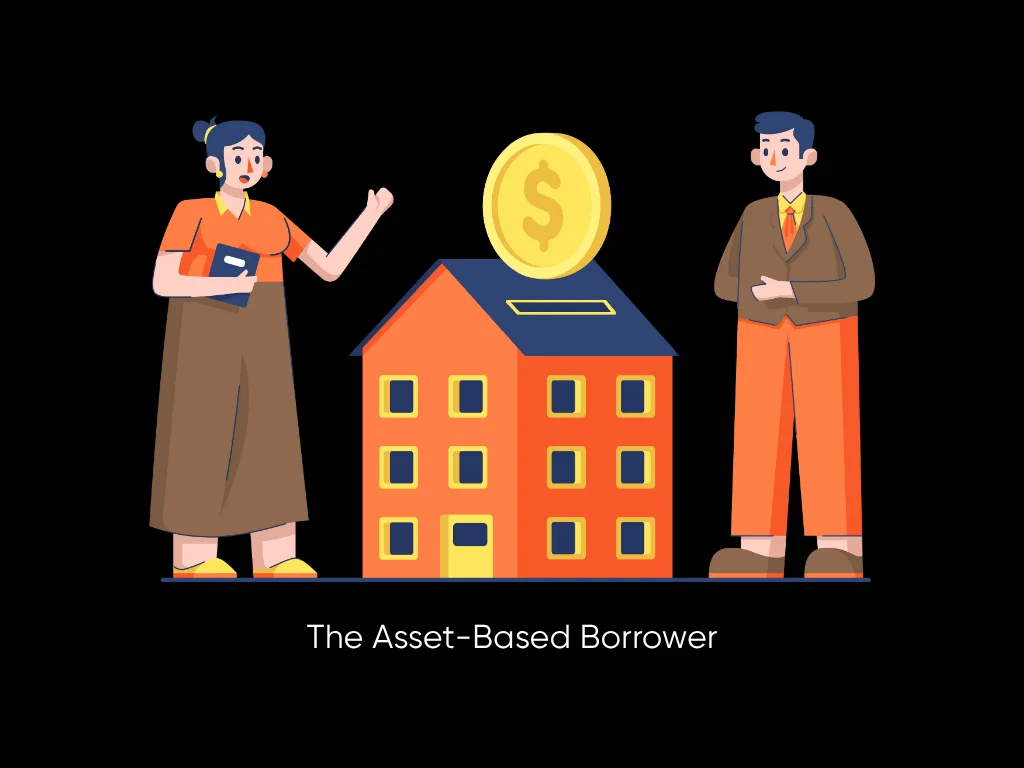
Lenders specializing in these programs can also structure loans around diverse asset classes, such as brokerage and checking accounts, retirement funds if of age, and certain vested stock.
Essential Lender Evaluation Criteria: The 5-Point Scorecard
Once you’ve defined your borrower profile, the next step is to evaluate lenders by measurable standards rather than just rates. In non-QM lending, execution quality matters most. This five-point scorecard helps you identify lenders with the systems, flexibility, and reliability to close with confidence.
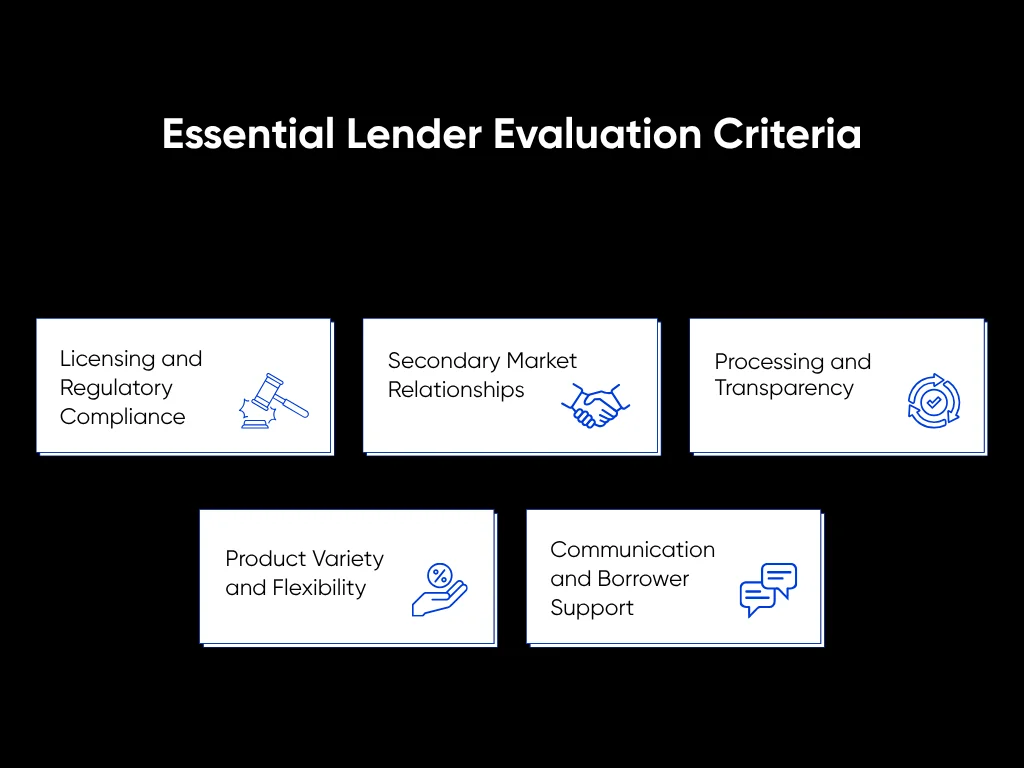
1. Licensing and Regulatory Compliance
Always start by confirming that your lender is fully licensed. Use the NMLS Consumer Access database. Things to check for include active registration, disciplinary history, and the company’s authorized loan types. You can cross-check info with your state’s financial department to be absolutely certain about a lender’s compliance record.
2. Secondary Market Relationships and Expertise
A lender’s connection to institutional investors determines whether they actually have to funds to close your loan, not just approve it. Non-QM lenders that maintain steady relationships with private capital buyers gain greater liquidity and thus lower fallout risk.
Lender expertise is equally important. For example, Defy Mortgage specializes in non-QM programs, particularly DSCR loans. This is because our team is intimately familiar with the nuances of investment property income underwriting, thanks to their decades of experience originating investment mortgages throughout the United States. Choosing a lender with deep experience in your intended loan option ensures smoother processing, better guidance, and higher chances of long-term success.
3. Processing Time and Operational Transparency
Beware of lenders promising 15-day closings on complex loans. As of November 2025, realistic timelines are 30-45 days, even for experienced teams. A professional lender will provide a written timeline and outline the documentation stages in advance. A simple test you can do to verify a lender’s transparency is to ask how long their underwriters typically take once conditions are submitted. If they’re purposely vague or avoid mentioning specifics, that’s a red flag.
4. Product Variety and Underwriting Flexibility
Top non-QM lenders stand out by offering a broad range of loan programs, such as bank statement, DSCR, and asset depletion loans. These loans target the needs of diverse borrower types, ensuring that each strategy and budget, ensuring that each strategy and budget has a financing option to match.
They should also be skilled at tailoring documentation methods to your situation. An experienced underwriting team should be experienced in complex income structures to know when to apply nuance and make exceptions where they’re warranted.
For instance, say you’re a software engineer who left a salaried job to start an LLC that caters to the same client base. A good non-QM underwriter would recognize the continuity of work, review prior earnings, and average the new contract income over the period since your LLC’s founding. But the best non-QM lenders can gauge the overall stability and sustainability of your income stream and balance that against your assets, credit history, and market demand for your profession to make a fair, data-driven approval decision.
5. Communication and Borrower Support
A successful non-QM transaction accounts for every relevant nuance. Miscommunication can derail closing, so prioritize lenders who provide dedicated points of contact. These include proactive updates, dedicated customer service, and clear explanations of underwriting procedures and terms. At Defy Mortgage, we’re committed to providing white-glove service to each borrower, with a dedicated Mortgage Consultant assisting you from application to closing and beyond. With an average rating of 4.8 stars on Google reviews, you can be sure that our service is centered on your success.
Due Diligence Deep Dive: Vetting Lender Claims and Capabilities
After identifying top candidates, some extra due diligence can reveal how well each lender actually delivers on their promises. The non-QM space is home to both high-performing specialists and undercapitalized newcomers whose marketing often outpaces their capacity. A disciplined due diligence process separates reliable lenders from those who may not have the operational stability or the expertise to underwrite complex financial situations accurately.
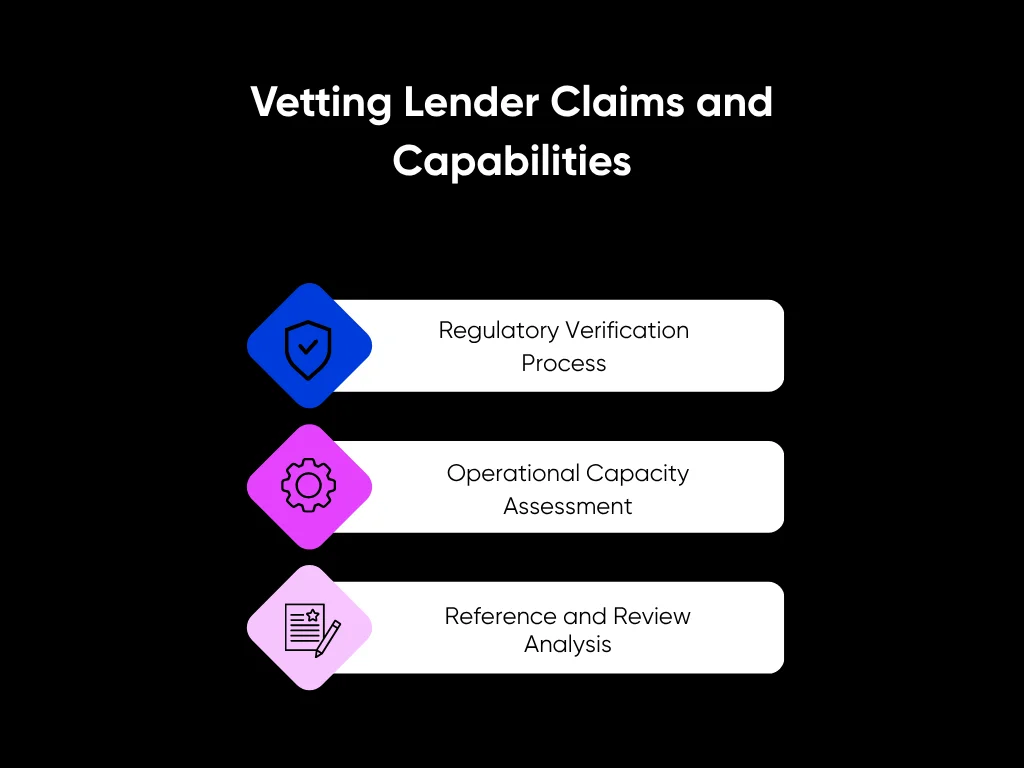
Regulatory Verification Process
Start by confirming legitimacy through the NMLS Consumer Access portal linked above, which lists license types, branch offices, and disciplinary actions. You can also check your state regulatory agency website for complaint histories and enforcement actions.
Operational Capacity Assessment
Strong lenders maintain consistent loan volume and underwriting staff relative to their pipeline. You can independently verify this using Home Mortgage Disclosure Act (HMDA) data, which lists total funded loans per institution. Lenders that regularly originate non-QM loans in your state are generally better equipped to handle complex borrower profiles.
Here are some additional scenario-based questions you can ask your lender to gauge how experienced they are at originating the loan types you’re targeting:
- “How do you calculate qualifying income for P&L borrowers?”
- “What’s your average underwriting turnaround time this quarter?”
- “What percentage of your recent funded loans were bank statement or DSCR programs?”
- “What is your experience with funding loans for seasoned real estate investors?”
- “What exceptions have you made for bank statement loans you offer?”
If they struggle to provide specifics or defer to vague answers, that’s a signal to proceed cautiously.
Reference and Review Analysis
After verifying licenses and assessing operational capacity, you can employ a final layer of due diligence focusing on real borrower experiences. The Better Business Bureau (BBB) aggregates reviews and unresolved complaints for mortgage lenders.
Look for recurring patterns across platforms like Google My Business and or TrustPilot. Multiple mentions of “unresponsive underwriting” or “last-minute term changes” often reveal deeper systemic issues that can impact your loan process. This helps you confirm whether a lender’s advertised efficiency and flexibility actually hold up in practice.
Navigating Rates, Terms, and Total Cost Analysis
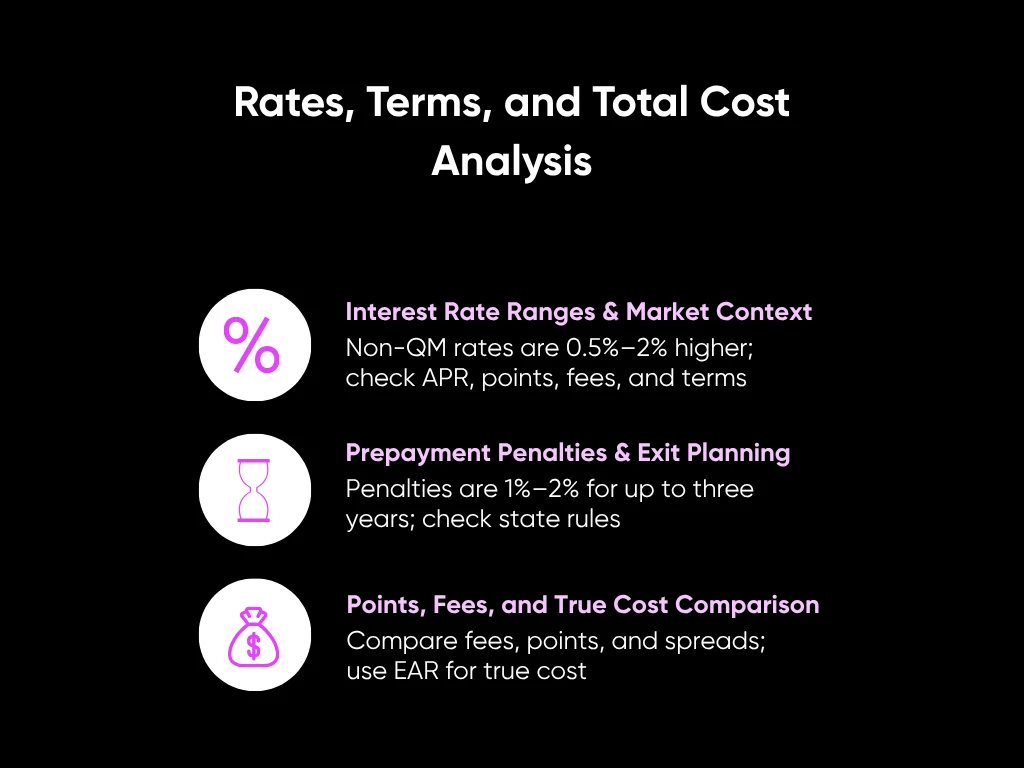
Even experienced borrowers can misjudge the real cost of a non-QM loan by focusing too much on advertised interest rates. What looks like a small rate difference can actually mean thousands in additional costs over the long term. Here’s how you can analyze how loan structure, fees, and term length interact to shape your true cost of capital:
Interest Rate Ranges and Market Context
Non-QM rates typically fall 0.5% to 2.0% higher than comparable conventional loans due to their custom underwriting and private investor funding; however, this can vary by lender. But headline rates only tell part of the story. Make sure to assess the loan’s APR along with points, fees, and term flexibility to determine your effective borrowing cost, and be sure to ask each lender what their exact rates are based on your scenario, as mortgage rates can vary based on LTV, FICO score, DTI, and more.
Many lenders transparently display their loans’ projected APR at the average or lowest possible rate on their rate table. But in the case that the lender you’re researching doesn’t don’t be concerned, Defy Mortgage has handy mortgage calculators for both purchase and refinancing that can help you out.
Prepayment Penalties and Exit Planning
Most non-QM products include prepayment penalties, especially those structured for investment properties or short-term flips. These often amount to 1%-2% of the purchase price, and can apply for up to the first three years. However, 15 states, including California, Connecticut, and Louisiana, apply restrictions to prepayment penalties that lenders can charge for mortgages. Prepayment penalties also vary by lender, so always be sure to ask.
Seven other states, including Delaware, Florida, and Tennessee, prohibit lenders from charging penalties for early mortgage payments if such a penalty was not declared in the mortgage agreement. Regardless of the regulatory environment, if you anticipate refinancing or selling soon, choose a lender offering shorter penalty periods or reduced charges for partial paydowns.
Points, Fees, and True Cost Comparison
Origination fees, broker spreads, and discount points vary significantly among lenders. A lender quoting a lower rate might offset it with higher upfront fees. It’s often best to request full loan estimates from multiple lenders to compare rates, origination costs, and lender credits.
To get an accurate picture of what you’ll actually pay, you can calculate the loan’s effective annual rate (EAR). Unlike the annual percentage rate (APR), the EAR reflects the true annualized cost of borrowing by factoring in compounding and the impact of upfront fees over the time you expect to hold the loan. To calculate your EAR, divide the total cost of interest and fees by the loan amount, adjust for the loan term, and annualize the result to see how much your financing truly costs each year. Also, asking never hurt.
Making Your Final Decision on Non-QM Lenders
By following the guidelines above, you can narrow down the list of potential non-QM lenders to a handful of solid picks. But what truly makes a lender the best choice for your financial goals, income profile, and timeline? Here’s how you can make your final decision:
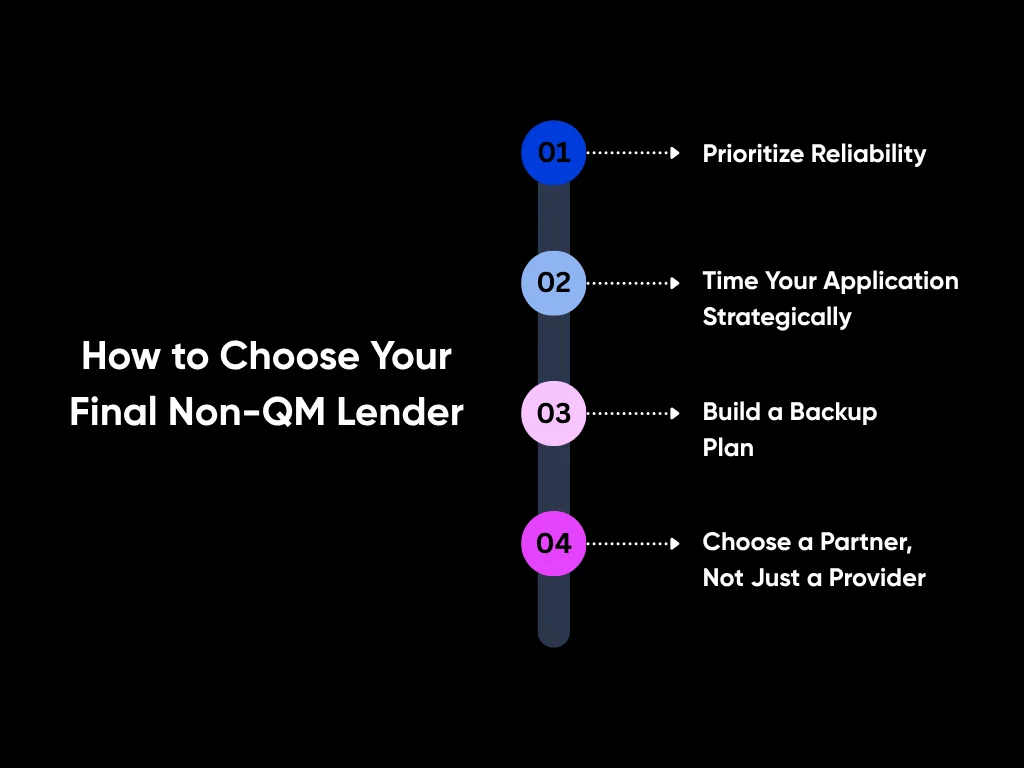
- Prioritize Reliability: Your number 1 pick should be the lender that maintains consistent, transparent communication. Evaluate how each lender handles your documentation, prequalification, and underwriting. These factors determine whether your loan closes smoothly, or even at all.
- Time Your Application Strategically: Market conditions can heavily influence approval timelines and rate locks, but not all lenders handle these shifts equally. Before you apply, ensure your bank statements, leases, or P&L statements are current, then look for lenders that can issue rapid preapprovals and flexible lock extensions when rates fluctuate. Lenders with streamlined documentation reviews and predictable lock policies are better partners for time-sensitive transactions.
- Build a Backup Plan: Even top-performing lenders encounter capacity bottlenecks or underwriting constraints. Maintaining a secondary lender relationship, especially for time-sensitive transactions, provides insurance against unexpected setbacks. Seasoned real estate investors keep multiple lenders close at hand to ensure that they can always receive funding to seize on a time-sensitive opportunity, in case a deal with their primary lender falls through.
- Choose a Partner, Not Just a Provider: The best non-QM lenders tend to be those that guide borrowers through every step of the approval process and clearly outline their expectations. Lenders who offer direct access to loan officers are the most likely to be able to answer nuanced questions and provide personalized guidance.
This is where Defy Mortgage stands out. We blend flexible underwriting with real-time responsiveness, giving borrowers and brokers clear visibility from prequalification to funding. Our mortgage process is both technology-driven and people-driven, allowing us to accelerate approvals without sacrificing personal guidance. Here’s what sets us apart:
- Minimum down payment: As low as 15% for borrowers with 680+ FICO (purchase/RT), >1.000 DSCR, and ≤ 1.5M loan amount (20% for DSCR cash-out).
- Minimum credit score: Down to 640
- Maximum loan amount: Up to no hard maximum loan limit
- and no seasoning DSCR options available
- Gift funds accepted
- First-time investor option for new, smaller investors (not including STRs): Min FICO 700, DSCR > 1.0000
- No cash-in-hand limits pending LTV
- No tradeline options
- Available in all states except: Alaska, Arizona, Idaho, Indiana, Michigan, Minnesota, Nevada, North Dakota, Oregon, South Dakota, Utah, and Vermont
- Minimum down payment: As low as 10% (20% for bank statement cash-out).
- Minimum credit score: Down to 640
- Maximum loan amount: Up to no hard maximum loan limit
- Available in the following states: Alabama (AL), California (CA), Colorado (CO), Florida (FL), Georgia(GA), Tennessee (TN), and Texas (TX).
- Minimum down payment: As low as 10% (20% for P&L cash-out).
- Minimum credit score: Down to 640
- Maximum loan amount: Up to no hard maximum loan limit
- Available in the following states: Alabama (AL), California (CA), Colorado (CO), Florida (FL), Georgia(GA), Tennessee (TN), and Texas (TX).
- Interest-only, ARM, and 30-year-fixed structures available.
- Minimum down payment: As low as 20% for purchase or refinance.
- Minimum credit score: Down to 640
- Maximum loan amount: Up to no hard maximum loan limit
Eligible properties include single-family rentals, PUDs, town homes, row homes, site-built condo, warrantable condo, non-warrantable condo, co-ops, condotels, and 2-4 unit multifamily properties.
With over 100 years of collective experience with borrowers of various income profiles and a 4.8-star rating on Google, our Mortgage Consultants can fine-tune each of our non-QM solutions to every borrower’s financial reality.
About the author: Todd Orlando is Co-Founder and CEO of Defy Mortgage. Twenty-five years in Non-QM, investment property, and self-employed lending. Defy operates as both a direct lender (retail) and wholesale lender (Defy TPO), specializing in DSCR, bank statement, P&L, asset depletion, foreign national, and jumbo Non-QM programs.