


Buying U.S. real estate as a non-U.S. citizen used to mean working through a bank that wanted three years of U.S. tax returns, a Social Security Number, and an established U.S. credit file. None of that exists for most foreign buyers — which is why traditional mortgage lenders simply say no. Foreign national loans were built specifically for this gap. They’re U.S. mortgages designed for non-U.S. citizens and non-U.S. residents who want to purchase or refinance American property without the documentation a conventional loan demands.
This guide walks through how foreign national loans work, what borrowers need to qualify, the step-by-step application process, how these loans compare to conventional and DSCR loans, the pros and cons, U.S. tax considerations, and the most common questions we receive at Defy Mortgage. If you’re ready to get started on a purchase or refinance now, you can view our foreign national loan product page for current terms and to start your application.
Foreign National Loan Qualification Requirements
Foreign national loans replace the documentation a conventional U.S. mortgage requires (W-2s, tax returns, U.S. credit) with alternative qualification paths designed for non-resident borrowers. The exact requirements vary by lender, but the typical qualification framework looks like this:
Identification & Residency Documentation
- Valid passport from country of citizenship
- Visa if currently in the U.S. (B1/B2, E-2, L-1, EB-5, etc.) — though no visa is required for most purchase scenarios
- Proof of foreign residency — utility bill, bank statement, or government-issued residence document from country of residence
- ITIN (Individual Taxpayer Identification Number) is helpful but not required for most foreign national loan programs at Defy
Credit & Income Alternatives
Because most foreign nationals don’t have a U.S. FICO score, foreign national lenders accept a range of alternatives:
- International credit report from country of residence (when available)
- Letters of reference from foreign banks confirming account history and standing
- 12 to 24 months of foreign bank statements demonstrating income or assets
- Foreign tax returns (when used) — translated and converted to USD
- DSCR qualification on the subject investment property’s rental income — no personal income documentation required at all
Down Payment & Reserves
- Down payment: typically 25–40% of the purchase price (Defy goes up to 70% LTV on purchase / rate-and-term, meaning as low as 30% down)
- Reserves: 6–12 months of mortgage payments held in liquid assets (U.S. bank account preferred, but foreign assets can qualify)
- Source of funds: documented seasoning of the down payment (typically 60–90 days) to confirm funds are not borrowed
Property Type
Foreign national loans are typically restricted to investment properties and second homes — not primary residences (since the borrower is, by definition, a non-resident). Eligible property types include single-family residences, 2–4 unit small multifamily, condominiums, and townhomes in most markets.

The Foreign National Loan Application Process, Step by Step
The application process for a foreign national loan moves faster than most borrowers expect — Defy closes most foreign national files in 14 to 21 days. Here’s what the typical timeline looks like from initial conversation to closing:
Step 1: Pre-Qualification Conversation
Start with a 15-minute call to walk through your scenario: country of residence, citizenship, target property, intended use (investment vs. second home), and rough purchase price and down payment. This is where we identify which foreign national loan program fits — DSCR-qualified, asset-based, or full-doc with foreign income.
Step 2: Initial Document Collection
You’ll provide passport, current visa (if applicable), proof of foreign residency, and a starting set of asset documentation (foreign bank statements, brokerage account statements, or proof of liquid reserves). This package is enough to issue a pre-approval letter for property shopping.
Step 3: Property Selection & Purchase Contract
Once you have a property under contract, your real estate agent or attorney sends the executed purchase agreement to your loan officer. The clock starts on the formal application timeline at this point.
Step 4: Full Application & Underwriting Documentation
Complete the formal loan application (Form 1003 or its non-QM equivalent). Provide the full documentation set: 12–24 months of foreign bank statements (or foreign tax returns if using full-doc), source-of-funds documentation for the down payment, foreign credit report or letters of reference, and any business documentation if you’re self-employed abroad.
Step 5: Property Appraisal & Title Work
The lender orders a U.S.-based appraisal of the subject property and a title search. For DSCR-qualified foreign national loans, the appraisal also includes a market rent analysis (Form 1007) used to calculate the debt service coverage ratio.
Step 6: Underwriting Review
Underwriting evaluates the file against program guidelines: identity and residency verification, source of funds, asset reserves, property condition, and either DSCR or income calculation depending on the qualification path. Conditions are typically issued within 5–7 business days of full submission.
Step 7: Conditional Approval & Final Documentation
You’ll receive a list of remaining conditions — usually clarifications on bank statement transactions, updated balances, or any missing documentation. Most foreign national files clear conditions in 2–4 business days.
Step 8: Clear-to-Close & U.S. Banking Setup
Once the file is clear-to-close, you’ll wire down payment and closing costs to the title company’s escrow account. Most foreign national borrowers don’t have a U.S. bank account at this stage — wiring directly from a foreign account is fully acceptable and routine.
Step 9: Closing & Funding
Closing for foreign national borrowers is typically handled remotely via a Power of Attorney executed at the U.S. consulate or embassy in your country of residence, or via mobile notary service. The property funds and records, the keys are released, and you become the U.S. property owner — without ever needing to fly in for closing.
Foreign National Loans vs. Conventional Loans
Conventional U.S. mortgages — the loans most American borrowers use — are governed by Fannie Mae and Freddie Mac guidelines that explicitly require U.S. residency, U.S. credit history, and U.S. tax documentation. This is why most non-U.S. citizens are turned away by traditional banks. Foreign national loans don’t play by those rules. Here’s how they compare:
| Requirement | Conventional Loan | Foreign National Loan |
|---|---|---|
| U.S. citizenship or permanent residency | Required | Not required |
| Social Security Number | Required | Not required |
| U.S. credit score (FICO) | Required (typically 620+) | Not required — international credit or letters of reference accepted |
| U.S. tax returns | 2 years required | Not required (DSCR or asset-based) |
| Down payment | 3–20% (most programs) | 25–40% typical (Defy: as low as 30%) |
| Maximum LTV | 97% (some programs) | Up to 70% (Defy purchase / R&T) |
| Property type | Primary, second home, investment | Investment + second home only |
| Documentation timeline | 30–45 days typical | 14–21 days at Defy |
| Maximum loan amount | Conforming limit (currently ~$832,750) | Up to $3M at Defy |
The trade-off is clear: foreign national loans require a larger down payment and carry slightly higher interest rates than conventional loans, but they make U.S. property ownership accessible to borrowers who would otherwise be locked out entirely. For most foreign buyers and investors, that trade-off is the only path to U.S. real estate.
Foreign National Loans vs. DSCR Loans
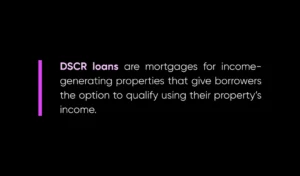
DSCR (debt service coverage ratio) loans and foreign national loans are both non-QM products, and they overlap significantly. Many foreign national borrowers actually qualify under DSCR guidelines — using the property’s rental income rather than personal income. Here’s how to think about which one fits:
| Feature | Foreign National Loan | DSCR Loan |
|---|---|---|
| Borrower citizenship | Non-U.S. citizen / non-resident | U.S. citizen, permanent resident, or foreign national |
| Qualifying income | Foreign income, foreign assets, or property rental income | Property rental income only (no personal income required) |
| U.S. credit required | No — international credit or alternatives accepted | Yes for U.S. borrowers; alternatives for foreign nationals |
| Eligible properties | Investment + second home | Investment only |
| Minimum DSCR | Varies by program (often 1.0+ if DSCR-qualified) | 0.75 minimum at Defy |
| Minimum FICO (when used) | None required | 640 minimum at Defy (with alternative credit options) |
| Maximum LTV (purchase) | Up to 70% | 85% SFR / 80% 2–4 unit at Defy |
| Maximum loan amount | Up to $3M at Defy | Up to $3M+ at Defy |
The simplest decision rule: if you’re a non-U.S. citizen buying or refinancing a U.S. investment property and the property cash-flows on its own, you have two paths — a foreign national loan or a DSCR loan structured for foreign borrowers. At Defy, we structure foreign national loans on DSCR qualification routinely, so most non-resident investors end up with what is functionally a hybrid product: foreign national documentation flexibility with DSCR-style qualification on the property’s rental income. Learn more about DSCR loans if you’d like to compare in detail.
Pros and Cons of Foreign National Loans
Pros
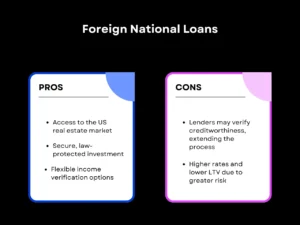
- Access to U.S. real estate without U.S. residency. Foreign national loans exist specifically to remove the residency barrier. You can buy or refinance U.S. property without a green card, visa, or Social Security Number.
- No U.S. credit history required. International credit reports, letters of reference from foreign banks, or DSCR qualification on the property all replace the U.S. FICO score requirement.
- Faster closings than most conventional foreign-buyer programs. Defy closes most foreign national files in 14–21 days versus 30–45 for conventional and 60+ for some bank-specific foreign buyer programs.
- Diversification into a stable U.S. real estate market. For investors in countries with currency volatility or political risk, U.S. property is a hedge — and foreign national loans let you leverage that hedge rather than tying up 100% cash.
- Remote closing. Most foreign national closings happen via Power of Attorney executed at a U.S. consulate or by mobile notary in your country of residence — no U.S. travel required to close.
- Cash-out refinance available. Once you own U.S. property, you can refinance to pull equity out for additional investments, also without U.S. residency requirements.
Cons
- Higher down payment. Foreign national loans typically require 25–40% down versus 3–20% for conventional. The trade-off is unavoidable — lenders price for the additional foreign-borrower risk.
- Higher interest rates. Rates are typically 1–2 percentage points above conventional rates. The premium reflects the loan’s non-QM status and the foreign-borrower risk profile.
- Investment and second-home only. You cannot use a foreign national loan for a U.S. primary residence, since you’re by definition a non-resident. If you later become a U.S. resident, you can refinance into a conventional or non-QM owner-occupied product.
- U.S. tax obligations. Owning U.S. property creates U.S. tax-filing requirements (FIRPTA on sale, 1040-NR or 1120-F on rental income). These are manageable but require a U.S. CPA familiar with non-resident filings.
- Source-of-funds documentation. Foreign borrowers need to document the seasoning and source of the down payment (typically 60–90 days). For borrowers whose funds come from non-traditional sources or recently transferred accounts, this can add friction.
U.S. Tax Implications of Foreign National Loans
Foreign national loans don’t themselves create U.S. tax obligations, but the U.S. property they finance does. Here’s a high-level overview of the U.S. tax framework non-resident property owners should plan around. None of this is tax advice — work with a U.S. CPA who specializes in non-resident filings before closing.
Rental Income Taxation
Rental income from U.S. property is U.S.-source income and is taxable to non-resident owners. By default, the IRS withholds 30% of gross rental receipts. Most foreign owners file an annual Form 1040-NR (individual) or Form 1120-F (foreign corporation) and elect to be taxed on net rental income — meaning you can deduct mortgage interest, property taxes, insurance, depreciation, repairs, and management fees, which typically reduces or eliminates U.S. tax owed in the early years of ownership.
Mortgage Interest Deductibility
Interest on a foreign national loan secured by U.S. real estate is fully deductible against U.S. rental income for non-resident owners who elect net income taxation. This is one of the biggest tax advantages of leveraging the property versus paying all-cash.
Capital Gains & FIRPTA
When you sell U.S. real estate as a non-resident, the buyer is required to withhold 15% of the gross sale price under FIRPTA (Foreign Investment in Real Property Tax Act). The 15% is a withholding, not the final tax — your actual tax liability is calculated on the gain (sale price minus basis and improvements) when you file the year-end return. If your final tax owed is less than the FIRPTA withholding, you receive a refund.
Estate Tax Considerations
U.S. real estate held by a non-resident is subject to U.S. estate tax on death, with a much lower exemption ($60,000) than U.S. citizens receive (~$13M). Many foreign investors hold U.S. property through a structure (foreign corporation, trust, or LLC layered with a foreign holding company) to mitigate U.S. estate tax exposure. Discuss the right structure with your CPA or international tax attorney before closing — restructuring after acquisition is more expensive and can trigger transfer taxes.
Tax Treaties
The U.S. has bilateral tax treaties with many countries that affect how rental income, dividends, and capital gains are taxed and where. If your country has a U.S. tax treaty (most major economies do — UK, Germany, France, Japan, Canada, Mexico, Australia, etc.), the treaty may reduce withholding rates or affect how net income is calculated. A CPA familiar with the relevant treaty can structure the ownership to take maximum advantage.
Frequently Asked Questions: Foreign National Loans
What are the interest rates for foreign national loans?
Interest rates for foreign national loans are typically 1–2 percentage points above conventional mortgage rates because lenders price for the additional risk of underwriting a non-U.S. borrower. The exact rate depends on loan-to-value, debt service coverage ratio (if DSCR-qualified), credit alternatives, and the loan amount. At Defy, foreign national rates move with the broader non-QM market — for current pricing, request a quote on the foreign national loan product page.
What are the down payment requirements for a foreign national loan?
Foreign national loans typically require a 25–40% down payment. At Defy, we go up to 70% LTV on purchase and rate-and-term refinance — meaning a minimum of 30% down. The exact down payment depends on property type (single-family vs. 2–4 unit), DSCR if rental-qualified, and loan amount. Larger loan amounts and lower DSCR values typically require higher down payments.
Are foreign national loans the same as ITIN loans?
No — they’re related but distinct. An ITIN (Individual Taxpayer Identification Number) loan is designed for borrowers without a Social Security Number who reside in the U.S. (often undocumented immigrants or visa holders living and working in the U.S.). A foreign national loan is for borrowers who live outside the U.S. ITIN loans typically require U.S. employment income; foreign national loans use foreign income, foreign assets, or DSCR. Some borrowers qualify for either; the right product depends on where you reside and how you’re documenting income.
Can foreign nationals get a U.S. mortgage without a Social Security Number?
Yes. Foreign national loans are explicitly designed for borrowers without a Social Security Number. Identity is verified through your passport, foreign tax ID, and an ITIN (if you have one). The SSN requirement is a conventional-loan rule that doesn’t apply to non-QM foreign national programs.
Can foreign nationals get a mortgage without a U.S. credit score?
Yes. The most common credit alternatives accepted on foreign national loans are: international credit reports from your country of residence, letters of reference from foreign banks documenting your account history and standing, 12–24 months of foreign bank statements, and DSCR qualification on the subject investment property’s rental income (which bypasses personal credit entirely).
What is a foreign national loan?
A foreign national loan is a U.S. mortgage purpose-built for non-U.S. citizens and non-U.S. residents who want to purchase or refinance American property. Unlike a conventional U.S. mortgage, it doesn’t require a Social Security Number, U.S. credit score, U.S. tax returns, or U.S. residency. Foreign national loans are typically structured as non-QM (non-qualifying mortgage) products underwritten on the borrower’s foreign assets, foreign income, or the property’s rental income.
Can non-U.S. residents get a foreign national loan?
Yes — that’s exactly who foreign national loans are designed for. Non-U.S. residents (whether U.S. citizens living abroad, dual citizens, or non-citizens with no U.S. ties) can finance U.S. investment properties and second homes through foreign national programs. The lender treats your country of residence as your primary jurisdiction for documentation purposes.
What are the requirements for a foreign national loan?
Standard foreign national loan requirements include a valid passport, proof of foreign residency, 25–40% down payment with documented seasoning, 6–12 months of mortgage payment reserves, and qualifying income or assets through one of three paths: foreign income with documentation, foreign liquid assets, or DSCR qualification on the property’s rental income. Defy’s foreign national program also accepts borrowers without a U.S. credit score using international credit alternatives.
What types of foreign national loan programs exist?
Foreign national loans come in several structural variants: full-doc foreign national (uses foreign income with documentation), asset-based foreign national (uses foreign liquid assets to qualify), DSCR foreign national (uses the property’s rental income — no personal income required), and bank statement foreign national (uses foreign bank statements as income proxy). Each program has different documentation requirements and rate/LTV trade-offs. The right one depends on what documentation you can provide most easily.
Are foreign national loans available in California?
Yes. California is one of the most active markets for foreign national mortgages — particularly Los Angeles, San Francisco, San Diego, and Orange County, all of which see significant foreign investor demand. Defy Mortgage is licensed in California and originates foreign national loans for purchase and refinance throughout the state.
Are foreign national loans available in Florida?
Yes — and Florida is the single most active state for foreign national mortgages, driven by demand in Miami, Orlando, Tampa, and the Naples/Bonita Springs corridor. Defy Mortgage is licensed in Florida and works with foreign buyers from Latin America, Europe, and Canada on Florida investment properties and second homes.
Can foreign nationals get loans for U.S. investment properties?
Yes — investment property is the most common use case for foreign national loans. Most foreign nationals buying in the U.S. are buying rental property, vacation rental, or second-home property they may rent out. Defy structures most foreign national loans on DSCR qualification, which means the property’s rental income (not your personal income) qualifies the loan. This is the cleanest path for most foreign investors who don’t want to document personal income across jurisdictions.
Get Started With a Foreign National Loan at Defy
Defy Mortgage is licensed in nine states and originates foreign national loans for purchase, rate-and-term refinance, and cash-out refinance — with U.S. property buyers and investors from over 30 countries. Most files close in 14–21 days, with remote closing handled via consulate or mobile notary in your country of residence.
If you’re ready to start a scenario, the fastest path is to visit our foreign national loan product page — you’ll see current loan terms, eligibility, and a direct path to start your application. Dare to Defy.