


If you are a homeowner, investor, or entrepreneur in Alabama, a home equity line of credit (HELOC) could be the key to enhancing your financial strategy. One note up front: Defy’s home equity product is Smart Equity, a closed-end fixed-rate second mortgage. You receive the full amount as a lump sum at closing and repay it at a locked rate, rather than drawing against a revolving line. HELOCs offer more flexible access to cash than other equity financing options, making them suitable for a broader range of applications compared to traditional mortgages.
At Defy Mortgage, we simplify the mortgage process with 75+ fully customizable mortgage solutions. Our home equity offering is Smart Equity, a closed-end fixed-rate second mortgage funded as a single lump sum at closing rather than a revolving line. We also offer HELOCs, DSCR loans, bank statement loans, and more. Paired with our competitive rates, seamless platform, and dedicated, personalized support, we can guarantee that your mortgage experience will be
In this blog, we’ll explore how HELOCs work, how they can elevate your financial strategy, and how to get the best HELOC rates in Alabama. We’ll also discuss qualification requirements and how Defy’s HELOC loans in Alabama can give you an edge that other lenders may not.
Let’s get started!
Current Home Equity Rates in Alabama
Home equity pricing in Alabama moves with the broader rate environment and with your combined loan-to-value, credit profile, and property type. Because pricing changes frequently, this page does not publish a static range; speak with a Defy advisor for a current Smart Equity quote. National average HELOC rates are tracked by several rate publishers and move week to week.
HELOC rates are generally tied to the prime rate, which is the lowest interest rate banks offer to their most creditworthy clients, such as corporations that borrow large amounts regularly. HELOC rates typically range from 0.5% to 2.25% above the prime rate, which is generally 3% higher than the Federal funds rate. The prime rate moves with Federal Reserve policy and is worth checking at the time you apply.
Aside from the prime rate, HELOC rates vary based on several factors, including credit score, loan-to-value (LTV) ratio, and lender-specific terms. Be sure to compare offers from multiple lenders to confirm that you’re getting the best rate possible.
What Is a HELOC and How Does It Work in Alabama?
Defy’s home equity product, Smart Equity, is a closed-end fixed-rate second mortgage: the full amount is disbursed at closing and repaid on a fixed schedule at a locked rate. For context on the broader category, a traditional Home Equity Line of Credit (HELOC) is a revolving line of credit, like a credit card, that allows homeowners to borrow against their property’s built-up equity, similar to a home equity loan. However, unlike a traditional home equity loan that provides a lump sum, a traditional HELOC lets you draw funds as needed during a draw period that typically lasts 5 to 10 years. Smart Equity works differently: there is no draw period, because the full balance is advanced at closing and repaid on a fixed amortizing schedule.

This structure allows borrowers to customize their debt obligations and pay interest only on the amount they actually need. Because borrowing excessive funds can lead to paying more interest than necessary, HELOCs (Home Equity Lines of Credit) can even be suited for covering ongoing expenses, such as:
- Home improvement projects or investment property renovations
- Medical bills or other emergencies
- College tuition
- Business improvements
- Vacations or events
- Debt consolidation
- Large expenses or purchases
In most cases, you can refresh your credit limit by paying only the interest on the amount you borrowed. You are able to borrow up to the agreed-upon limit as many times as you like, as long as you’ve refreshed the credit limit. With Smart Equity there is no draw period to exit and no outstanding line to settle before you can borrow again; repayment begins after closing on a fixed schedule at a locked rate.
What Affects HELOC Rates in Alabama?
Securing the best HELOC rates in Alabama involves understanding the main factors influencing the rates that lenders offer. Here’s a breakdown of the key elements:
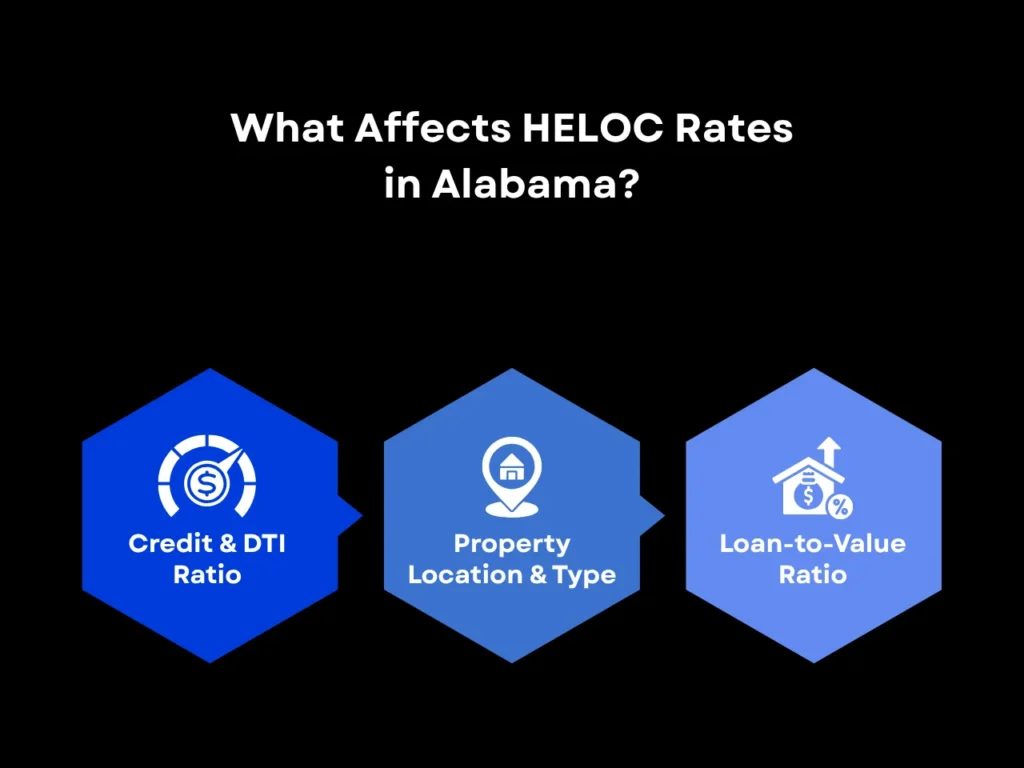
Credit Score and Debt-to-Income Ratio
Your creditworthiness is one of the primary factors affecting HELOC rates in Alabama. Much like many other loan types, a higher credit score typically results in lower rates. The best terms are often reserved for borrowers with FICO scores above 740.
Your debt-to-income ratio (DTI), which compares your monthly debt payments to your gross monthly income, is another critical factor. Your DTI tells lenders how much of your income goes to debt payments, so they can verify whether you make enough to cover both your existing debt and the HELOC repayment. Much like in many other places, lenders in Alabama offer the most competitive rates to borrowers with DTI under 36%.
Property Location and Type
The location and type of your property can impact your approval and rates for a HELOC in Alabama. Properties in urban areas like Birmingham or Huntsville may be viewed as less risky due to their higher property values and the overall stability of their local market, potentially leading to more favorable rates.
Rural areas may yield lower loan amounts due to lower home values as compared to those in urban or suburban areas. Many lenders can apply higher rates to uninsured properties due to the increased risk. Additionally, owner-occupied homes often qualify for better terms compared to second homes or investment properties, again due to reduced risk associated with owner-occupied properties.
Loan-to-Value (LTV) Ratio
Your loan-to-value ratio (LTV), which is the principal amount left on your mortgage compared to the appraised value of your home, is another crucial element that decides the HELOC rates you get. LTV is the basis for your combined loan-to-value ratio (CLTV), which is the amount you still owe on the mortgage plus the amount you want to borrow, versus your home’s appraised value. The closer your CLTV is to the total value of your property, the higher your rates are likely to be.
How to Qualify for a HELOC in Alabama
HELOCs tend to have similar qualification requirements to other non-QM loans, but like other second mortgages, they emphasize home equity and your combined loan-to-value (CLTV) ratio. Let’s break down each of the main requirements:
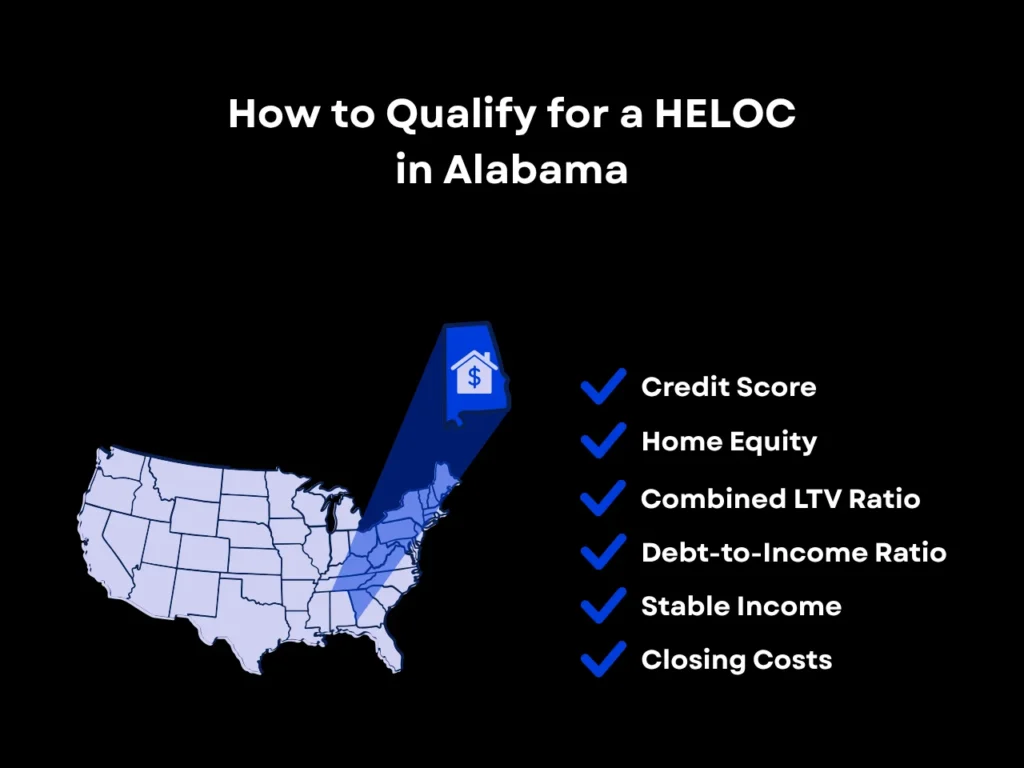
- Credit Score: Although the best HELOC rates Alabama are typically available for borrowers with FICO scores above 740, lenders usually look for a minimum credit score of 620.
- Home Equity: Lenders generally require that you have at least 20% equity in your home to qualify for a HELOC. If you have made at least a 20% down payment on your home, you should already qualify in terms of LTV with most lenders.
- Combined Loan-to-Value Ratio: Lenders prefer that your combined loan-to-value ratio (CLTV) stays below 90%. This means that if you’ve already made a 20% down payment, you start with 20% equity and thus 80% LTV. Therefore, you can borrow up to 10% the value of your home. Given the current median sale price of $282,000 for a single-family home in AL, this translates to a credit limit of $28,200.
- Debt-to-Income (DTI) Ratio: The maximum DTI that lenders allow is typically 43%, although some can allow up to 50%. Some lenders also impose a maximum DTI of 36% for your first lien.
- Stable Income: Proof of consistent and reliable income is essential. For salaried employees, this typically involves recent pay stubs and W-2 forms. Self-employed individuals or freelancers may need to provide additional documentation, such as tax returns and profit-and-loss statements, to verify income stability.
- Closing costs: Aside from the down payment, you will also have to pay closing costs, which can be 2 to 5% of the credit limit. Depending on your lender, you may also have to pay application fees, origination fees, and/or appraisal fees.
At Defy, we support a wide array of alternative qualification methods, such as bank statements, profit-and-loss statements, and liquid asset-based assessments in the form of asset depletion loans. We’ll help you qualify for the right loan for you every step of the way.
Benefits of Using a HELOC in Alabama
A traditional, open-end HELOC is one of the most versatile financial tools a homeowner can derive from their home’s equity. Here are the advantages most often cited for that structure. Note that Defy does not originate open-end revolving HELOCs — Defy’s home equity product is Smart Equity, a closed-end fixed-rate second mortgage funded in a lump sum at closing:

Ready Access to Cash
With an open-end HELOC, a borrower can continuously draw from and replenish the credit limit throughout the draw period. That structure suits expenses paid in multiple installments over time, such as home repairs and renovation, education, or emergencies. Defy does not originate this revolving structure.
Flexible Borrowing
On an open-end HELOC, interest accrues only on the amount actually drawn, which avoids paying interest on funds the borrower does not need. Withdrawals can be made at any time, which is more flexible than a home equity loan or cash-out refinance.
Cost-Effective Financing
Although they may seem to have higher rates than primary mortgages, HELOCs actually have much lower interest rates than other types of revolving credit such as credit cards. This is because they are secured by your home, which reduces the lender’s risk. An open-end HELOC effectively offers the convenience of a credit card without the steep repayments.
Potential Tax Savings
If you use the HELOC funds for expenses that are tax deductible, such as home improvements, you may be able to claim your interest payments as mortgage interest on your federal tax return. With consultations with a tax advisor who can ensure that your expenses comply with IRS guidelines, this can further enhance the cost-effectiveness of a HELOC.
Strategic Financial Planning
A HELOC can be invaluable for your overall financial strategy. It can provide a safety net as an emergency fund to respond immediately to unforeseen expenses or address issues before they become costly to fix. For investors, having immediate access to cash can be a significant advantage, as it allows you to enhance the potential returns from these opportunities.
HELOC Loan Options Available in Alabama Through Defy
Apart from the main benefits you can get from HELOCs, Defy’s tailored solutions can give Alabama homeowners unique benefits, such as:

- Competitive Rates: Access to some of the best HELOC rates Alabama has to offer.
- Non-Traditional Lending: Defy is deeply committed to accommodating individuals with non-traditional income streams, such as the self-employed, freelancers, business owners, entrepreneurs, and real estate investors. Our non-QM loan options, including HELOCs, allow for alternative income verification, removing the need for W-2 income or tax returns.
- Fine-tune Your Mortgage to Your Strategy: Our unparalleled customizability allows you to finetune each of our products to fit your exact strategy. Looking to use your HELOC to fix-and-flip? Let’s talk interest-only payments to minimize your initial costs. Entrepreneur reinvesting in your business? We can work out an amortization schedule that balances your monthly payments with your total interest.
- Expert Guidance: Our mortgage experts each have several years of experience in real estate markets across the United States, Alabama being a prime example. With our local expertise, we can ensure that your Alabama HELOC process will be as simple as possible, with terms that align perfectly with the most accurate appraisal of your home’s value.
HELOC Rates Alabama FAQ
Does Defy offer HELOCs or similar equity-based lending in Alabama?
Yes. Defy Mortgage offers Smart Equity in Alabama, a closed-end fixed-rate second mortgage funded as a single lump sum at closing, along with other equity-based lending options that let homeowners and investors access their property’s value for renovations, debt consolidation, or new investments.
As an alternative, Defy also offers cash-out refinancing on non-QM loans. This option can offer lower interest rates than HELOCs, a lump-sum payout, and the ability to restructure your existing loan to better fit your financial goals.
How does Defy compare to traditional banks in terms of HELOC alternatives?
As a non-QM specialist, Defy offers more flexible solutions, especially for self-employed individuals, freelancers, business owners, and investors. Aside from HELOCs, Defy also offers other types of equity financing, such as home equity loans and cash-out refinances. But what truly sets us apart are our non-QM alternatives to HELOCs, such as bank statement cash-out refinances, P&L cash-out refinances, DSCR cash-out refinances, and more. Please note, however, that we currently do not offer stated income HELOCs or anything stated income at Defy Mortgage.
Can I get a HELOC through Defy if I’m self-employed or investing in rental properties?
Unfortunately, we currently do not offer non-QM stated income HELOCs that allow alternative income verification, such as bank statement HELOCs. However, we do have non-QM alternatives to HELOCs, such as bank statement cash-out refinance, P&L cash-out refinance, and DSCR cash-out refinance. Contact us today, and we’ll get the process started!
What are the current average HELOC rates in Alabama?
Home equity pricing in Alabama shifts with the broader rate environment, and individual rates vary depending on factors such as the property’s LTV ratio and the borrower’s credit score.
Differences in HELOC rates in Alabama vs Home Equity Loans in Alabama?
The best choice depends on whether you need ongoing access to funds (HELOC) or prefer payment predictability (home equity loan). Consider consulting with Alabama lenders like us at Defy for current quotes, as rates can vary significantly between institutions.
- Access to Funds:
- A traditional HELOC works like a credit line – draw funds as needed up to the limit
- Home equity loans provide a lump sum upfront
- Payment Structure:
- A traditional HELOC offers interest-only payments during the draw period (usually 10 years), then principal and interest payments during repayment period
- Home equity loans require immediate principal and interest payments from day one
- Rate Stability:
- HELOC rates can increase significantly if interest rates rise
- Home equity loan rates are locked in and won’t change
Is it better to choose a fixed or variable home equity rate?
Fixed rates allow you to secure a favorable interest rate for the duration of the loan. In contrast, variable-rate Home Equity Lines of Credit (HELOCs) can provide the opportunity to benefit from declining mortgage rates. Generally, short-term projects may be better suited for variable rates, while longer-term projects tend to benefit from the stability of fixed-rate HELOCs.
While it’s impossible to predict market outlook, you can make an informed decision based on your financial situation, risk tolerance, and your expectations around how the interest rate may change over time.
Key Takeaway
Depending on your financial goals, it might make sense to lock in the current HELOC rates in Alabama. With a fixed-rate HELOC, you can gain access to a revolving credit line ready to support your expenses for up to the next 10 years without having to worry about interest rates going up. While we cannot give financial advice, monitoring HELOC rates is a good place to start if you’re looking to take advantage of the changing market conditions.
Need help figuring out a well-rounded strategy? Defy is ready to assist! Call us at (615) 622-1032 or email us at team@defymortgage.com, and one of our mortgage experts will be in touch with you ASAP, ready to answer any questions you may have.