


Becoming a serious player in the Texas luxury housing market requires both financial strength and strategic financing. Homes in leading enclaves like Highland Park in Dallas or The Woodlands in Houston often carry price tags above standard loan limits, and a conventional mortgage might not be enough.
That’s where jumbo loans come in. Jumbo loans allow maximum loan amounts far above the standards set by institutions like Fannie Mae and Freddie Mac. The jumbo mortgage rates Texas investors face are a major deciding factor in the profitability of their investment.
At Defy Mortgage, we’ve built a deep understanding of Texas real estate markets through decades of experience. We can navigate the nuances of the Lone Star State’s luxury markets and maximize investment potential for you. We’re able to tailor our jumbo programs, as well as our 75+ other non-traditional loan options, to ensure that each high-value acquisition becomes an even higher-return investment.
In this guide, you’ll get:
- A snapshot of Texas jumbo mortgage rates today.
- A breakdown of 2025 jumbo loan requirements in Texas.
- A comparison of leading Texas jumbo mortgage lenders
- Tactical strategies to secure the lowest possible jumbo rates.
- Clear next steps for getting your tailored jumbo loan in Texas.
Let’s begin.
Texas Jumbo Mortgage Rates Today
Jumbo pricing is scenario-specific — it depends on loan size, credit, LTV and documentation type. Talk to a Defy advisor for a current quote. With gradual easing on rates, The Fed is expected to continue to lower rates through 2026. Current jumbo mortgage rates Texas remain on a consistent downward trend.
Market Factors
Several Texas-specific and macroeconomic dynamics influence how readily lenders will offer favorable jumbo rates in 2025:
- Local real estate market strength: High-activity markets like Dallas-Fort Worth, Austin, and Houston are maintaining robust demand and limited supply, keeping home values relatively stable. However, lenders also have to adjust rates upward to compensate for longer turnaround times and increased sensitivity to market volatility associated with luxury properties.
- Economic policy: Like all mortgage rates, jumbo rates generally follow long-term Treasury yields and mortgage-backed security spreads. If the Federal Reserve cuts short-term rates, or even if markets simply expect them to, long-term yields can decline. As inflation cools and the Fed transitions toward a more neutral policy stance, jumbo loan pricing could gradually ease through 2025.
- Borrower profile & assets: The stronger your credit profile and asset base, the more likely you are to qualify for the best jumbo pricing.
- Loan size, LTV, and loan structure: The larger the loan, or the higher the loan-to-value (LTV) ratio, the greater the premium added by the lender.
- Geographic factors: Texas has an investor-friendly tax climate, with its lack of capital gains tax being one of its chief advantages. This can reduce lenders’ perceived risk, encouraging them to offer a lower rate. However, Texas also faces region-specific economic risks, such as oil price fluctuations and environmental hazards like floods and tornadoes. These increase perceived risk and, therefore, factor into a higher rate.
Rate Projections
Based on current market direction and expert commentary, here’s how jumbo mortgage rates in Texas may evolve during 2025:
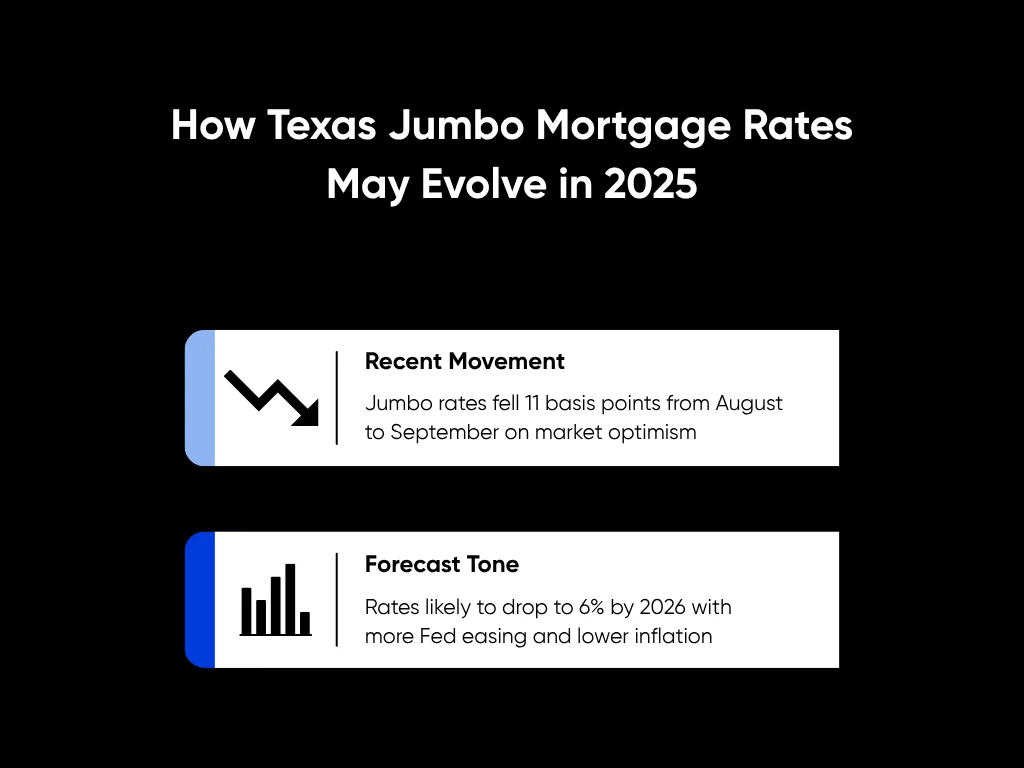
- Recent movement: Jumbo loan rates have been on a steady downturn for some time. Rates fell 11 basepoints between August and September, which could reflect increasing market optimism.
- Forecast tone: Experts predict that the downward trend of mortgage rates will continue through 2026, assuming more Fed easing and cooling inflation. Jumbo loan rates throughout the US are very likely to follow suit.
Texas Jumbo Loan Requirements in 2025
Jumbo mortgages have stricter underwriting standards than conventional loans. Below are the key requirement categories you’ll need to meet (or exceed) to position yourself for competitive jumbo mortgage financing.
Credit and Income Requirements
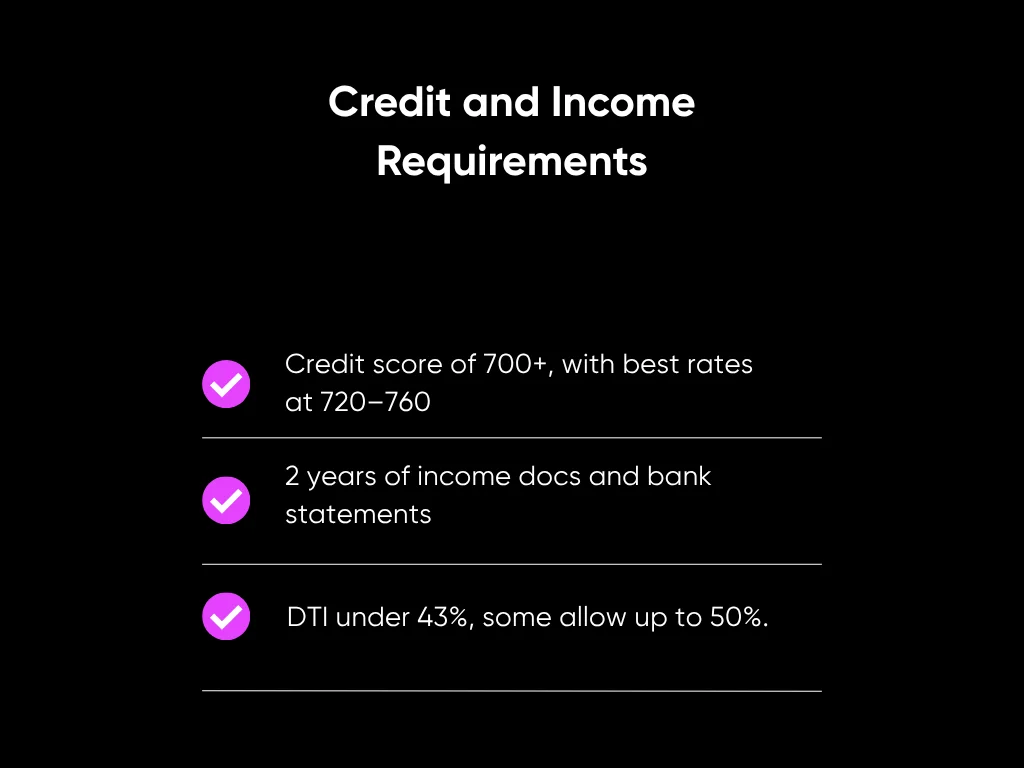
- Credit score: Jumbo loans typically require a credit score of 700 or higher, with many lenders offering the best pricing to borrowers with at least 720-760. Some lenders may accept scores as low as 680 if you have compensating strengths, such as a large down payment or strong reserves. However, these “near miss” jumbo loans can come at the cost of higher premiums or stricter terms.
- Income verification: Jumbo lenders expect robust, well-documented income. If you’re a salaried individual, that means W-2s, pay stubs, and tax returns. For business owners or contractors, expect to present profit & loss statements, balance sheets, bank statements, and multi-year tax returns. If you’re self-employed, you’ll typically need to provide at least two years of personal and business tax returns, a current year-to-date profit and loss statement, a business balance sheet, and 12 to 24 months of bank statements to verify cash flow consistency. Lenders will average your income over the past two years and review its stability
- Debt-to-income ratio (DTI): Your total monthly debts, including the proposed jumbo loan, should not exceed 43% of your gross income. Some lenders may go up to 45% or even 50% depending on compensating factors, but like with credit score, this can come with pricing adjustments
Down Payment and Reserves
Jumbo loans commonly go up to 80% LTV, meaning the lowest possible down payment for the average jumbo loan is 20%. Some lenders can go as high as 90% LTV/10% down, but interest rates adjust upward accordingly.
Additionally, make sure to prepare 6-12 months’ worth of mortgage payments, including principal, taxes, insurance, and HOA dues, as well as closing costs if you decide to have them rolled into your loan.
Property Requirements
Because of their larger value, jumbo loans have stricter property requirements than standard mortgages. Here’s what you need to prepare for:
- Appraisals & valuation: Professional appraisals are essential for many types of mortgages, but jumbo loans are one of the few types that require a second appraisal to ensure an accurate valuation. The lower of the two appraised values is typically used. Jumbo appraisals will include a deeper inspection of unique features or custom amenities, and support value with multiple high-quality comparable sales (often requiring at least three recent comps).
- Property types: Primary residences typically enjoy the most favorable terms. Second homes, vacation properties, and investment properties often come with higher down payment or reserve requirements. Some lenders may also exclude certain property types, such as manufactured housing and co-ops, from their list of allowable properties.
Comparing Texas Jumbo Mortgage Lenders
When selecting a jumbo mortgage lender in Texas, make sure to look at more than just the average rate a lender offers. Everything from underwriting flexibility to loan program specifics can factor into your long-term success.
Here are five of the best jumbo mortgage lenders in Texas, with an analysis of the lender’s strengths, weaknesses, and current offerings and terms.
1. Defy Mortgage
Since our founding in 2022, Defy Mortgage has stood out for ultra-flexible underwriting and specialized investor programs designed to get the most mileage out of non-traditional income structures. Defy Mortgage allows borrowers to qualify using rental income, business cash flow, or asset-based calculations, allowing luxury buyers in Texas to leverage their full financial strength, instead of being limited by W-2 and tax return requirements.

Here’s what we offer to borrowers seeking jumbo loans:
- Minimum FICO score: 700
- Maximum debt-to-income (DTI) ratio: 43%, though higher ratios may be acceptable with compensating factors such as excellent credit or a larger down payment.
- Down payment: Typically between 10% and 25%, with higher down payments potentially improving loan terms.
- Cash reserves: Minimum of 6 months’ worth of mortgage payments; 12 months is ideal.
- Documentation: Varies based on income type; may include tax returns, W-2s, 1099s, bank statements, and investment statements.
If you’re seeking flexible qualification criteria and personalized service, you can’t go wrong with Defy Mortgage. For investors, we also have DSCR loans specifically designed for investment strategies and properties, with loan amounts up to no hard maximum loan limit, allowing you to target high-end rental properties. Down payments can be as low as 15% for loan amounts up to $1.5M with over 1.000 DSCR and 740+ FICO.
2. U.S Bank
This national institution’s main strength lies in its broad national presence, offering both competitive rates and a wide array of loan options, including fixed-rate and adjustable-rate mortgages. They also have strong online lending features.
- Maximum loan amount: $3M
- Minimum down payment: 25%
- Minimum credit score: 660
While U.S. Bank provides a user-friendly online experience, some borrowers have noted that certain tools lack personalization features, such as estimating rates based on credit score.
3. Bank of America
Bank of America is known for its large-scale jumbo capacity, with benefits such as rate and closing credits through their Preferred Rewards program.
- Minimum down payment: 10%
- Minimum credit score: 740
- Maximum loan amount: $5 million
Bank of America is a solid pick for borrowers who value relationship discounts and large-scale lending, but it is less ideal for borrowers with unconventional income or those seeking more flexible qualification options
4. Wells Fargo
Wells Fargo customers may benefit from interest rate discounts if they maintain at least $250,000 in Wells Fargo accounts. They also have underwriters who specialize in jumbo loans.
- Minimum down payment: 20%
- Minimum credit score: 620
- Maximum loan amount: $10 million
Wells Fargo can be a strong option for borrowers with existing bank relationships or those seeking specialized physician/executive programs. However, they’re less ideal for borrowers without an existing banking relationship with them.
5. Texas United Mortgage
A local jumbo specialist, Texas United offers localized underwriting, competitive jumbo rate tables, and faster turnarounds for Texas-based borrowers and investors.
- Minimum down payment: 20%
- Minimum credit score: 740
Texas-based support and quicker underwriting cycles make Texas United a good choice for buyers who want a regional lender familiar with Texas markets and title/closing norms.
For a more in-depth look at jumbo mortgage lenders across the US, check out our article on the 7 best jumbo mortgage lenders of 2025.
Strategies for Securing the Best Jumbo Rates (2025)
Securing a competitive jumbo mortgage rate in Texas relies on strategy as much as strong credit and income. With less transparent pricing than conforming loans, rates are influenced by timing, negotiation, and the strength of your relationship with the lender.
1. Compare rates aggressively
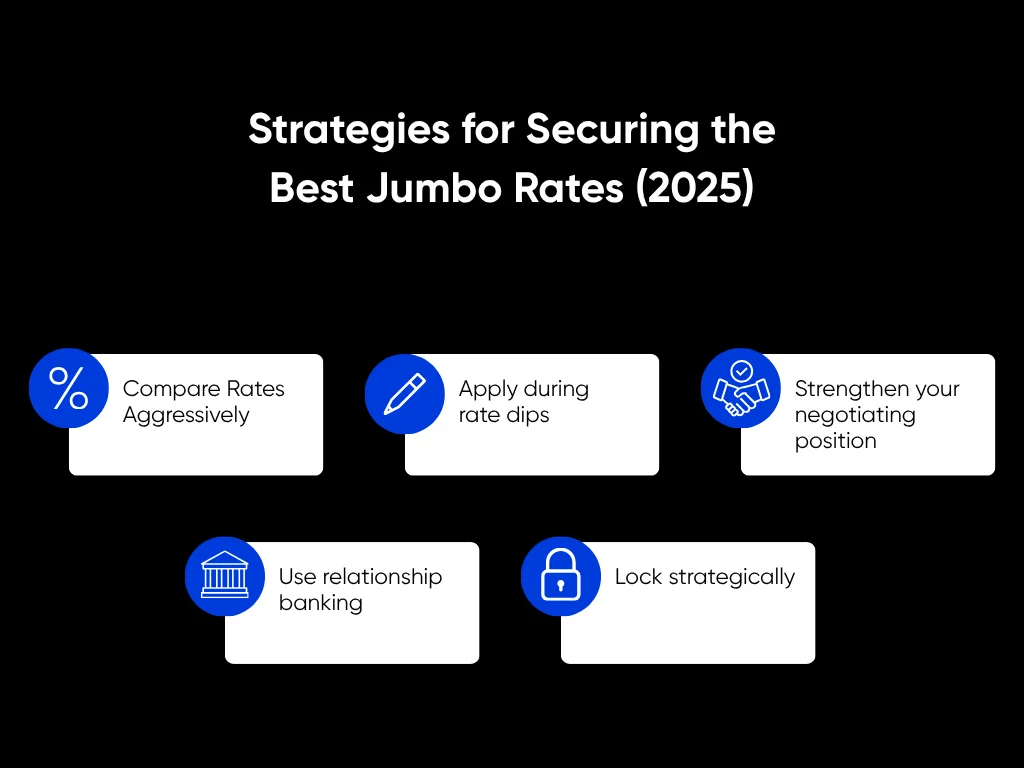
Jumbo loan pricing varies from lender to lender, and on a $1,000,000 loan even a fraction of a percentage point compounds into six figures over the life of the loan. Collect competing quotes rather than accepting the first one you are offered.
2. Time your application with market dips
Since mortgage pricing is strongly influenced by long-term Treasury yields, it may be your best strategic move to wait for yields to fall, especially if experts anticipate that to happen soon. Locking in soon after a yield drop can help you capture a lower rate before the bond market resets or before new policies or inflation effects kick in.
3. Strengthen your negotiating position
Lenders reward strength and stability. Demonstrating large cash reserves, strong FICO (740+), and a verifiable history of high-value asset management often earns rate discounts. But apart from these, LTV (loan-to-value) will be your key leverage point.
Keeping the LTV under 70% decreases lender risk, and signals to them that you are more committed to this investment because you’re willing to make a larger down payment. Even a shift from 80% to 70% LTV can encourage a lender to place you into a lower rate tier.
4. Use relationship banking to your advantage
High-net-worth buyers benefit a lot more from relationship leverage than standard borrowers. Jumbo lenders often provide preferential pricing to clients who consolidate assets, maintain business accounts, or invest using their financing.
At Defy Mortgage, we go the extra mile in building relationships with our borrowers. Your dedicated Mortgage Consultant will be fully attuned to the ins and outs of your financial profile and investment strategy, allowing us to align your goals with our solutions. We don’t just treat jumbo financing as a one-size-fits-all product. As with all of our other loan programs, we customize lending based on full asset visibility, rewarding your liquidity and investment diversity by tailoring terms according to your financial depth.
5. Lock strategically
Rate markets can move several times a week, so once you land a strong quote, it’s wise not to delay. Some lenders offer a float-down option, which lets you lock now but still benefit if rates drop before closing.
Get Your Jumbo Loan in Texas
When you’re investing in high-value Texas real estate, a jumbo mortgage is a practical necessity. Whether you’re growing a portfolio of vacation homes along the Hill Country corridor or building your own luxury residence in Dallas, working with the right lender can make a huge difference in how efficiently your capital can work for you.

Defy Mortgage was built specifically for borrowers like you: investors, entrepreneurs, and high-net-worth individuals who don’t fit the traditional W-2 profile. Instead of boxing borrowers into rigid underwriting formulas, Defy Mortgage evaluates your entire financial ecosystem. We take a full 360-degree look at your income diversity, asset structure, and investment strategy, all to design the jumbo loan package that’s a perfect fit for you specifically.
Where most lenders see complexity, Defy Mortgage sees opportunity. Our platform specializes in:
- Customized underwriting: We adapt to the specifics and nuances of business owners, real-estate investors, and clients with non-traditional income sources.
- Competitive jumbo rates: Aligned with top Texas lenders, but with added flexibility on reserves, documentation, and portfolio diversification.
- Fast, concierge-level closing: We’re deeply familiar with how timing can make or break a deal in competitive markets like Dallas–Fort Worth and Austin. This is why we streamline every step of the jumbo loan process, from application to funding, to help clients secure their properties quickly and efficiently.
- Relationship pricing: At Defy Mortgage, we reward ongoing collaboration. Clients who maintain multiple properties or plan to expand portfolios with us often receive preferential terms.
Conclusion
With its resilient luxury markets, Texas continues to attract high-value buyers and investors looking to capitalize on premium properties with higher yield opportunities and stronger appreciation potential than standard real estate.
If you’re interested in joining their ranks, remember that smart financing can multiply long-term returns. With jumbo mortgage rates Texas expected to trend downwards through 2026, waiting strategically may allow you to secure lower rates while maintaining flexibility.
Defy Mortgage can be your partner in structuring high-value acquisitions with customized jumbo financing solutions. With our tailored options, you can be sure that each investment aligns with your liquidity strategy, supports long-term growth objectives, and maximizes returns on high-value assets. Our expert guidance, custom underwriting, and flexible terms are designed specifically for high-net-worth borrowers seeking to leverage complex income streams and investment opportunities.
And if you’re a mortgage broker, Defy TPO provides streamlined access to our full suite of jumbo and non-traditional loan programs. Defy TPO has dedicated support, fast underwriting feedback, and competitive investor pricing to help you serve clients in Texas’ luxury and high-value markets efficiently. Send us one of your pricing scenarios and we’ll show you how we do it at Defy Mortgage. Alternatively, you can check out our AI Pricer for a quick quote.
FAQs
What qualifies as a jumbo mortgage in Texas and how do rates compare to conventional mortgages?
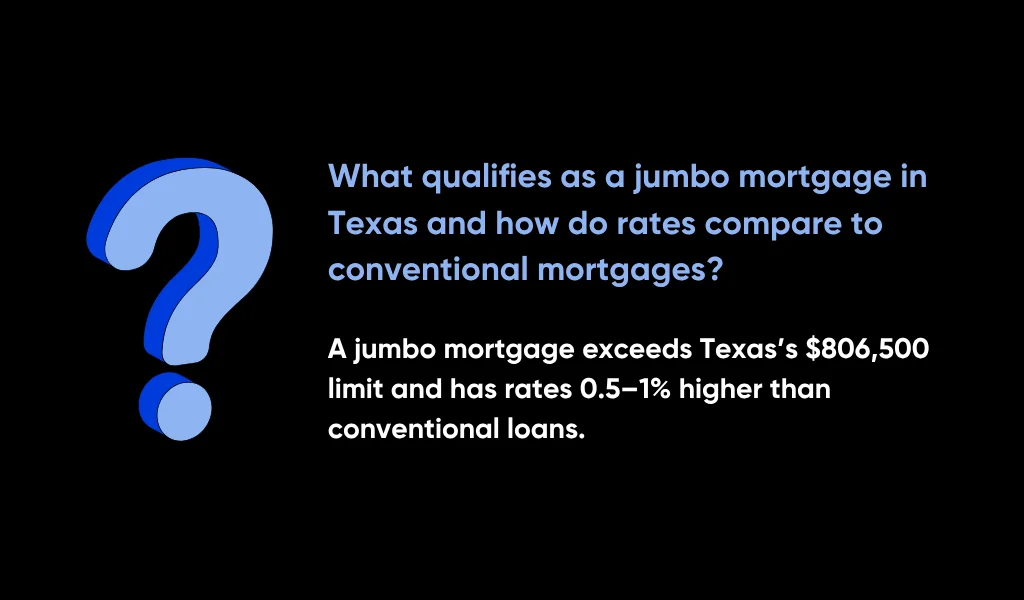
A jumbo mortgage is any loan amount exceeding the conforming loan limit for a particular county. Throughout Texas, this limit is $832,750 for a one-unit property. Any loan above that amount will be considered jumbo. Jumbo pricing is scenario-specific — it depends on loan size, credit, LTV and documentation type. Talk to a Defy advisor for a current quote.
How do Texas jumbo loan requirements differ from conventional mortgages?
Jumbo loans have stricter underwriting because they aren’t guaranteed by government-sponsored entities. For example, many lenders require down payments of 20% or more, higher credit scores (often 720+), and ample cash reserves.
What credit score do I need for a Texas jumbo mortgage, and how does it affect my rate?
A FICO score of 720 or above is commonly required to access the best jumbo loan pricing. A higher credit score can reduce the rate by reducing perceived default risk. At Defy Mortgage, we allow credit scores down to 700 for jumbo loans.
How much down payment is required for Texas jumbo mortgages?
Most jumbo lenders ask for at least 20% down (i.e. 80% loan-to-value) to qualify for favorable pricing. However, in some circumstances, more qualified borrowers with strong credit and reserves may secure lower down payment options, but such offers are rarer in jumbo markets.
What should I look for when comparing Texas jumbo mortgage lenders?
Focus on their experience with high-balance loans, underwriting flexibility, transparency in how they evaluate nontraditional income, and whether they offer investor perks or portfolio lending, as these open up more avenues for negotiation.