


With zero state-level capital gains tax, Texas is one of the best states for real estate investment. Whether you sell a Dallas rental condo or a vacation home in Galveston, the IRS simply looks at your holding period, income bracket, and even past depreciation deductions to calculate what you owe at the federal level.
At Defy Mortgage, we take into account all of these factors when crafting custom mortgage programs that maximize your long-term returns while minimizing your tax burden. Each of our loan products is tailored to the exact needs of our borrowers. Whether you’re a real estate investor seeking a DSCR loan or a high-net-worth individual interested in a jumbo loan, Defy takes a full 360-degree view of your goals and finances to create a loan that positions you for sustainable growth and financial flexibility.
In this guide, we’ll walk you through:
- The mechanics of federal capital gains tax
- How Texas investors are uniquely positioned
- Practical steps you can take to keep more of your profits working for you
Disclaimer: This article is for informational purposes only and does not constitute tax advice. Always consult a qualified CPA before making financial decisions.
Understanding Capital Gains Tax Basics
Although there is no capital gains tax Texas, you still have to pay federal capital gains tax. Whether your gain is taxed as ordinary income or long-term capital gains depends on how long you’ve held the property, your cost basis, and other income you have in the year of sale.
Short-term vs. Long-term Capital Gains
The IRS divides capital gains into two categories:
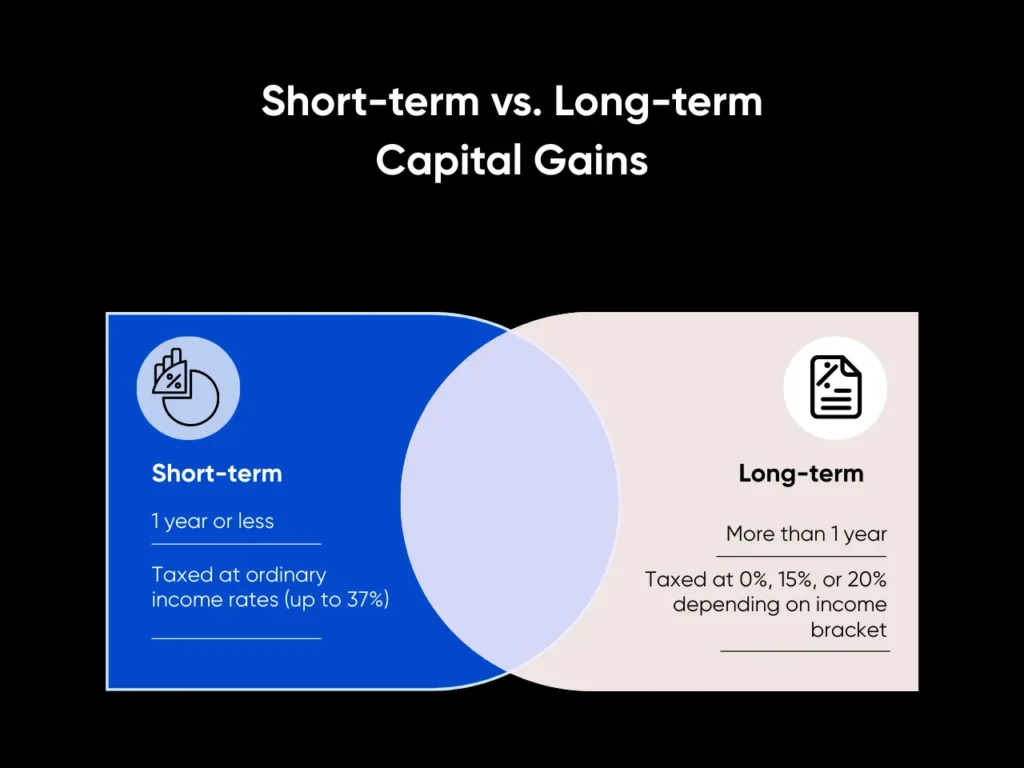
- Short-term capital gains: Apply to properties held for one year or less. These gains are taxed at your ordinary income rates, which can be as high as 37% for top earners.
- Long-term capital gains: Apply to properties held for more than one year. These receive lower rates of 0%, 15%, or 20%, depending on your income bracket.
A key detail is that the one-year holding period is measured to the day, meaning you must hold the property for more than 365 days. For example, if you bought a Houston rental property on July 1, 2024, you would need to wait until July 2, 2025, at the earliest to qualify for long-term capital gains.
Leap years lengthen the waiting period by one day. If you purchased the property on July 1, 2023, and intend to sell in 2024 (a leap year), you would still need to wait until July 2, 2024, to meet the holding period requirement, even though there are technically 367 days between those two dates.
Selling even a day early can cause a huge increase in your tax liability. Federal income tax brackets are more granular than federal capital gains tax. A $300,000 capital gain with $150,000 annual income will cost $106,240 as short-term capital gains, but only $54,500 as long-term capital gains.
Federal Tax Brackets and Rates
Long-term capital gains are taxed at rates of 0%, 15%, or 20%, depending on your total realized gain. This gain is “stacked on top” of your regular income, meaning that your income is counted first, and capital gains are counted where your regular income left off.
However, your ordinary income is only used to determine which capital gains tax bracket you fall into; it’s taxed separately according to the federal income tax rates and brackets of the filing year.
Capital gains tax bracket thresholds for the tax year 2025:
| Rate | Single | Married filing separately | Married filing jointly or qualifying surviving spouse | Head of household |
| 0% | $48,350 | $48,350 | $96,700 | $64,750 |
| 15% | $48,351 – $533,400 | $48,351 – $300,000 | $96,701- $600,050 | $64,751- $566,700 |
| 20% | >$533,401 | >$300,001 | >$600,051 | >$566,701 |
To help you visualize how long-term capital gains are taxed, let’s say you make $100,000 a year, and you make a $500,000 capital gain:
- The $100,000 regular income goes into the capital gains tax brackets first. It fills up the $48,350 in the 0% bracket, and spills over into the 15% bracket.
- The remaining $51,650 takes up space in the 15% bracket. Since it goes from $48,351 to $533,400, that leaves enough space for $433,400 before it fills up. Anything exceeding that will spill over into the 20% bracket.
- Since your total realized gain is $500,000, it will fill up the remaining $433,400 and spill over into the 20% bracket. $500,000 – $433,400 = $66,600.
- Therefore, $433,400 of your gain will be taxed at 15% ($65,010), and $66,600 of it will be taxed at 20% ($13,320). This makes your total federal tax liability $78,330, before surtaxes and state and local taxes.
Disclaimer: This is a simplified estimate based on the tax brackets for the 2025 tax year. This estimate does not account for deductions, credits, or other taxes. Your actual tax liability can vary depending on your complete financial situation. Please consult a licensed tax professional or financial advisor for an accurate representation of your tax liability.
Calculating Your Basis
Your basis is the starting point for determining how much of your sales price is taxable gain. The IRS defines it as what you paid for the property, adjusted for certain costs and improvements. For real estate investors, basis typically includes:
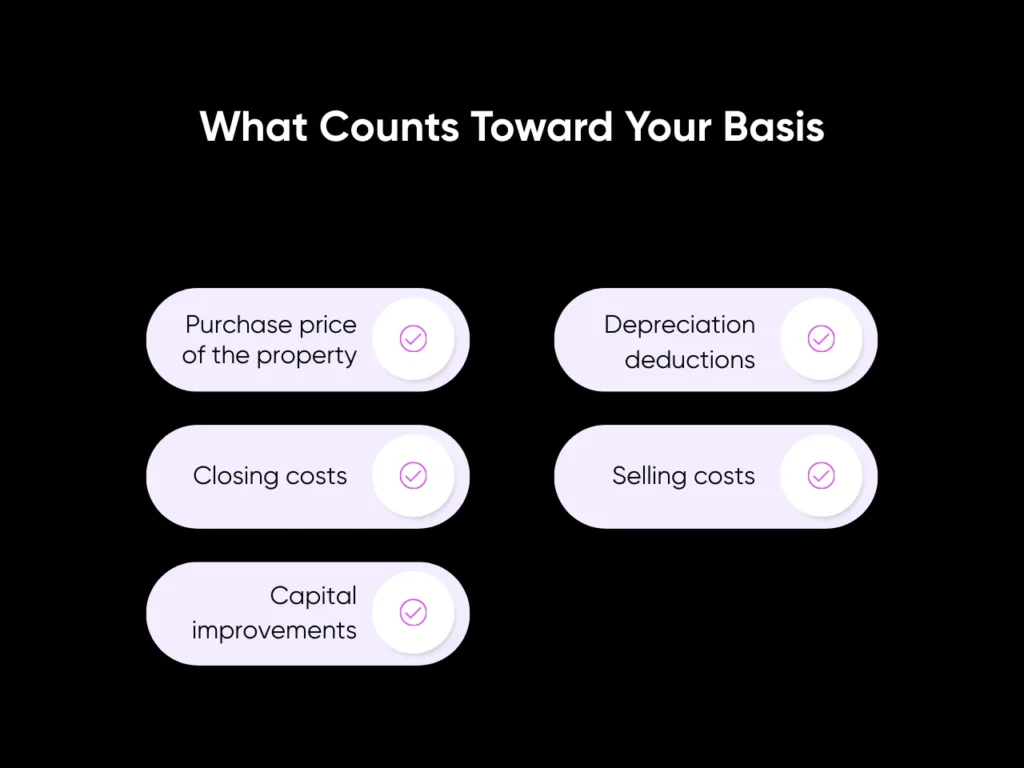
- Purchase price of the property: This is the cost of purchasing the property, whether it’s in cash or through financing, including any debt you assume upon transfer of ownership.
- Closing costs: These include title fees, legal and accounting expenses, and recording fees. However, they can also include sales tax, installation and testing, excise taxes, revenue stamps, logistics fees (if applicable), and any real estate taxes assumed for the seller.
- Capital improvements: These include additions, remodels, and major upgrades like new roofs, HVAC systems, room additions, or landscaping that adds value or extends the property’s life.
- Depreciation deductions: The total amount of depreciation claimed over the years. Unlike the other adjustments, this will reduce basis, not add to it.
- Selling costs: Real estate commissions and marketing fees can also contribute to the cost basis.
Here’s a simple example. Let’s say you purchase a Dallas duplex for $400,000. You then incur the following cost basis adjustments:
- Closing costs: $10,000
- Renovations: $40,000
- Depreciation taken over 5 years: –$20,000
- Realtor commission and other selling expenses: $24,000
- Final sales price: $600,000
Adjusted basis before sale = $400,000 + $10,000 + $40,000 – $20,000 = $430,000
Taxable gain = $600,000 – $430,000 – $24,000 = $146,000
Every dollar added to the cost basis reduces taxable gain. To make sure your renovations and other costs count towards your cost basis, remember to keep meticulous records of all improvements and expenses..
Texas’s Unique Tax Advantage
Texas is one of only 9 states in the US that have no state-level capital gains tax. While every investor must still pay capital gains tax on the federal level when selling property, Texas residents avoid the sizable extra layer of taxation that states like California, New York, and Oregon impose.

Constitutional Protection
Texas has no state income tax, and by extension there is no capital gains tax in Texas. However, a Texas capital gains tax can still be a possibility in the future through an amendment to Texas state law.
This is why Texas Proposition 2 was put on the ballot for November 4, 2025. If approved, there will be an amendment that explicitly prohibits the state from ever imposing capital gains tax on individuals, estates, or trusts through a future constitutional amendment. Since capital gains are considered income, this effectively locks in Texas’s no-tax status for the long term.
How Texas Compares to High-Tax States
With the absence of state capital gains tax, the savings Texans enjoy are substantial. Let’s look at the total tax obligation in high-tax states to compare:
- California: Investors face a state income rate of up to 13.3% on top of federal capital gains tax rates. In California, capital gains are taxed like regular income on the state level, meaning if you make $150,000 a year and make $500,000 in capital gains, you will pay income tax for $650,000. This pushes you up to California’s 12.3% bracket, the second-highest one. Your total obligation: $148,683.
- New York: Similar to California, capital gains are also taxed at the same rate as state income tax in New York. However, NY tax brackets only go up to 10.9%. Given the same income figures above, a total income of $650,000 will fall into New York’s 6.85% tax bracket. This equates to a total obligation of $130,980. However, if you live in NYC itself, you also have to pay local income taxes, increasing your tax bill to $150,360.
All of that on top of the ~$98,000 federal tax liability you would get for a $500,000 capital gain. In contrast, Texas investors only owe federal capital gains tax, which maxes out at 20% plus the 3.8% Net Investment Income Tax (NIIT) for high earners.
For investors managing large portfolios, these differences compound over time, potentially freeing up hundreds of thousands of dollars for reinvestment.
Implications for Investors
Because Texas property owners keep more of their profits, they have more flexibility to:
- Reinvest into additional properties.
- Pay down existing mortgages faster.
- Fund renovations or expansions that increase rental income and property value.
The first of those is arguably the most impactful for your bottom line. With a larger profit pool, you can fuel rapid portfolio expansion. Defy’s DSCR loans are perfect for this; with no hard cap on the number of properties you can finance, you can scale at your own pace without the constraints of traditional lending.
Tax Planning for Texas Property Investors
Several techniques exist to preserve as much of your investment returns as possible as a Texas property investor. These include the transfer of a capital asset, conducting improvements that raise your property’s sale price, and deducting losses from other investments.

1031 Exchange Strategies
A 1031 exchange allows you to defer capital gains tax by reinvesting the proceeds from one investment property into another of equal or greater value. To qualify:
- The replacement property must be identified within 45 days of the sale.
- The transaction must close within 180 days.
- Both properties must be for investment or business use (not a primary residence).
- Sale proceeds must be held by a qualified intermediary; you cannot take possession, and all proceeds must be fully reinvested to avoid taxable “boot.”
Let’s say you have a Dallas rental home you bought for $550,000. Instead of selling it, you decide to trade it for an $800,000 San Antonio apartment building. By following the 1031 rules, you’ve technically gained $250,000 without having to pay capital gains until you make a final sale. If you make similar trades further down the line, you can keep compounding value until then.
It’s important to note that 1031 exchanges only delay taxes; you’ll still pay the amount you would have paid if you had simply sold the properties in your 1031 chain. The difference is in the immediate capital gains tax obligation. Let’s look at some examples:
If you purchase a home for $350,000 and sell it normally for $550,000, you have to pay capital gains on the $200,000 return. If you make $150,000 a year, that amounts to a liability of around $30,000 before adjustments. That immediately reduces the amount you have available to reinvest; instead of having $550,000 on hand, you’ll only have $520,000.
By contrast, swapping a $350,000 property for a $550,000 one means you’ll have a $550,000 value to trade with by the next swap. And if we factor in unrealized capital gains in the form of property appreciation, it could even be more.
Tax-Loss Harvesting
If you have other investments, you can use tax-loss harvesting to offset gains. Selling underperforming assets at a loss can directly reduce taxable capital gains from home sales. For instance, if you realize a $200,000 gain from selling a Houston duplex but also realize $50,000 in losses from selling stocks, your taxable income drops to $150,000.
However, timing matters. You must realize losses in the same tax year as your gains. Good documentation is also essential in case of an IRS audit.
Also note that losses from rental real estate are generally treated as passive activity losses, which under IRS rules can usually only offset passive income. There are exceptions, such as the $25,000 special allowance for active participants with incomes under $100,000, but rental income will generally not affect your capital gains tax liability. For that, you will have to rely on a different type of asset such as stocks, bonds, or mutual funds.
Property Improvements
One of the most overlooked strategies for reducing taxable gains is reinvesting in your property, otherwise known as capital improvements. These increase your basis, which lowers your taxable gain. Improvements can include:
- Major renovations: Such as kitchen or bathroom remodels.
- Structural additions: A garage, new floor, or extension.
- Energy-efficient upgrades: Improvements that decrease your carbon footprint, such as solar panels and more efficient lighting and HVAC systems.
For example, if you spent $60,000 improving a vacation rental in Galveston, that amount is added to your basis, effectively reducing your taxable gain when you sell.
At Defy, you have a wealth of options to fund improvements, from bank statement loans to asset depletion loans to let you qualify using your overall liquidity. If you own rental properties, you can also tap into their stored equity using a DSCR cash-out refinance.
Special Situations and Exceptions
Aside from the above financial planning techniques, there are also special circumstances that can reduce your overall tax burden even further. These include:
Primary Residence Rules
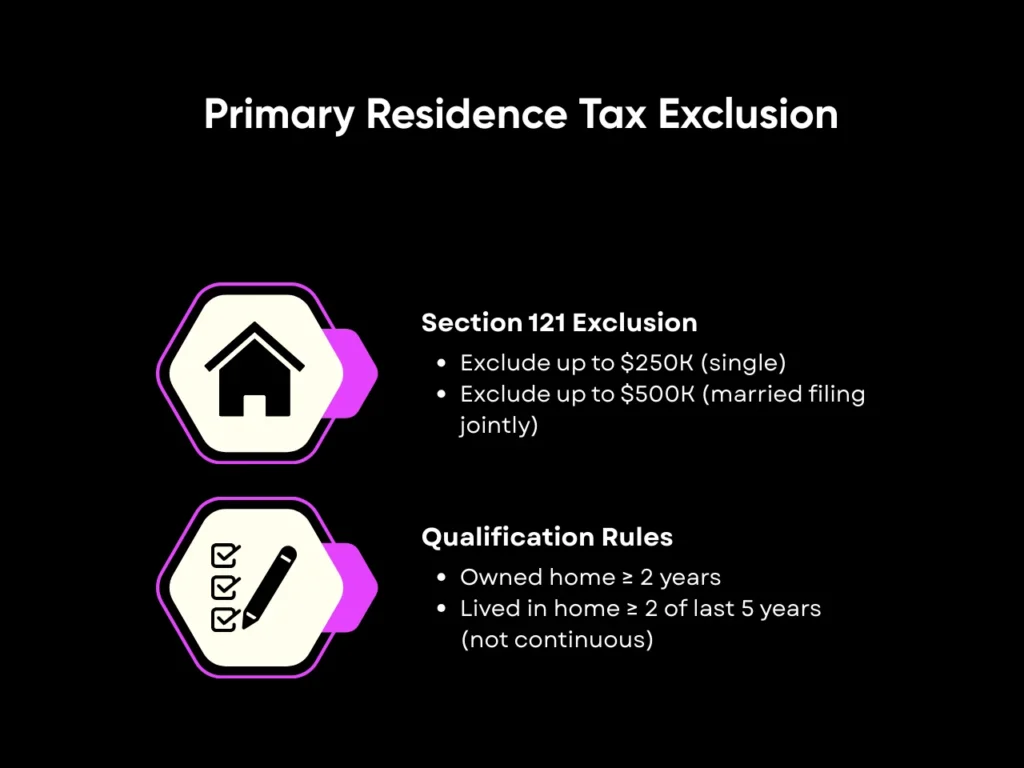
If you sell a property that was your primary residence, you may qualify for Section 121 exclusion. Under Section 121 of the Internal Revenue Code, you can exclude up to $250,000 of capital gain if you’re a single filer, or up to $500,000 if married filing jointly.
To qualify, you must pass the ownership and use tests:
- You must have owned the property for at least two years.
- You must have lived in it as your main home for at least two of the past five years. However, these two years don’t have to be continuous.
For example, say you live in Fort Worth, and you decide to turn your primary home into a rental because you’re moving away. To qualify for Section 121 inclusion, you must sell the property within three years of it becoming a rental to be considered to have lived in the home for at least two of the past five years.
Otherwise, you will have to move back into the property and make it your primary home again. But since the two-year requirement doesn’t have to be continuous, you can stay in a property for one year, rent it out for three years, move back in, and stay for one final year before selling it to claim Section 121 exemption. However, if it has been more than three years since you’ve lived in the property, you will have to stay for at least two years to fulfill the ownership and use tests.
If the home was valued at $750,000 at the time of sale, you’ll only have to pay tax on $250,000 of that if you’re married and file taxes jointly with your spouse.
Inherited Property
Inherited real estate receives a stepped-up basis, meaning the property’s basis is adjusted to its fair market value at the date of death of the previous owner. This can drastically reduce taxable gains if the property has appreciated significantly.
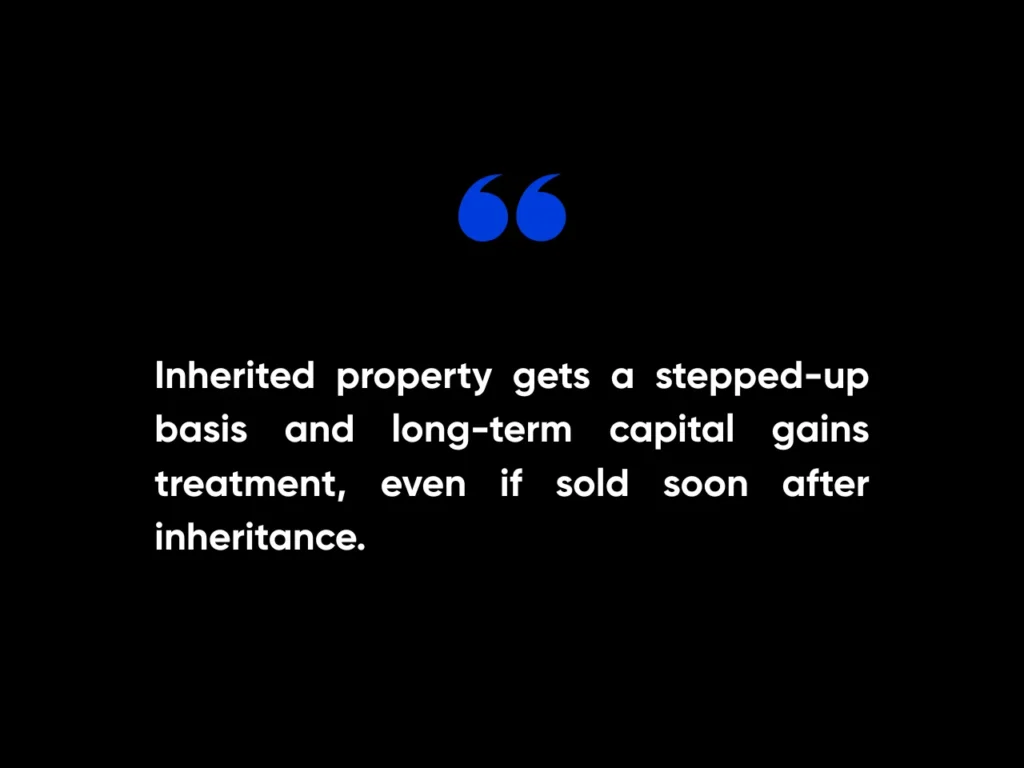
According to IRC § 1223(9), heirs automatically qualify for long-term capital gains treatment, even if they sell shortly after inheriting.
Example: Your relative purchased a property decades ago for $100,000. In their will, they bequeathed this property to you. It is now worth $600,000. Because of the stepped-up basis rule, this new fair market value is considered to be the property’s cost basis. This means that if you sold the property for $610,000, the taxable gain is only $10,000, not $510,000. You’ll be able to pocket $600,000 completely tax-free.
This provision is especially beneficial for Texas families transferring investment property across generations, since Texas also has no state estate tax to worry about. And if Proposition 2 passes, future state lawmakers would be permanently barred from imposing a capital gains tax on inherited property, ensuring heirs are shielded from any state-level erosion of value.
Conclusion
Lacking a state-level capital gains tax, Texas is one of the best states for long-term real estate investment. And once Proposition 2 is passed, this advantage will be secured for estates and trusts for generations to come, creating unmatched certainty for wealth transfer planning.
If you intend to make Texas your home to enjoy these benefits, remember that strategies such as 1031 exchanges, tax-loss harvesting, property improvements, and Section 121 exclusions can all help maximize the gain you get out of your portfolio.
At Defy, our specialized financing tools give investors the flexibility to execute these strategies effortlessly. From DSCR loans with no property cap to asset depletion loans for those with a healthy asset portfolio, each of our investment property loans is purpose-built to help you scale your real estate wealth while keeping more of what you earn.
If you’re a mortgage broker, Defy also has a TPO business. Defy TPO can equip you with Defy’s competitive products designed for unconventional borrowers, giving you unparalleled access to a slice of the market that traditional lenders can’t touch. This can be just what you need to set yourself up for long-term market dominance.
Curious about how it all works? Send us your pricing scenarios or hop on our AI Pricer for a quick quote.
FAQs
Does Texas have a state capital gains tax in 2025?
No, Texas has never imposed a state capital gains tax. And in 2025, Proposition 2 will be decided on. If the majority votes yes, any future amendment to impose income taxes on individuals, estates, and trusts will be constitutionally prohibited. With no state capital gains tax, Texas investors are only responsible for the federal capital gains tax. This can lead to tens of thousands in savings compared to high-tax states like California or New York.
Should I establish Texas residency specifically for capital gains tax benefits?
Most states require new residents to exhibit a certain level of commitment to ensure that your intent to stay is genuine. In Texas, this can involve obtaining a Texas driver’s license, registering to vote in the state, updating your mailing address, and spending the majority of your time in Texas.
Should I focus my real estate investments in Texas to maximize tax benefits?
Texas is highly favorable for investors due to its lack of state income and capital gains taxes, as well as its strong job growth. In recent years, its major real estate markets, such as Dallas, Austin, and Houston, have been on a steady upward growth trend as well. But while its tax benefits are a strong incentive, it’s also wise to diversify and tailor your investment strategy to your specific circumstances. With Defy’s DSCR loans, you can easily establish a portfolio of income-producing properties in 37 states.
Can I use the tax savings from Texas’s advantages to invest in more properties?
Absolutely. The money you save from the lack of state taxes can be reinvested into additional properties to fuel portfolio growth.
How does Texas compare to other no-capital-gains-tax states?
Texas’s main edge compared to the 8 other states with no capital gains tax is relatively more affordable real estate. In Florida, for example, the average home price is around $378,000 as of early September 2025, while in Texas, it’s at $300,000. This lower cost of entry allows investors to acquire larger or multiple properties, which could increase rental income potential or speed up portfolio expansion.