


For real estate investors, every percentage point counts when it comes to profit. This is why tax-friendly states like Florida are incredibly popular. But even in tax havens like Florida, your holding period, income level, depreciation recapture, and surtaxes can swing your net proceeds more than you might expect. This is especially true for vacation rentals and condos, which often carry higher HOA dues and stricter rules on property use.
At Defy, we specialize in creative solutions to complex financing problems. DSCR loans can fuel indefinite portfolio expansion with just your property’s cash flow. If you’re a retiree, asset depletion loans can allow you to secure financing using liquid assets, like mutual funds and your retirement account, instead of conventional forms of income. Whatever your investment strategy, we’ve got the tools to see it through.
In this guide, we’ll tell you all you need to know about capital gains tax Florida. From how federal rules on long- vs. short-term gains actually apply to your sale, to the Florida-specific factors like homestead exemptions, documentary stamp taxes, and rising condo and vacation rental costs that affect your bottom line. By the end, you’ll walk away with Florida-focused examples that will enable you to estimate impact and choose the right path quickly.
Let’s dive in.
Disclaimer: This article is for informational purposes only and should not be considered tax advice. Always consult a licensed tax professional for guidance specific to your situation.
Understanding Federal Capital Gains Tax Basics
The capital gains tax Florida is a great opportunity for investors to tap into, but the federal taxes still apply. Your federal tax liability will depend on factors such as how long you hold an asset, how much you make per year, depreciation, etc.
To plan effectively, you need to understand the following:
- Short- vs long-term capital gains
- Federal tax brackets, and how gains “stack” on top of ordinary income
- Special tax rules that can add or subtract from your tax obligations
Short-term vs. Long-term Capital Gains
The holding period of an asset determines how it’s taxed. An asset sold after holding it for only one year or less is considered a short-term gain, and is taxed at the ordinary income tax rate. If you hold it for longer than one year, it qualifies for long-term capital gains rates, which tend to be lower.

To illustrate:
- Let’s say you bought a rental property on July 1, 2024.
- Since 2024 was a leap year (366 days), you would need to have held it for at least 366 days to qualify for long-term capital gains. Because there are only 365 days between July 1, 2024 and July 1, 2025 (2025 is not a leap year), if you sell on July 1, 2025, your gain will be taxed as short-term capital gain.
Let’s say you earn $150,000 a year. This means that selling a property one day short of the long-term gains threshold can result in your profit being taxed at your marginal tax bracket (24% to 32% as a single filer in 2025), rather than the long-term capital gains tax of 15%.
Federal Tax Brackets and Rates
Long-term capital gains rates are 0%, 15%, or 20%, depending on your income. Keep in mind that any capital gains are stacked on top of your regular income.
Here are the thresholds for each bracket for the tax year 2025:
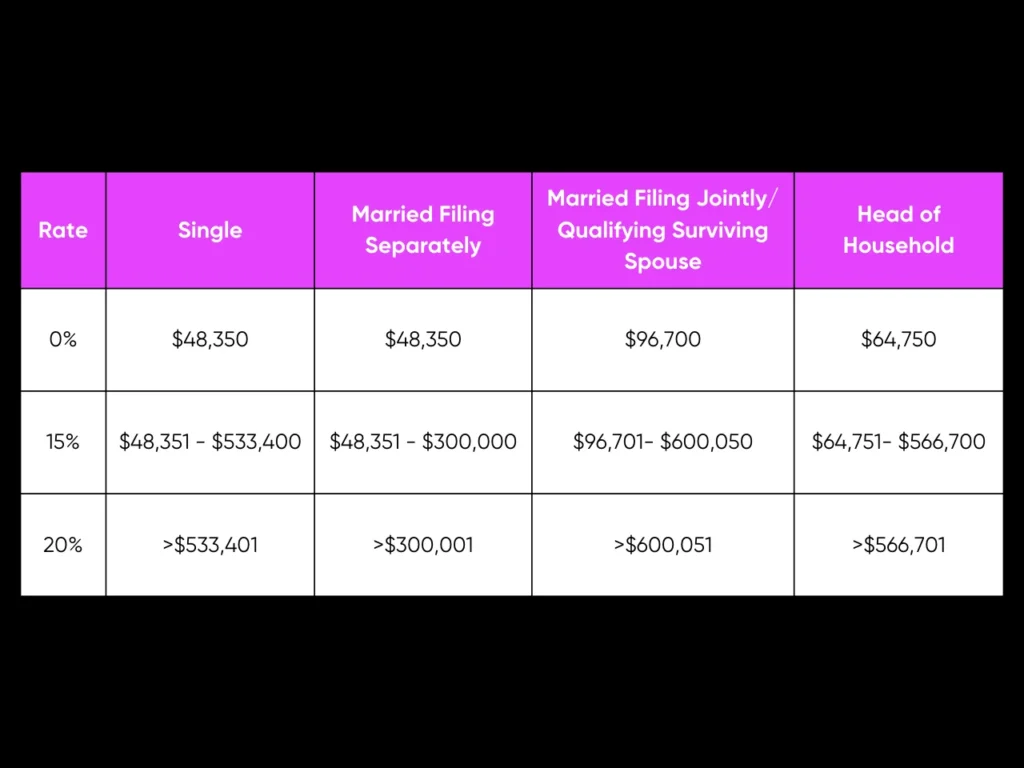
If you make a $100,000 profit from a sale in a year where you received an annual salary of $150,000 as a single filer, your capital gains tax will be calculated as follows:
- First, stack your profit on top of your regular income. In this case, it will be $250,000. This is to determine which brackets you land in.
- $250,000 falls into the 15% bracket, which means that the profit that you received will be taxed at 15%.
- Please note that the bracket in this chart only applies to long-term capital gains. Although used to calculate your bracket for LLPG, your salary will be taxed according to the federal income tax rates and brackets.
Disclaimer: These examples are simplified estimates based on the tax brackets for the 2025 tax year. They do not account for deductions, credits, or other taxes. Actual tax liability can vary depending on your complete financial situation. Consult a licensed tax professional or financial advisor for personalized advice.
Special Considerations
Aside from federal income and capital gains taxes, certain additional federal surcharges and rules can impact your overall tax liability when selling assets at a profit:
- Net Investment Income Tax (NIIT): The Net Investment Income Tax rate of 3.8% is an additional surtax imposed on high earners. It applies when modified adjusted gross income exceeds $200,000 for single filers or $250,000 for married couples filing jointly.
- Collectibles: Tangible personal property like art, antiques, stamps, coins, metals, rugs, and certain historical items are taxed at a preferential 28% long-term capital gains rate..However, this typically does not apply to real estate.
- Depreciation Recapture: If you’ve claimed depreciation on a rental property over the years, and then sold it for an amount exceeding its depreciated value, the IRS requires you to “recapture” that benefit when you sell, on the basis that the value did not drop after all. This can result in a maximum rate of 25% on the total depreciation you’ve claimed.
- Primary residence exclusion: IRC Section 121 allows exemptions up to $250,000 of gain if you’re a single filer or up to $500,000 if married filing jointly. However, you are required to live in the property for a minimum of two years for the IRS to consider it your primary residence.
Florida’s State Tax Treatment of Capital Gains
Like a few other states across the US, Florida doesn’t charge state income tax whatsoever. According to the Florida Department of Revenue: “The State of Florida does not have an income tax for individuals, and therefore, no capital gains tax for individuals.”

The advantage of this is clear: Let’s say you want to sell an investment property for $500,000, and its initial purchase price was $350,000. If you’re single without dependents earning $150,000 a year, that $300,000 total taxable income falls under the 15% federal tax bracket. Let’s compare your total tax liability in Florida versus a state with state-level capital gains tax, like California:
- In Florida, you only owe federal income tax. $48,350 of your total income is tax-free, leaving $251,650 to be taxed under the 15% bracket. That’s a $37,747.50 tax obligation.
- Selling the same property in California results in the same $37,747.50 in immediate capital gains tax, plus state tax. Capital gains in California are taxed at ordinary income rates, so your $300,000 taxable income falls into their 9.3% income tax bracket. That means a state tax obligation of up to $28,691, raising your total capital gains tax liability to $66,438.50.
That $28,691 stays in your pocket if you’re a Florida resident. This advantage is especially valuable for retirees and business owners who relocate to Florida. With no personal income tax, no state capital gains tax, and no state estate tax, Florida allows investors to preserve more wealth across generations.
Defy’s investment financing tools like jumbo loans and DSCR loans are great for leveraging Florida’s favorable tax climate. With a much lower tax drag, you have much more free rein to grow portfolios and accrue investment returns more efficiently.
Special Considerations for Florida Real Estate Capital Gains
While you don’t have to pay state-level capital gains tax in Florida, real estate sales still trigger federal capital gains rules and Florida-specific transaction costs at closing that can affect your net proceeds. Watch out for the various tax implications when selling a home in Florida.

Primary Residence Exemption
On the state level, Florida exempts homeowners from a portion of property tax through its homestead exemption, which provides both property tax relief and creditor protection. For property taxes, the exemption reduces the assessed market value of your primary residence by up to $50,000, lowering your annual tax bill. For example, if your primary home in Florida is valued at $300,000, you only have to pay tax on $250,000.
Unlike the federal-level tax exemption on primary residences, there is also no specific time period for which you have to reside in Florida to claim this exemption. This can save you a significant amount of money if your strategy is to use one of the homes that you’re holding in your portfolio as your Florida domicile as well.
Investment Property Considerations
Investment properties don’t qualify for the homestead exemption. This includes multi-unit properties that the owner rents out while living in one of the units themselves. According to the Florida Senate, the exemption “…applies only to those parcels classified and assessed as owner-occupied residential property or only to the portion of property so classified and assessed.”
1031 Exchange Opportunities
An important technique in Florida investors’ toolkit is the 1031 like-kind exchange, so named because it involves exchanging a property for a similar, but slightly more highly-valued property in lieu of selling it. Since it’s not a sale, you will not be charged federal capital gains tax for the exchange, but you still get a net gain thanks to the more valuable property. Repeating this essentially allows you to defer capital gains indefinitely, until you decide to make the final sale and cash in your gains.
For example, say you have an Orlando rental valued at $350,000, and you find the owner of a Tampa apartment building valued at $400,000 willing to switch with you. Barring external factors, you’ve essentially made a net gain of $50,000 without actually selling, therefore not making any real capital gain. However, keep in mind that the IRS recognizes this “loophole” and has implemented rules for the timing and identification of like-kind exchanges, such as identifying the replacement property within 45 days of the sale, and closing on the replacement property within 180 days of the sale.
Transaction Costs at Closing
While Florida avoids state income and capital gains taxes, real estate transactions still involve several costs that reduce your net proceeds. These charges are not technically “taxes” on gains but can significantly affect how much you walk away with after a sale.
- Doc stamp taxes: Florida imposes a documentary stamp tax (commonly called “doc stamps”) on the transfer of real estate. This is essentially a tax on the deed itself, calculated based on the property’s sale price. The rate is $0.70 per $100 of value in most counties, meaning a $500,000 sale will cost $3,500 in doc stamps, regardless of the profit.
- Title insurance and recording fees: Sellers are also responsible for providing clear title to the buyer. This involves purchasing owner’s title insurance. Title insurance premiums in Florida are state-regulated, typically costing between $500 and $3,500 depending on the sale price. Recording fees, on the other hand, run around $10 for the first page and $8.50 per additional page.
- Broker commissions: Real estate commissions are often the single largest transaction cost aside from capital gains taxes. In Florida, the standard commission is typically 5%–6% of the sale price, split between the listing agent and buyer’s agent. On a $500,000 property, this means $25,000–$30,000 in commissions deducted from your proceeds.
Together, these transaction costs can reduce net proceeds by 7%–10% of the sales price, even before federal capital gains taxes are applied. Remember to account for them in advance when calculating expected profits.
Tax Planning Strategies for Florida Investors
Although Florida is famed for its lack of income tax, it’s also known for higher insurance, HOA, and maintenance costs, which continue to rise in 2025. These costs can compress your ROI and force hard choices on whether to sell, hold, or use a 1031 exchange. At the same time, shifting mortgage rates and cap rates reshape buyer pools and pricing, so your tax plan should be aligned with the current market you’re selling into, not last year’s conditions.
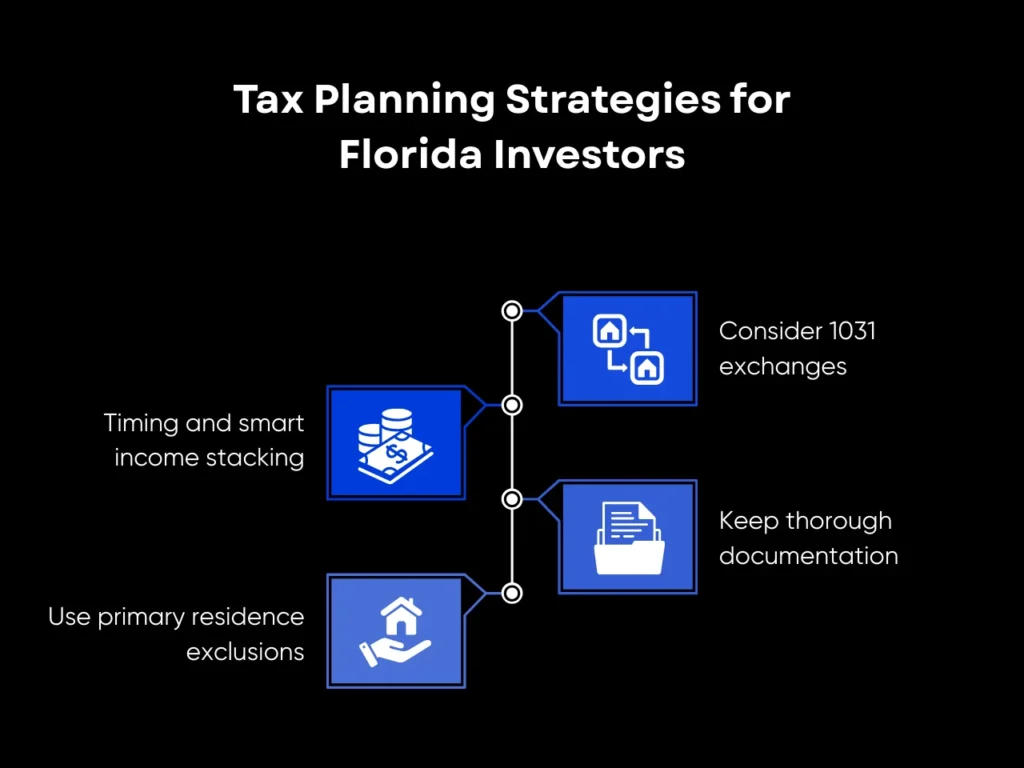
- Timing and smart income stacking: Holding property for more than 12 months is essential to claim the lower rates of long-term capital gains. But you can also aim for a lower tax bracket by timing your sales during years when your overall income is low. If you typically make $100,000 a year from all sources, a $450,000 gain would put you in the 20% LTCG band. But selling during a year in which your income was at least $20,000 lower could allow you to avoid hitting the 20% bracket and stay within 15%.
- Take advantage of primary residence exclusions: Consider using one of the properties in your portfolio as your primary Florida home as well. Once you sell it, Section 121 exclusion lets you discount up to $250,000 from your federal capital gains tax liability as a single filer or $500,000 as a married couple filing jointly. While you’re holding your property, Florida’s homestead exemption lets you knock off $50,000 from your home’s taxable value.
- Consider 1031 exchanges: Deferring capital gains through a 1031 lets you reinvest in larger or better-located properties without losing capital to taxes. Paired with primary residence exclusions, this can result in significant federal tax savings by the final sale. Jumbo loans are particularly suited for this strategy, giving you a headstart on your chain of 1031 exchanges with a high-value property. Meanwhile, you can keep growing your portfolio with DSCR loans, which have no hard cap and base approval on the property’s cash flow, not yours.
- Keep thorough documentation: Essential documentation for Florida’s various tax exemptions includes your recorded Declaration of Domicile and proof of Florida residency. Remember to keep occupancy records for Section 121 exemption as well. It’s also wise to keep meticulous records of purchase dates, depreciation schedules, improvements, and residency. These records can defend your tax position during audits and maximize your exclusions.
Common Mistakes and Pitfalls to Avoid
Even seasoned investors can misproject their capital gains tax. Make sure you avoid these common pitfalls when selling in Florida:
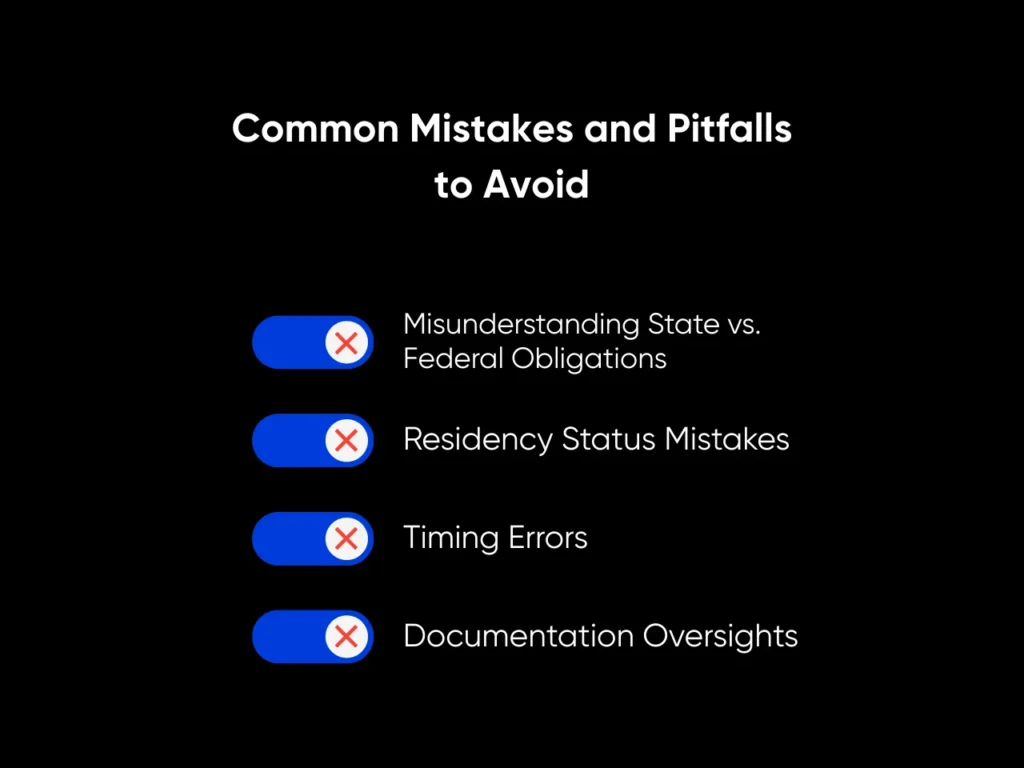
- Misunderstanding state vs. federal obligations: Be sure not to confuse federal and Florida-specific tax rules. Homestead exemptions and documentary stamp taxes are local to Florida, while capital gains taxes and Section 121 are strictly federal.
- Residency status mistakes: Failing to properly establish Florida residency can leave you exposed to your previous state’s capital gains tax. Florida requires that you file a formal Declaration of Domicile to the Clerk of Courts in order to be considered a full Florida resident for tax purposes. You also have to maintain a physical Florida mailing address, not a PO Box, register to vote, obtain a driver’s license, title your vehicles in Florida and use a Florida address on all legal paperwork.
- Timing errors: Remember, while Florida doesn’t impose a minimum stay period for your primary home, the federal government requires you to have resided in your domicile for at least 2 of the 5 years prior to the sale date to be eligible for the Section 121 exemption. Watch out for confusion with leap years: as in the above example, the number of days between July 1, 2024, and July 1, 2025, was only 364, as there were 366 days in 2024.
- Documentation oversights: Poor record-keeping around improvements, depreciation, or residency can reduce exclusions or trigger higher tax rates. Make sure to track all major improvements and dates, maintain depreciation schedules accurately, and have proof of personal residency handy. 1031 exchanges are particularly sensitive to documentation lapses, since the IRS requires strict proof of both intent to hold the property for investment and compliance with identification and closing deadlines (45 days to identify a replacement property, 180 days to close).
Conclusion
The absence of capital gains tax Florida is a major advantage for investors, but federal rules still apply, and they can significantly impact your net proceeds. Understanding short- vs. long-term rates, exemptions like Section 121, and deferral strategies such as 1031 exchanges is essential for anyone managing a portfolio in the Sunshine State.
With strong markets in Miami, Tampa, and Orlando, the opportunities are plentiful. If you’re planning your next move in Florida real estate, the right financing product from the right investment property lender can help you keep more of your gains working for you. At Defy Mortgage, we help investors make smarter financing decisions that align with their tax strategies, whether you want to capture luxury buyers migrating into Florida markets using jumbo loans or use DSCR products to scale portfolios of condos and vacation rentals using rental income alone.
If you’re a mortgage broker, those same perks can work just as well for you. By helping your clients navigate both financing and tax considerations, you strengthen your role as a trusted financial advisor and build deeper, longer-term relationships. Florida’s advantages as a tax haven pair well with Defy’s non-QM solutions, including jumbo loans and DSCR loans. Partnering with Defy TPO gives you access to all of these and more.
Send us your pricing scenarios and we’ll show you just how much you can win by leveraging our products, or try our AI Pricer for a quick quote.