


On July 10, 2025, Missouri became the first US state with an individual income tax to completely eliminate capital gains taxation. The landmark House Bill 594, signed by Governor Mike Kehoe, allows individuals to deduct 100% of federally reported capital gains from Missouri taxable income retroactively starting January 1, 2025. This is expected to save high-net-worth individuals tens of thousands of dollars with each sale and position Missouri as a premier destination for optimizing wealth.
At Defy Mortgage, we’re making wealth optimization accessible for investors of all income levels. From DSCR loans for those with unconventional incomes to asset depletion loans for high-net-worth individuals, we’ve got the tools to make your investment goals a reality, no matter how complex your financial situation.
In this blog, we’ll break down what the elimination of Missouri capital gains tax means for you, and share strategies you can use to maximize your tax savings. From timing major asset sales to restructuring your business and maximizing reinvestment efficiency with DSCR loans, we’ll show you how to turn Missouri’s historic move into a springboard for long-term wealth-building.
Missouri’s Capital Gains Tax Elimination: What Changed and When It Takes Effect
House Bill 594 subtracts 100% of all federally reported Missouri capital gains tax derived from adjusted gross income. This includes both short-term gains (assets held less than one year) and long-term gains, covering virtually all forms of income-generating asset previously taxable in the state of Missouri:
- Stocks
- Bonds
- Mutual funds
- ETFs
- Real estate, including primary residences and investment properties
- Business ownership interests
- Cryptocurrency
- Carried interest for fund managers
- Collectibles

And all other capital assets as defined by federal tax code. Previously, the capital gains rates in MO reached as high as 4.7%, the same as the state income tax. Now it’s at 0%.
Unlike many income tax deductions that phase out at higher incomes, Missouri’s capital gains elimination has no limits or caps on the capital gains income, or asset type restrictions, making it equally valuable for middle-class retirees selling a family home and billionaire entrepreneurs exiting businesses.
What This Means For Missouri Investors
HB 594’s immediate retroactive application to January 1, 2025 means that any capital gains realized in the tax year 2025 (January 1, 2025 through December 31, 2025), will be able to qualify for the exemption.
However, although capital gains tax obligations have been eliminated in the state of Missouri, federal capital gains taxes still apply. Long-term gains will continue to be taxed at 0%, 15%, or 20% depending on income levels, while short-term gains face ordinary income rates up to 37%. High earners still face the additional 3.8% Net Investment Income Tax on gains above $200,000 for singles or $250,000 for married couples.
Consider a Missouri entrepreneur selling a business for a net profit of $500,000. Previously, at 4.7% capital gains tax, they would pay $23,500 to Missouri. This is in addition to $150,000 in federal long-term capital gains, at 15% capital gains tax for incomes not exceeding $518,900. This comes up to a total of $173,500. Under the new law, only the $150,000 federal obligation remains. This is nearly 14% off the total tax burden in this hypothetical case.
Let’s look at another example. Let’s say you purchased an investment property for $250,000 in Missouri and then sold it five years later for $500,000. With no capital gains, this means that you’d pay $0 in state capital gains tax on that $250,000 profit.
- Pure Profit Preservation: On a $250K gain, you could save $10,000-$25,000+ in state taxes
- Faster Flips: Real estate investors can flip faster without timing constraints, more transactions = MORE $$$
- Portfolio Expansion & Diversification: Keeping 100% of gains means bigger down payments on your next property with zero tax bleeding and tax penalty concerns
Residency Planning: Increasing Your Tax Savings Through Proper Missouri Establishment
Meeting the proper standards for Missouri tax residency is essential for ensuring you get the new tax benefits. Keep these factors in mind:
Passing Residency Tests
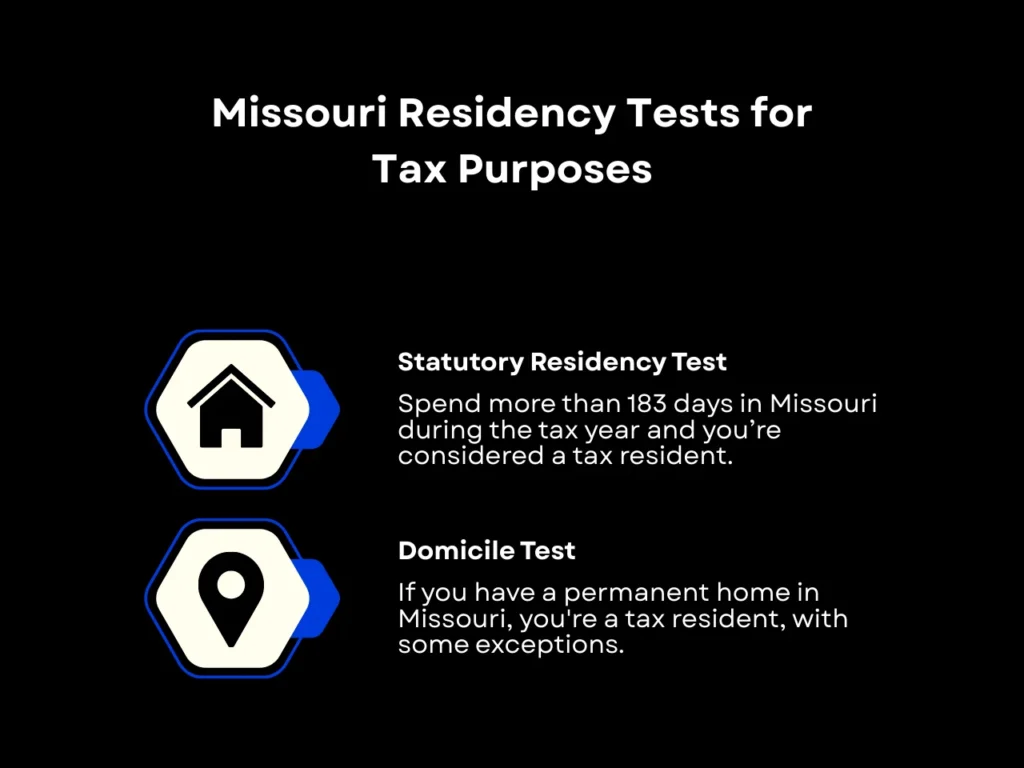
Missouri employs two tests to determine tax residency. Make sure you pass at least one of these tests to ensure that you qualify for Missouri tax residency and claim the capital gains tax benefit:
- The statutory residency test: The primary residency test in many states is the 183-day rule. Any individual who spends more than 183 days in Missouri during a tax year is automatically considered a resident of Missouri for tax purposes. Any portion of a day counts as a full day for the count.
- The domicile test: As long as you maintain a permanent home in Missouri, you are considered a resident for tax purposes. Exceptions include those with no permanent Missouri residence, those who maintain a permanent residence elsewhere, and those who spent 30 days or fewer in Missouri during the tax year.
Documentation Requirements
Beyond just obtaining a Missouri driver’s license, establishing domicile in Missouri requires proving that Missouri is the place you intend to be your permanent home. Obtaining the following documentation will help reinforce that:
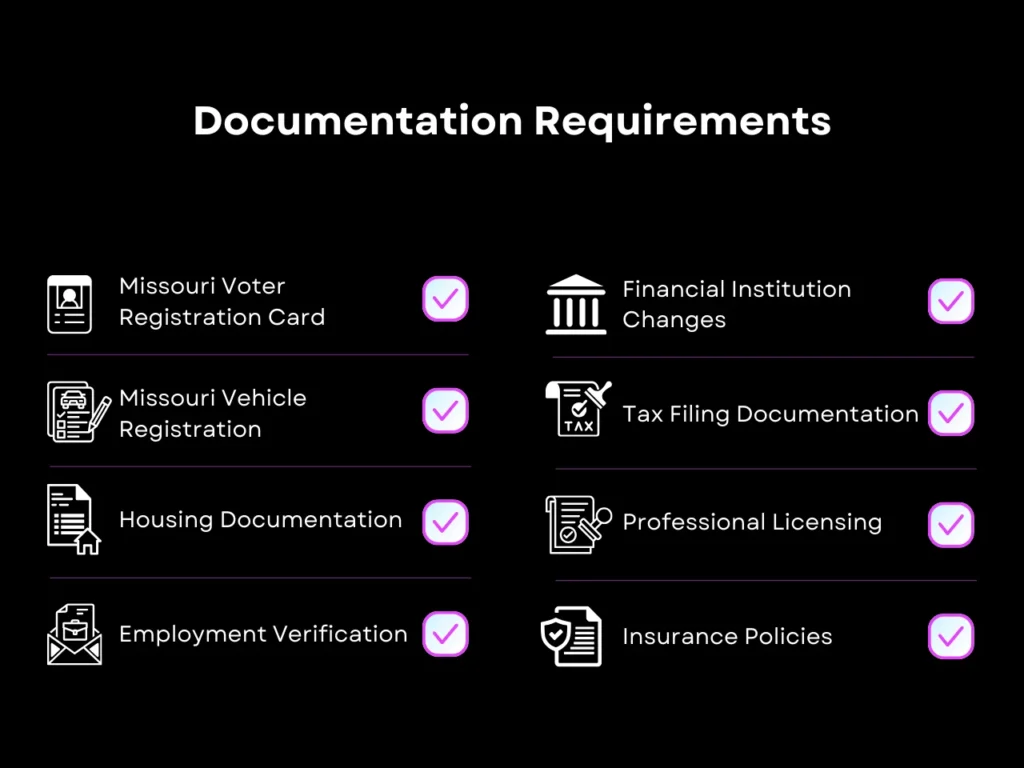
- Missouri voter registration card: Demonstrates civic engagement and intent to participate in Missouri’s political process.
- Missouri vehicle registration: Shows you’ve registered your vehicles in the state.
- Housing documentation: Either a warranty deed if you purchased a house in Missouri or a copy of your apartment lease showing permanent living arrangements.
- Employment verification: If employed, a letter from your employer on company letterhead stating you are working in a full-time, benefit-eligible position in Missouri will help.
- Financial institution changes: Bank accounts, investment accounts, and loan documents showing Missouri addresses.
- Tax filing documentation: Filing your Missouri state tax returns as a resident officially declares your tax status to the state authorities.
- Professional licensing: Any professional licenses transferred to or obtained in Missouri.
- Insurance policies: Auto, homeowner’s, or renter’s insurance policies showing Missouri addresses.
Common Pitfalls That Could Jeopardize Tax Benefits
Even after establishing domicile, there are still some common mistakes you can make that can compromise your ability to take advantage of the new tax benefits, especially if you’re not a Missouri native:

- Moving too fast: If you’re not currently a Missouri resident, relocating to Missouri and immediately selling your business or investments could ring alarm bells with your former state. It’s often best to establish residency at least 12 months before any big sales to provide sufficient proof that you didn’t just move for the tax break.
- Keeping ties with your former state: Expect an audit, especially if you’re a high earner moving from a state like California, New York, or Illinois. These states are known for their rigorous residency audits, which analyze activity such as credit card transactions. Make sure you’ve completely uprooted before making your financial moves.
- Not keeping enough documentation: You need to be able to present sufficient proof that you actually live in Missouri now, besides official documentation. This includes everything from gym memberships, toll records, and even location data from your phone.
With this landmark change in capital gains taxation, Missouri might actually be better than states with no individual income tax rate at all. Although Florida and Texas similarly have a 0% capital gains tax rate, they do charge hefty property taxes and hurricane insurance. Missouri offers a sweet spot, with zero capital gains tax for your investments and reasonable taxes on everything else. All while being able to enjoy the opportunities offered by one of the fastest-growing business centers in the Midwest.
Wealth Optimization Strategies: Timing Asset Sales and Restructuring Investments
The capital gains tax exemption Missouri offers is a big help to those looking to build up their wealth, but that help can only go so far. Maximizing the gain you can get from this benefit requires restructuring investment strategies to make the most out of this unprecedented tax advantage.

Timing Your Sale Strategically
If you own a business set up as an S-corp or LLC, you get the tax break immediately since these pass-through entities report capital gains on individual returns. But if you own a regular C-Corporation, C-Corporations won’t be eligible for the capital gains exemption in 2025. The corporate capital gains deduction takes effect in the tax year following when the rate reduction occurs.
Optimizing Business Structures For Tax-Free Growth
If you’re starting a business or considering restructuring, S-corporations and LLCs offer immediate access to Missouri’s capital gains exemption. As an added benefit, S-corp structures can also reduce self-employment taxes on business profits.
Whether you realize gains directly from asset sales or receive distributions from partnerships, LLCs, or S-corporations, Missouri’s law treats all individual capital gains equally. This means your business structure won’t affect your ability to benefit from the tax exemption.
Reinvesting To Multiply Gains Exponentially
The tax savings provided by the new law offer a fantastic opportunity for reinvestment. Say you turn a profit of $500,000 selling a property. With the 4.7% tax obligation gone, you save $23,500 in state capital gains taxes. Now you can reinvest that $23,500 you saved right away.
With DSCR loans, you can significantly boost the output of this strategy. DSCR loan terms are based on a property’s rental income potential, and there’s no hard limit on how many DSCR loans you can have active at a time. This is particularly suitable in places like St. Louis where rental demand is high. As one of the best DSCR lenders in the mortgage space, Defy can help you work out the best strategy to make sure your reinvestments align with your long-term wealth goals while maintaining a healthy cash flow.
Adjusting Your Estate Planning
The elimination of capital gains tax rewrites many of the old rules about estate planning in Missouri. For example, donating appreciated stock to charity is now less effective, as it now only affects federal capital gains tax because there is no longer any state-level capital gains tax to pay.
Missouri’s zero capital gains tax may change the timing calculus for wealth transfers. Previously, the “stepped-up basis” at death eliminated capital gains taxes for heirs. Now that Missouri doesn’t tax capital gains regardless, lifetime transfers allow beneficiaries to begin tax-free growth immediately.
Note: Estate planning strategies vary significantly based on individual circumstances. Consult with qualified tax and estate planning professionals before making any decisions.
Opportunities for Mortgage Brokers: What Financial Professionals Need To Know
As a financial professional, you have a fiduciary responsibility to ensure your clients are fully informed about significant tax optimization opportunities. One of the most substantial advantages available today involves strategic property positioning in states with favorable Missouri capital gains tax treatment and similar zero-tax jurisdictions.
Missouri stands among the select states that offer a zero state capital gains tax on real estate profits, creating substantial wealth preservation opportunities for your real estate investor clients. This Missouri capital gains tax advantage, shared with Texas, Florida, Tennessee, New Hampshire, and Wyoming, can result in significant savings on six-figure property transactions.
Your clients depend on your expertise to identify tax arbitrage opportunities that directly impact their bottom line. Failing to address Missouri capital gains tax implications and similar state-level considerations could mean overlooking tens of thousands of dollars in potential savings for each transaction.
Initiating the Missouri Capital Gains Tax Conversation
Consider implementing these professional approaches to discuss the Missouri capital gains tax and broader tax strategy with your clients:
Strategic Opening Questions:
- “Have you evaluated how Missouri capital gains tax laws could impact your investment returns compared to other states?”
- “Before finalizing your property acquisition strategy, let’s analyze the complete tax landscape, including Missouri capital gains tax advantages.”
- “Given the significant Missouri capital gains tax benefits available, would you like to explore how property location affects your overall tax liability?”
Implementation Strategy:
- Assessment Phase: Evaluate current client portfolios for Missouri capital gains tax optimization opportunities (including those clients with DSCR loans)
- Education Phase: Present clear comparisons showing Missouri capital gains tax advantages versus high-tax states
- Action Phase: Develop strategies to maximize Missouri capital gains tax benefits through strategic property positioning
Understanding Missouri capital gains tax implications is an essential fiduciary practice. Your clients’ wealth preservation depends on your ability to identify and communicate these critical tax advantages. Make Missouri capital gains tax optimization a cornerstone of your advisory approach.
Conclusion
The complete elimination of Missouri capital gains tax can have a knock-on effect that will boost Missouri’s economic output, making future investments in the state that much more lucrative.
Investors can take advantage of this landmark change by carefully documenting Missouri residency, timing sales strategically, and making smart reinvestments. Likewise, mortgage brokers stand to gain much from the far-reaching effects of this new policy. Guiding clients to tax-saving Missouri properties and maximizing their returns with DSCR loans can strengthen client trust, demonstrate your expertise, and foster long-term relationships that drive repeat business and referrals.
Ready to amplify the benefit of Missouri’s capital gains tax exemption with a DSCR loan? Reach out to Defy and learn how to start building wealth now with our customizable DSCR options. You can schedule an appointment on our site, email us at team@defymortgage.com, or give us a call at (615) 622-1032–we’re always standing by to answer your questions. No application fees or obligations EVER when you apply.
If you’re a mortgage broker, this can be your chance to gain a real edge. Instead of losing clients to competitors because of steep underwriting standards, partnering with Defy TPO can let you offer flexible programs that close quickly and keep borrowers satisfied. With Defy TPO, you’ll have access to high-LTV bank statement loans and HELoans, interest-only structures on primary or secondary homes, and more. Send us the loan scenarios you need pricing on or try our AI pricer for a quick quote!
Frequently Asked Questions
What changed in Missouri’s capital gains tax law?
On July 10, 2025, Missouri officially became the first state with an individual income tax to completely eliminate capital gains taxes. Under House Bill 594, signed by Governor Mike Kehoe, individuals can now deduct 100% of their federally reported capital gains from Missouri taxable income, retroactively covering all transactions from January 1, 2025 onward. This inclues both short-term and long-term gains across all asset types, including stocks, cryptocurrency, and real estate.

Do I still owe the federal government capital gains tax if I live in Missouri?
Yes. Federal capital gains taxes remain unchanged. Long-term gains are taxed at 0%, 15%, or 20% depending on income levels, while short-term gains face ordinary income rates up to 37%. High earners also face the additional 3.8% Net Investment Income Tax. Missouri’s change only eliminates state-level taxation.
Who benefits most from Missouri’s capital gains elimination?
All investors benefit, but the law is particularly valuable for high-net-worth individuals, business owners, real estate investors, and fund managers with carried interest. Unlike many tax benefits, Missouri’s exemption has no income limits or caps, making it equally valuable for middle-class retirees and billionaire entrepreneurs.
Can I use Missouri’s tax savings to invest in more properties?
Absolutely. The tax savings create additional capital for reinvestment. For instance, saving $23,500 on a $500,000 property sale provides immediate funds for down payments on additional properties. Defy’s DSCR loan programs are particularly effective for scaling real estate portfolios, as they’re based on property income potential rather than personal income.
If I move to Missouri, do my past gains get exempted?
No. The exemption only applies to gains realized on or after January 1, 2025, if you’re a Missouri resident. It does mean that any qualifying gains from early 2025 can benefit from the exemption when you file your taxes.