

Updated: March 2026
A Non-QM loan is a mortgage that qualifies borrowers outside the standard guidelines set by the Consumer Financial Protection Bureau — using alternative income documentation, flexible credit standards, or asset-based qualification instead of traditional W-2s and tax returns.
This guide covers Non-QM loan requirements for 2026 across every major program type, and how to choose the right option based on your income profile and goals.
Non-QM Loan Requirements (Quick Answer)
Non-QM loans are designed for borrowers who can’t qualify using traditional income — including self-employed borrowers, real estate investors, and high-net-worth individuals.
Most Non-QM loans qualify borrowers using alternative income instead of tax returns.
Non-QM loan requirements vary by program, but most share these common factors in 2026:
- Alternative income documentation — bank statements, P&L, assets, rental income, and other non-traditional income verification methods (no tax return mortgage, mortgage without W-2)
- Minimum 620–640 credit score depending on program
- 10–25% down payment depending on LTV and loan type
- 3–12 months of cash reserves
- No W-2s, tax returns, or personal income verification required for most programs
These Non-QM mortgage requirements apply across DSCR, bank statement, P&L, and asset depletion loan programs.
Compared to conventional loans, Non-QM loans offer more flexible qualification but typically carry slightly higher interest rates reflecting the alternative documentation structure.
What Is a Non-QM Loan?
Definition: A Non-QM loan (non-qualified mortgage), sometimes called an alternative income mortgage or mortgage without tax returns, is a home loan that does not meet the Consumer Financial Protection Bureau’s Qualified Mortgage standards — allowing lenders to use alternative methods to verify a borrower’s ability to repay.
Non-QM loans are not subprime. They are fully underwritten mortgages designed for creditworthy borrowers whose income, assets, or financial structure doesn’t fit conventional documentation requirements.
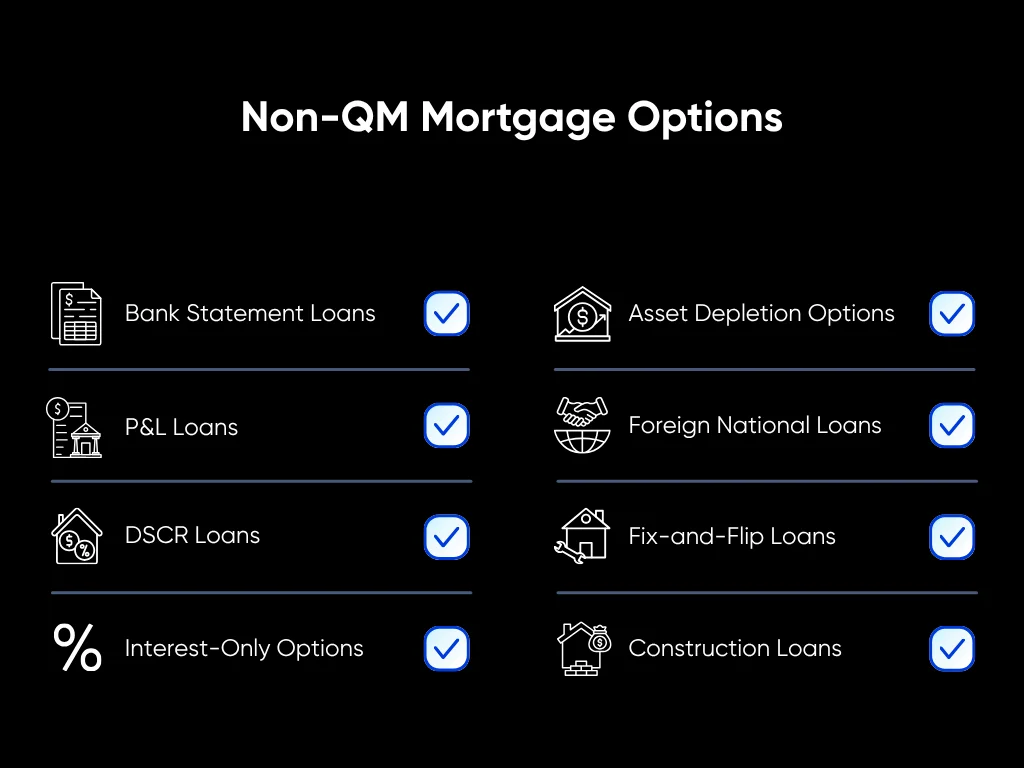
The four primary Non-QM loan types are:
- DSCR loans — qualify based on rental property income
- Bank statement loans — qualify based on deposit history
- P&L loans — qualify based on business net profit
- Asset depletion loans — qualify based on liquid assets
Each program uses a different income verification method. The right choice depends on how your income is structured.
Non-QM Loan Requirements by Program Type
DSCR Loan Requirements
A DSCR loan qualifies based on a rental property’s debt service coverage ratio — monthly rent divided by monthly mortgage payment. No personal income required.
Core requirements:
- Minimum DSCR: 0.75 at Defy (most lenders require 1.0)
- Minimum credit score: 640
- Maximum LTV: up to 85% on SFR purchases
- Reserves: 3+ months PITI
- Property types: SFR, 2–4 unit, STR, condo, LLC-vested
Best for: Real estate investors qualifying on rental income rather than personal income.
Formula: DSCR = Rental Income ÷ PITIA
👉 Full breakdown: DSCR Loan Requirements
Bank Statement Loan Requirements
A bank statement loan qualifies based on 12–24 months of bank deposit history. Income is calculated using an expense factor applied to gross deposits.
Core requirements:
- 12 or 24 months of personal or business bank statements
- Industry standard expense factor: 50% (CPA letter = actual ratio, no minimum at Defy)
- Minimum credit score: 640
- Maximum LTV: up to 90% on primary residence purchases
- Reserves: 3+ months PITI
Best for: Self-employed borrowers with strong deposit history whose tax returns understate income.
Formula: Income = Gross Deposits × Expense Factor (50% standard)
👉 Full breakdown: Bank Statement Loan Requirements
P&L Loan Requirements
A P&L loan qualifies based on a CPA-prepared profit and loss statement. Income is the net profit figure — no expense factor applied.
Core requirements:
- 12 or 24 months of CPA-prepared P&L statements
- 2–3 months of supporting bank statements
- Minimum credit score: 640
- Maximum LTV: up to 85% on primary residence purchases
- Reserves: 3+ months PITI
- 2 years self-employment history
Best for: Business owners with clean financials whose net profit accurately reflects earning capacity.
Formula: Income = Net Profit ÷ Statement Period (months)
👉 Full breakdown: P&L Loan Requirements
Asset Depletion Loan Requirements
An asset depletion loan converts liquid assets into a monthly qualifying income equivalent. No employment income required.
Core requirements:
- Significant liquid assets (typically $500K–$1M+ depending on loan size)
- Eligible assets: savings, investments, retirement accounts (discounted by type)
- 60-month depletion period at Defy (maximizes qualifying income)
- Minimum credit score: 640
- Maximum LTV: up to 80% on primary residence purchases
- Post-close reserves required
Best for: Retirees, high-net-worth individuals, and borrowers with substantial assets but limited documented income.
Formula: Income = (Eligible Assets − Reserves − Down Payment) ÷ Depletion Period
👉 Full breakdown: Asset Depletion Mortgage Requirements
Non-QM Requirements Comparison Table
| Requirement | DSCR | Bank Statement | P&L | Asset Depletion |
|---|---|---|---|---|
| Income source | Rental income | Bank deposits | Net profit (P&L) | Liquid assets |
| Tax returns required | No | No | No | No |
| W-2s required | No | No | No | No |
| Min credit score | 640 | 640 | 640 | 640 |
| Max LTV (primary purchase) | 85% (SFR) | 90% | 85% | 80% |
| Max loan amount | $6M | $6M | $6M | $6M |
| Self-employment required | No | Yes (2 yrs) | Yes (2 yrs) | No |
| LLC vesting | Yes | No | No | No |
| Interest-only available | Yes | Yes | Yes | Yes |
| Foreign nationals | Yes | Limited | No | Yes |
Key takeaway: The right Non-QM loan depends entirely on how you earn or hold wealth — rental income, deposits, business profit, or assets. No single program fits every borrower.
Not sure which program fits best? We’ll run all four side-by-side and show you the highest qualifying option.
How to Choose the Right Non-QM Program
Choosing the right program comes down to one question: how does your income or wealth actually work?
Choose a DSCR loan if: You’re financing an investment property and want qualification based entirely on rental income. No personal income documentation needed at all.
Choose a bank statement loan if: You’re self-employed with strong gross deposit history. Your business generates high revenue, and a 50% expense factor still produces sufficient qualifying income.
Choose a P&L loan if: You maintain organized CPA financials and your net profit is a clean, accurate representation of what you earn. Works best for service businesses with low overhead.
Choose an asset depletion loan if: You have substantial liquid assets — savings, investments, retirement accounts — but limited or no documented income. Common for retirees and high-net-worth borrowers.
Can you combine programs? Yes. Asset depletion income can be layered with other income sources. Some borrowers qualify using a combination of rental income and personal assets.
Non-QM Credit Score Requirements
Most Non-QM programs in 2026 require a minimum 620–640 FICO. At Defy Mortgage, the minimum across all programs is 640.
Credit score affects:
- Interest rate (higher score = lower rate)
- Maximum LTV (higher score = higher LTV available)
- Reserve requirements (higher score may reduce required reserves)
Non-QM loans are not low-credit loans. They are alternative documentation loans. Creditworthy borrowers with strong credit profiles but non-traditional income documentation are the target borrower.
Non-QM Down Payment Requirements
Down payment requirements vary by program and LTV:
| Program | Minimum Down Payment | Max LTV |
|---|---|---|
| DSCR (SFR purchase) | 15% | 85% |
| Bank Statement (primary) | 10% | 90% |
| P&L (primary) | 15% | 85% |
| Asset Depletion (primary) | 20% | 80% |
| Any program (investment) | 20–25% | 75–80% |
Common Mistakes When Choosing a Non-QM Loan
1. Choosing the wrong program for your income type
Bank statement loans work best for borrowers with high gross deposits. P&L loans work best for borrowers with clean net profit. Choosing the wrong program can significantly reduce qualifying income — or result in a decline. A lender offering all four programs can run the comparison for you.
2. Not optimizing the income calculation method
For bank statement loans, a CPA letter documenting actual expenses can increase qualifying income significantly. For asset depletion, the depletion period is the most important variable — Defy’s 60-month period generates 6x more income than a 360-month calculation. These details matter.
3. Ignoring reserve requirements
Most Non-QM programs require 3–12 months of PITI reserves after closing. Many borrowers don’t account for this when calculating how much down payment they can afford. Always calculate reserves separately from down payment.
4. Assuming credit score doesn’t matter
Non-QM loans are alternative documentation loans — not low-credit loans. A 640 FICO may qualify, but a 740 FICO unlocks materially better rates and higher LTV. Credit optimization before application is worth the wait.
5. Not working with a lender that offers all program types
Some lenders only offer one or two Non-QM products. If your lender doesn’t offer DSCR, bank statement, P&L, and asset depletion, you may not be getting the best qualification path for your situation. Defy Mortgage offers all four.
Who Should Use a Non-QM Loan?
Non-QM loans are the right fit for:
- Self-employed borrowers who cannot document income through tax returns
- Real estate investors building portfolios beyond conventional loan limits
- Retirees and high-net-worth individuals with assets but limited documented income
- Foreign nationals investing in US real estate without US income documentation
- Business owners whose write-offs reduce taxable income below qualifying thresholds
- 1099 earners and freelancers with consistent cash flow but non-traditional documentation
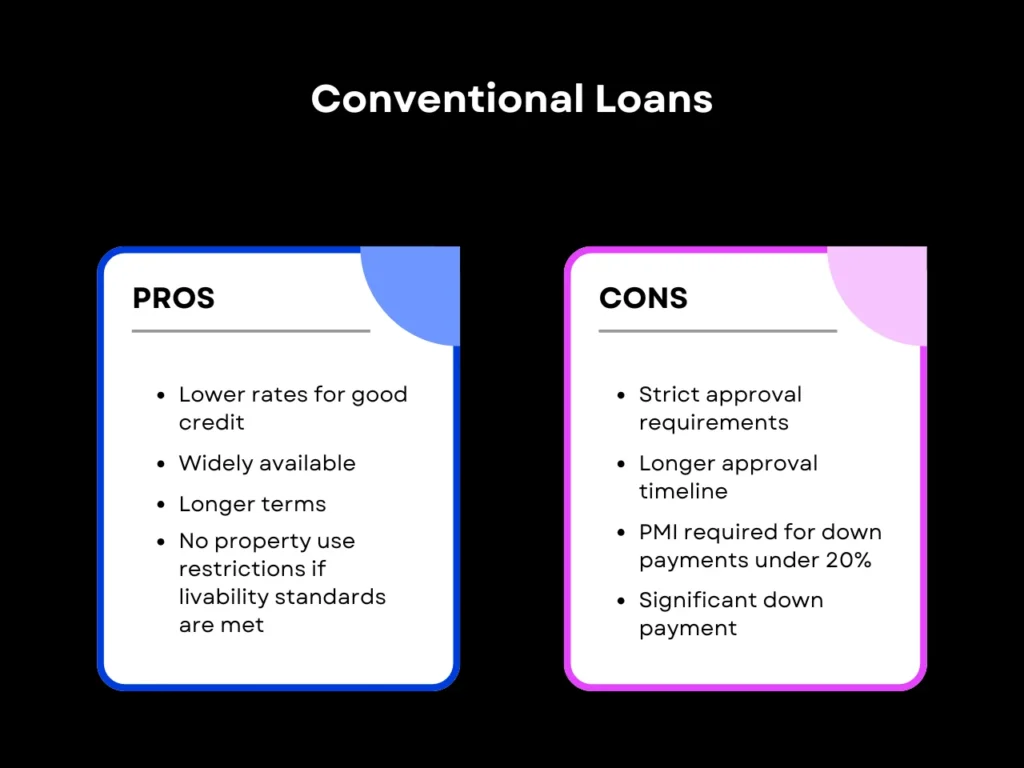
Non-QM loans are not the right fit for borrowers who qualify conventionally — conventional financing typically offers lower rates and less stringent reserve requirements.
Non-QM loans are also not ideal for: W-2 borrowers who qualify easily through conventional channels, buyers seeking the absolute lowest rate, borrowers seeking FHA, VA, or conventional financing, or borrowers without consistent income, assets, or rental property income to document.
Non-QM vs Conventional Loans
| Factor | Non-QM Loan | Conventional Loan |
|---|---|---|
| Income verification | Alternative (bank statements, P&L, assets, rental income) | W-2, tax returns, pay stubs |
| Tax returns required | No | Yes (typically 2 years) |
| Self-employed friendly | Yes — built for it | Limited |
| Interest rates | Slightly higher | Lower |
| Down payment | 10–25% depending on program | 3–20% |
| Flexibility | High — multiple qualification paths | Low — rigid guidelines |
| Best for | Self-employed, investors, high-net-worth | W-2 employees with stable income |
| Max loan amount | Up to $6M at Defy | Conforming limit ($832,750 in most areas) |
Conventional loans offer the lowest rates and least down payment for borrowers who qualify — but they require consistent W-2 income and penalize self-employed borrowers who use tax write-offs. Non-QM loans fill the gap for borrowers whose actual financial capacity exceeds what their documentation shows.
Frequently Asked Questions
What is a Non-QM loan?
A Non-QM loan is a mortgage that doesn’t meet the CFPB’s Qualified Mortgage standards. It allows lenders to verify income using alternative methods — bank statements, profit and loss statements, rental income, or liquid assets — instead of W-2s and tax returns. Non-QM loans are fully underwritten and designed for creditworthy borrowers with non-traditional income structures.
What credit score is required for a Non-QM loan?
Most Non-QM programs require a minimum of 620–640 FICO. Defy Mortgage requires 640 across all Non-QM programs. Higher credit scores unlock better rates and higher LTV options.
Are Non-QM loans more expensive than conventional loans?
Yes, typically. Non-QM loans carry slightly higher interest rates than conventional mortgages due to alternative documentation. The trade-off is qualification flexibility — borrowers who can’t qualify conventionally gain access to financing that accurately reflects their real financial capacity.
Do Non-QM loans require tax returns?
No. The defining feature of Non-QM loans is that they replace tax returns with alternative documentation — bank statements, P&L statements, asset statements, or rental income — as the primary income verification method.
What is the maximum loan amount for a Non-QM loan?
At Defy Mortgage, Non-QM loans go up to $6,000,000 across all program types. Loan limits depend on LTV, credit score, and program type.
Can I get a Non-QM loan for an investment property?
Yes. DSCR loans are specifically designed for investment properties. Bank statement, P&L, and asset depletion programs can also be used for investment properties with slightly more conservative LTV requirements.
For current rates across all Non-QM programs, see our Non-QM rates page.
Ready to Find the Right Non-QM Program?
Not sure which Non-QM loan is right for your situation? Get a side-by-side qualification analysis across all four programs in minutes. Schedule your Non-QM loan consultation with Defy Mortgage — we’ll match you to the right program and tell you exactly what you qualify for.
Todd Orlando
Senior Loan Officer | NMLS #2381554
Defy Mortgage — Non-QM & DSCR Specialist
What Defy Mortgage Does and Doesn’t Originate
Defy Mortgage originates DSCR loans (single-family and 2–4 unit), Foreign National DSCR, Bank Statement loans (12- and 24-month), P&L loans, Asset Depletion loans, Interest Only options, Foreign National loans, Full Doc (FNMA/FHLMC agency) loans, cash-out refinances, and Smart Equity closed-end fixed-rate second mortgages.
Defy Mortgage does not originate FHA, VA, or USDA loans, reverse mortgages, first-time homebuyer programs, or construction loans. Where this page discusses those products, it does so for educational purposes and refers to products offered by other lenders.