

Self-employed mortgage loan requirements differ significantly from traditional W-2 lending standards. While self-employment offers flexibility and higher earning potential, it can also introduces stricter documentation rules, income verification challenges, and underwriting scrutiny which it comes to getting a mortgage, especially for borrowers who use tax write-offs or have fluctuating income. However, that doesn’t mean that the process for getting a self-employed mortgage is more complicated. In fact, that opposite might be true as you have more alternative opportunities to qualify for a home loan.
Most self-employed mortgage lenders require two years of income documentation, but qualifying income is often reduced due to deductions, depreciation, and business expenses. As a result, many self-employed borrowers struggle to qualify under conventional mortgage rules, even with strong cash flow. This is why alternative income verification options exist for self-employed borrowers under the Non-QM umbrella.
This guide explains exactly what self-employed mortgage requirements are, how lenders calculate income, which documents are required, benefits to self-employed mortgages, how alternative loan programs such as bank statement loans, DSCR loans, P&L loans, and asset depletion loans can make approval easier and FASTER.
Let’s get started.
TL;DR
- Traditional mortgages offer great terms and rates for borrowers with high FICO and low DTI ratio, but they can penalize self-employed borrowers who make heavy use of write-offs.
- Fluctuating income can also skew traditional underwriting against the borrower’s favor.
- For those that are self-employed, lenders typically review 2 years of tax returns, including Schedule C, Schedule E, K-1s, and business returns.
- Non-QM loans (bank statement, DSCR, P&L, asset depletion) allow qualification using cash flow or assets instead of taxable income.
- Bank statement loans may use 12–24 months of deposits instead of tax returns.
- DSCR loans qualify investors based on property cash flow.
- Preparing documentation 3–6 months in advance improves approval odds and speeds up closing.
Defy Mortgage is a non-traditional mortgage lender for borrowers with unconventional income profiles. Specializing in self-employed and investor-focused lending, also considered, Non-QM lending, Defy Mortgage serves real estate investors, entrepreneurs, and those with self-employed income.
Quick Self-Employed Mortgage Requirements
Self-employed mortgage requirements typically include:
- Two years of personal and business tax returns
- Schedule C, E, or K-1 forms (depending on business structure)
- Bank statements (12–24 months for bank statement loans)
- Profit-and-loss statements
- Proof of business existence (license, CPA letter, or entity documents)
- Credit score, down payment, and reserve requirements
- Some lenders also offer Non-QM loans that allow self-employed borrowers to qualify using cash flow, assets, or rental income instead of tax returns.
What are the Self-Employed Mortgage Loan Requirements?
Traditional lending requirements, such as low DTIs and high FICO scores to qualify for an affordable rate, can be a significant barrier to effective portfolio expansion. Self-employed mortgage loan requirements offer a more accessible alternative. In general, the requirements for self-employed mortgage programs cover these major areas:
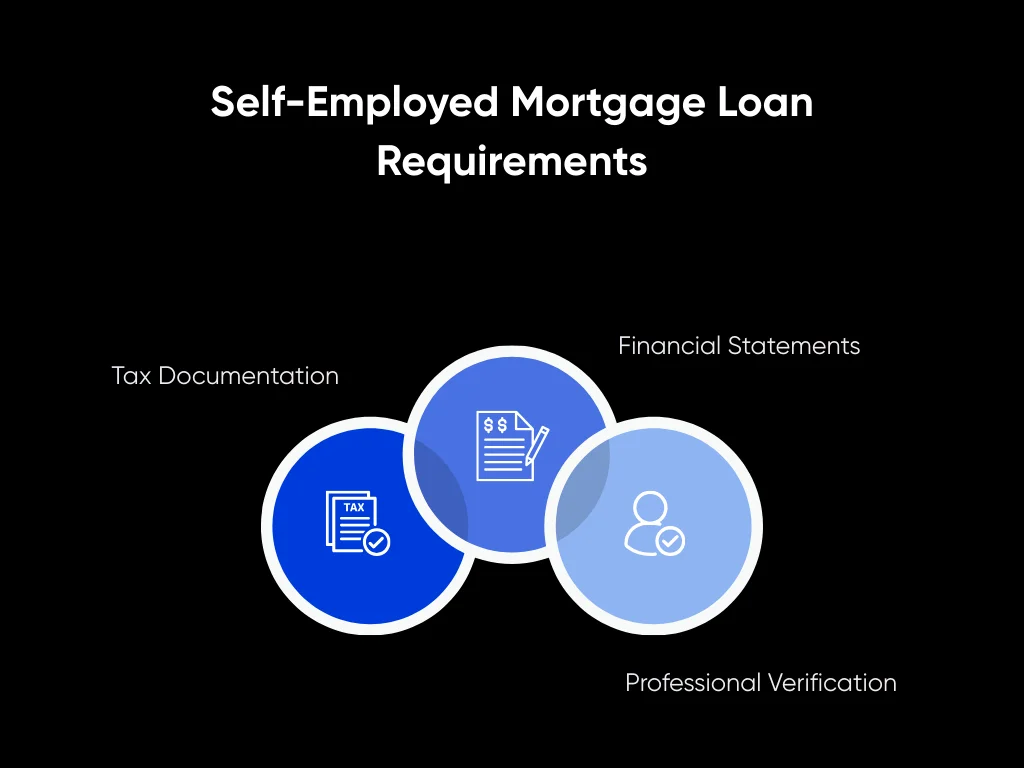
Tax Documentation Required for Self-Employed Mortgages
Tax returns are the primary method lenders use to verify self-employed income and business stability. Thus, your ability to repay the debt.
These are the most trustworthy because they’re official records, filed with the IRS (Internal Revenue Service), of your income and business activity over time. Regardless of your chosen loan type, it’s a good idea to prepare at least two years of personal and business federal tax returns.
Your tax documentation should come complete with at least two years of all necessary schedules for your business structure:
- Form 1040 – Complete Individual Federal Tax Return: This is the main tax return form that reports your total income, adjusted gross income (AGI), and tax liability.
- Schedule C – Profit or Loss From Business: This is the part of your tax return that shows net business profits or losses for sole proprietors and single‑member LLCs.
- Schedule E – Supplemental Income and Loss: This reports income from rental properties, partnerships, S‑corporations, royalties, and similar pass‑through income.
- Schedule D – Capital Gains and Losses: Schedule D reflects capital gains or losses from the sale of assets such as property or investments.
- Schedule K‑1 – Share of Business Income (from Form 1065 or 1120‑S): If you are a partner, S‑corporation shareholder, or member of certain LLCs, your income is reported on a Schedule K‑1 associated with a business return.
- Form 1065 – Partnership Return: This form isn’t used directly to calculate income, but instead is meant to support the K-1s you submit.
- Form 1120‑S – S‑Corporation Return: For S‑corporations, the tax return (Form 1120‑S) shows the corporation’s income and deductions, which feed into your Schedule K‑1.
Underwriters also review year-over-year trends closely. Declining income, unexplained write-offs, or discrepancies between reported income and bank deposits will often trigger additional scrutiny. These standards apply regardless of whether you’re researching self-employed mortgage requirements through a bank or a specialized lender.
Financial Statements Used to Qualify for a Self-Employed Mortgage
These can range from proof of income to more direct verification using bank statements and even assets. Alternative financial documents such as bank statements, profit-and-loss statements, and asset statements are especially important for non-QM loans, which give borrowers the option to qualify using ways other than traditional documentation.
Whether or not you’ll opt for a non-QM loan, it’s advisable to prepare these statements:
- The past few months of personal and business bank statements: This lets underwriters trace deposits and verify income consistency. Bank statement loans in particular hinge on these, requiring up to the last 24 months of bank statements. Other types of loans, such as conventional loans, may only require 6-12 months.
- A certified profit and loss (P&L) statement: Lenders typically require one prepared by a CPA, Enrolled Agent, or licensed tax professional. A P&L statement summarizes revenue and expenses when using business income to qualify. They are central to P&L loan qualification.
- Asset statements: Lenders may need to verify liquid assets in order to ascertain your financial reserves in the event of inability to pay. Conventional loans only take a cursory glance at your asset position, while dedicated asset depletion loans allow you to qualify with your entire liquid asset portfolio.
- Leases and rent rolls: These detail rental revenue, and are vital if you’re opting for a DSCR loan.
Borrowers with multiple businesses or income streams must provide statements for each entity. Proper labeling and organization are essential, especially when qualifying under requirements for self employed mortgage programs that rely on deposit analysis rather than taxable income alone.
Professional Verification
Lenders may also require third-party documents to confirm your business’s legitimacy and income accuracy:
- CPA letter: A CPA letter or an accountant-prepared verification can confirm self-employment status, ownership percentage, business activity, and financial stability.
- Business license: A current business license is proof that your business exists as a legally registered and authorized entity.
- Proof of business insurance: Documents such as liability, property, or professional insurance policies provide evidence that the business is operational and protected against common risks, which reduces lender risk exposure.
- Entity documentation: This includes Articles of Incorporation, LLC formation documents, or partnership agreements, showing the legal structure, ownership, and governance of your business. Lenders use this to verify ownership and the continuity of operations.
- Letters from clients: Client contracts or letters verifying ongoing work serve as proof of consistent income streams.
How Lenders Calculate Income for Self-Employed Borrowers
Unlike W-2 borrowers, self-employed applicants are evaluated using averaged income figures derived from filed tax returns and various other forms of income documentation. Additional scrutiny is applied to year-over-year consistency and business sustainability. Calculating self-employed income and creditworthiness involves these key components:
Income Averaging Formulas
Most lenders calculate self-employed income using a two-year average of net income reported on tax returns. Underwriters typically start with Schedule C net profit, K-1 income, or business net income, depending on the entity structure of your business. Then, they divide your combined total income by 24 months to arrive at a qualifying monthly income figure.
Apart from the two-year average, loan officers also verify whether your business is likely to stay at that level of income for at least the next three years after closing. They will look for things such as temporary market upticks and one-time windfalls or unusual revenue spikes to ensure that your business income is stable and sustainable enough to support the mortgage payments over the long term.
Tax Strategy Impact
For certain mortgages, taking business deductions may negatively affect your approval rate. By writing off expenses such as vehicle expenses, home office expenses, and accelerated depreciation, you lower your taxable income. This is why some underwriters may add certain expenses back, such as depreciation and amortization, because they do not impact actual cash flow.
Tax deductions are less of a concern with non-QM loans that give you the option to qualify using alternative income documentation, such as bank statement loans, P&L loans, and DSCR loans. These programs focus more on actual cash flow and deposit history rather than taxable income, allowing self-employed borrowers to demonstrate their true earning capacity even if aggressive deductions lower their reported net profit.
Compensating Factors
When calculated income alone does not meet standard thresholds, lenders may consider compensating factors, such as:
- Exceptionally strong credit
- Substantial liquid asset reserves
- Low overall debt obligations
- A large down payment
- Documented business stability
How much each of these can compensate for failure to meet the minimum residual income will ultimately be up to your lender’s discretion. Non-QM loans like bank statement loans and DSCR loans tend to be friendlier to compensating factors than conventional loans. Conventional loans have to be eligible to be sold to Fannie Mae and Freddie Mac, so they are typically subject to stricter standards.
Step-by-Step Application Process and Timeline
The mortgage process for self-employed borrowers follows the same broad structure as conventional borrowing, but with a few additional preparation and verification steps included. The timeline can be subdivided into three distinct phases:
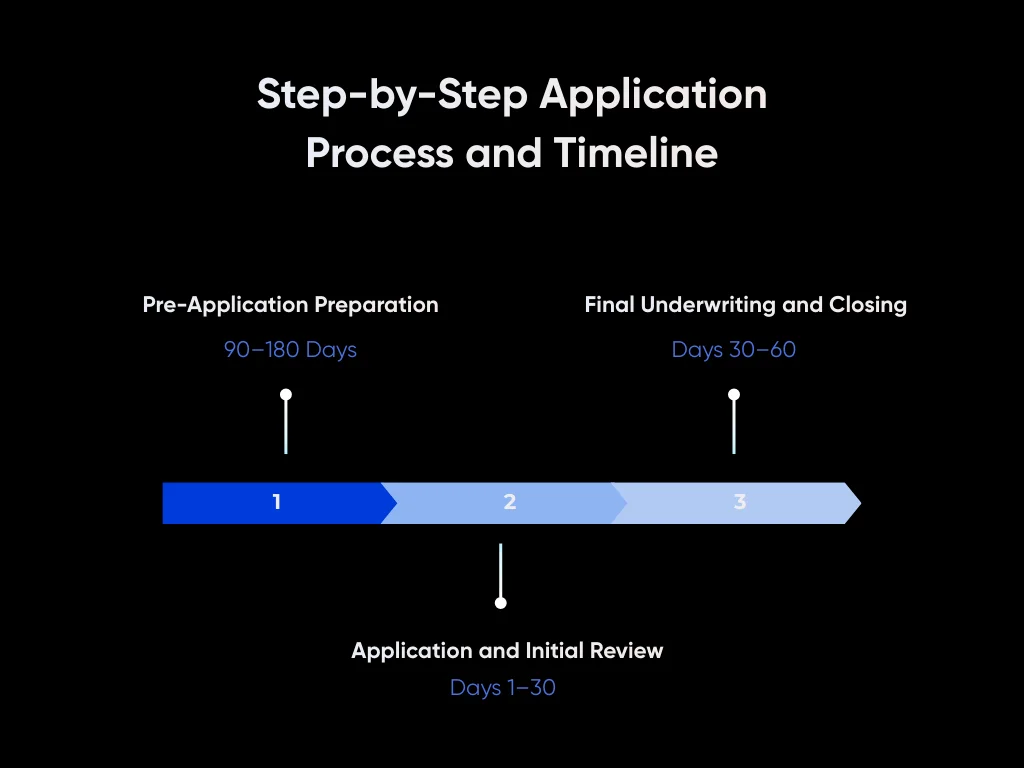
Pre-Application Preparation (90–180 Days)
Preparation should begin well before submitting a loan application. To maximize chances of getting approved with ideal rates and terms, take three to six months to do the following:
- Organize documentation: Begin gathering documentation as soon as possible. Collect the following, as-needed by your chosen loan type, and make sure there are no discrepancies before 60-90 days out from the day you plan to apply:
- CPA letter
- 12-24 months of personal and business bank statements
- Business licenses
- Entity documentation
- Year-to-date profit and loss statements, updated monthly
- The last two years of personal and business federal tax returns
- Review your credit report: Similar to all of your other documentation, make sure that there are no inconsistencies with your credit report at least 60 to 90 days before your lender pulls your credit info. This gives you time to resolve any issues.
- Minimize debt: Regardless of whether you’re going for a conventional loan or a non-QM loan, it’s a good idea to optimize your credit by minimizing debt. It may be beneficial to consolidate debt to make it easier to pay down during this period.
- Avoid taking on new loans: You should avoid applying for new credit cards or taking out car loans at least 6 months before applying for a mortgage.
- Ensure that business and personal bank accounts are separate: You’re probably doing this already, but make sure you haven’t missed common problem areas such as:
- Paying personal expenses from business accounts
- Depositing business income into personal accounts
- Making unlabeled transfers between accounts
Make sure all business and personal transfers are clearly labeled, and all income deposits are traceable to your business. Proper preparation during this phase significantly reduces underwriting back-and-forth later in the process.
Application and Initial Review (Days 1–30)
Once the application is submitted, lenders conduct an initial review. Here’s what you can expect during this stage:
- Application analysis: During roughly days 1- 10, lenders will analyze your credit, calculate your income, and validate all submitted documents. This includes verifying employment/self-employment status, reviewing bank statements for eligible deposits, and checking debt-to-income or cash-flow ratios before the file moves forward.
- Conditional pre-approval: Typically issued around days 10-20 (can be as early as day 2 with Defy Mortgage), a conditional pre-approval means that the lender is willing to proceed with the loan pending specific conditions being met. These can include additional documentation or appraisals. A pre-approval can be a significant edge in bidding, as it demonstrates to sellers that you’re serious about the purchase.
- Clarification follow-ups: These typically concern deposits, business expenses, or income fluctuations. It’s important that you clear these up within the 30-day window to avoid any hangups. Responding promptly and providing clearly labeled documentation helps a lot with that.
Final Underwriting and Closing (Days 30–60)
Final underwriting involves a deeper verification of income, assets, and business continuity. Here’s what you can expect:
- Final review and clearance process: Once the underwriter has verified that all conditions are satisfied, they will conduct a final review of the updated documentation, ensuring that no new issues have emerged since the initial review.
- Last-minute follow-ups: Throughout this last phase of the underwriting process, lenders may follow up on outstanding conditions such as updated business documentation or clarifications on income. Similar to the previous phases, respond promptly to prevent delays.
- Clear-to-close issuance: Once the file passes final review, the underwriter issues a clear-to-close, signaling that the loan is fully approved and ready for closing. This can take anywhere from 1-3 business days after all conditions are met.
- Closing preparation: During this period, the lender prepares closing documents, coordinates with the title company, and ensures that all final verifications are complete.
Best Mortgage Loan Options for Self-Employed Borrowers
Choosing the right loan program and lender is often just as important as qualifying in the first place, especially for self-employed borrowers whose income does not fit neatly into standard underwriting models. Let’s take a brief look at the main advantages, disadvantages, and ideal borrower profile for each of these:
| Advantages | Disadvantages | Best For | Income Used | |
| Conventional Mortgage | Typically lower interest rates Terms improve significantly with better FICO, DTI, and credit utilization ratio Wide availability | Requires full business or personal tax returns, W-2s, and/or pay stubs, which can disqualify some self-employed borrowers Stricter DTI and credit score requirements | High taxable income. Borrowers with strong, consistent documented income and good credit seeking the lowest rates | Tax returns/W2s |
| Bank Statement Loan | Uses bank deposits instead of tax returns, enabling approval for borrowers with nontraditional income Flexible documentation | Higher interest rates Lower availability | The self-employed. Self-employed borrowers with fluctuating or partially undocumented income Those who cannot qualify for traditional loans | Bank Statements |
| DSCR Loan | Qualify based on property cash flow rather than personal income Underwriting standards specifically designed for investment properties Get better terms with increasing property cash flow | May have higher rates than conventional Property must meet the minimum income-to-debt ratio threshold (unless your lender has a flexible option) Properties cannot be owner-occupied. Susceptible to rental market volatility | Real estate investors. Real estate investors with healthy rental income but lower personal income | Rental Income |
| P&L Loan | Uses current-year profit and loss statements to qualify Allows recent business growth to factor into getting better terms | Limited availability Requires CPA verification Higher rates than conventional | The self-employed. Self-employed borrowers with strong current-year income not fully reflected on previous tax returns | Profit and Loss Statements |
| Asset Depletion Loan | Qualify based on liquid assets instead of income Use a broad range of liquid assets, such as money market, stocks, retirement accounts, savings accounts, and more | Higher interest rates May require large cash reserves Limited availability | High-net worth/retirees. Borrowers with high net worth or liquid assets but irregular or low current income Often used for luxury or second homes | Liquid Assets |
| FHA home loanVA loans USDA loans | Lower down payment requirements More lenient credit requirements | Must meet FHA guidelines Must meet veteran requirements Mortgage insurance required; stricter property standards | First-time homebuyers and veterans. Borrowers with lower credit scores or smaller down payments Primary residences only | Tax Returns |
Loan Type Selection Framework
Before choosing a loan program, it helps to step back and evaluate your financial situation and investment goals to make sure a product aligns with your needs and expectations. Ask yourself the following questions:

- How would you characterize your income? Do you earn a constant amount each month, or are there highs and lows? Those with stable income that shows up on tax returns may be better off with a conventional loan, but for self-employed workers who have seasons of high and low business volume, a bank statement loan (or DSCR loan, if you’re investing) might serve you better.
- What’s your credit score? Borrowers with high credit scores can get the best results with a conventional loan. Those with middling credit scores can even the playing field by selecting a loan type that focuses on other factors, such as DSCR loans or asset depletion loans. If you’re a first-time homebuyer without an established credit score, an FHA loan may be better, but foreign national loans can also be a doorway to investment if you’re a non-US resident.
- How much in liquid assets do you have available? Being able to afford a high down payment can directly result in better terms. With Defy Mortgage’s DSCR loans, for example, availing of a lower LTV (~55%) can allow you to get the lowest possible rate of 5.999% (pending other qualifications such as 800+ FICO, 1.26 DSCR, 5-year prepay, and 6 months’ reserve. Rate estimate is for a $1M property in GA).
- How fast are you looking to close? If you need fast closing, choosing a loan type that underwrites with fewer documentation, such as a DSCR loan or bank statement loan, may be better.
How to Select the Best Lender
Selecting the right lender can be just as critical as choosing the right loan program. Regardless of which loan option you choose, make sure you account for these major factors:

- Experience lending to self-employed borrowers: Choose lenders with a high volume of self-employed loans. They will be more familiar with documentation nuances and processing requirements.
- Processing times: Look at borrower testimonies to determine how long a lender usually takes to close.
- Pre-approval depth: Assess how much goes into gaining pre-approval with a lender. Pre-approval gives you more leverage in bidding, so early pre-approval can be a significant edge when purchasing. At Defy Mortgage, we can pre-approve you in as few as 48 hours!
If you’d like to read more on this, we go more in-depth in this article on how to choose the right lender.
Making Your Final Decision on Self-Employed Mortgages with Defy Mortgage
Whether you’re an independent contractor looking to get into real estate investing or a freelance graphic designer buying a new home, Defy Mortgage can be your go-to. Our Mortgage Consultants have over 100 years of collective experience working with investors with irregular incomes across the United States, so we’re well-adapted to the nuances of self-employed lending.
Here’s what you can get by working with us:
- Tailored, 24/7 guidance. Your file will be handled by a dedicated mortgage consultant who will take an in-depth 360-degree look at your business and design a customized loan program to match.
- Access to 75+ different mortgage programs, both traditional and non-traditional. Whatever your needs, we can craft a mortgage solution for you.
- DSCR loans that let you qualify with as low as 0.75 DSCR, with flexible options unlocking at 740+ FICO. Get up to 85% LTV Purchase SFR (80% for cash-out refinance or R/T) or up to no hard maximum loan limit in financing once your FICO passes the 740-threshold.
- Bank statement loans that let you qualify with 12-24 months of business or personal bank statements. Get up to 90% LTV and no hard maximum loan limit in financing with 740+ FICO.
- P&L loans that let you qualify with P&L statements detailing your business income for the past 2 years. Similar to bank statement loans, these offer up to 90% LTV and no hard maximum loan limit max loan amount for borrowers with over 740 FICO.
- Asset-depletion loans that let you qualify with liquid assets to directly prove the ability to repay. Get up to 80% LTV and no hard maximum loan limit in financing.
- Get approved in as little as 14 days, pending requirements.
- Fixed-rate, ARM, and interest-only structures available.
Why Trust Defy Mortgage?
Defy Mortgage specializes in self-employed and investor lending, with over 100 years of combined mortgage experience across conventional and Non-QM programs. Our team underwrites complex income scenarios daily, including multi-entity businesses, short-term rentals, and high-net-worth borrowers.
If those sound like great deals to you, schedule a call with us and tell us about your next acquisition or refinance plans.
Conclusion
The self-employed mortgage loan requirements show that qualifying for a mortgage as a self-employed individual shouldn’t be more difficult than qualifying for one as a traditional W-2 employee. By selecting the right loan type and preparing complete documentation, be it tax returns, bank statements, asset statements, or others, you can prove income and gain qualification just as easily as a salaried individual.
With Defy Mortgage, you can get tailored guidance before you even put in the app. Schedule an appointment on our site or call us at (615) 622-1032.
And if you’re a mortgage broker, Defy TPO can help you dominate the self-employed sector with Defy Mortgage’s offerings. By working with us, you can get:
- High-LTV bank statement programs: Up to 90% pending FICO.
- High-LTV cash-out programs: Up to 80%.
- Investor-focused, in-depth underwriting: We take the time to get to know a borrower’s business in and out to ensure that we offer the fairest, most accurately aligned terms.
- ARM and interest-only structures available: Reduce debt obligation during the first few years of the loan to give income room to grow to its full potential.
If you’d like to know how we do it, send us your pricing scenarios, and we’ll show you. There’s also an AI Pricer for quick pricing estimates.
FAQs
What documentation do self-employed borrowers need for a mortgage?
Common documentation or self-employed borrowers include:
- Two years of personal and business tax returns, including all schedules and pages
- Bank statements
- Business documentation
- Profit-and-loss statements, if applicable
- Professional verification, such as a CPA letter
What is the minimum income required for a self-employed mortgage?
There is no universal minimum income requirement. Lenders evaluate whether verified income or cash flow is sufficient to support the mortgage payment, debts, and reserves. Some Non-QM loans allow qualification without traditional income verification.
How do lenders calculate income for self-employed borrowers?
Since self-employed borrowers don’t typically receive a regular salary, lenders usually calculate income by averaging net income from the last two years, as reported through documents like tax returns, bank statements, or rent rolls. During underwriting, they’ll analyze income trends to ensure earnings are stable or increasing.
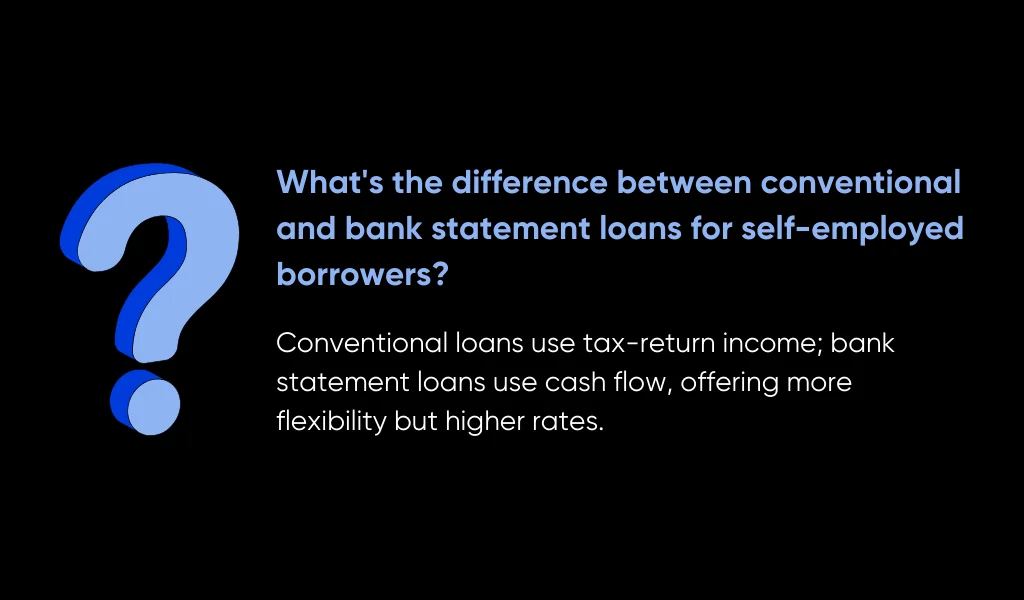
What’s the difference between conventional and bank statement loans for self-employed borrowers?
Conventional loans rely primarily on net income shown on tax returns, which can limit qualifying income for borrowers with large deductions. Instead of that, bank statement loans analyze cash flow from 12–24 months of bank statements, offering more flexibility but often at higher rates.
How long does the mortgage process take for self-employed borrowers?
The mortgage process for self-employed borrowers typically takes 45–60 days, though it can be longer if documentation is incomplete or income is complex. With proper preparation, you can significantly shorten that timeline. At Defy Mortgage, we’ve closed in as little as 14 days with complete documentation.
What loan programs are available specifically for self-employed borrowers?
There aren’t any loans designed specifically for self-employed borrowers; rather, some loans are particularly suited to self-employed borrowers’ income profiles. These include:
- Bank statement loans: Directly prove how much income regularly gets deposited in your account using the last 12-24 months of bank statements
- Profit-and-loss statement loans: Use your business’s P&L statements to qualify.
- DSCR loans: Qualify using a property’s rental income.
- Asset depletion loans: Use liquid assets like savings, money market, and retirement accounts to represent income.
How should self-employed borrowers prepare for a mortgage application?
Borrowers should organize tax returns, separate personal and business finances, review credit reports, and prepare updated financial statements several months before applying. Thorough preparation helps streamline underwriting and reduce approval timelines.
Do self-employed borrowers need two years of income to qualify for a mortgage?
Usually. Most lenders prefer to see two years of self-employed income, but it is not always required. Completely depends. Some loan programs allow approval with one year of income, and others, such as bank statement loans, DSCR loans, and asset depletion loans, do not rely on tax-return income at all. Eligibility depends on the loan type, credit profile, and overall financial strength. Be sure to ask your lender of choice what their requirements are.
When should self-employed borrowers choose Defy Mortgage over conventional lenders?
Defy Mortgage is highly attuned to the needs of real estate investors, with our high-LTV jumbo loans and specialized DSCR loans for STRs. With our industry-leading LTVs and closing times, we’re designed to help investors expand their wealth-building capabilities at their own pace.