


Georgia home values climbed hard through the first half of the decade, then flattened as higher borrowing costs pulled demand back. Will that cooling continue through 2026, or is the state setting itself up for another leg up?
At Defy Mortgage, we make the mortgage process as simple as possible for homebuyers, real estate investors, self-employed individuals, and business owners. We have expertise in 75+ non-traditional mortgage solutions, including DSCR loans, bank statement loans, and foreign national loans, with each option fully tailored to your unique situation.
In this article, we’ll answer your questions about whether Georgia’s housing market cools further or holds steady in 2026 and explain inventory, pricing, and buyer behavior to give you a potential outlook of investing or buying a house in Georgia.
Let’s dive in!
Current State of the Housing Market in Georgia in 2026
Georgia’s market has settled into a slower, more negotiable pattern than the one buyers faced at the start of the decade: supply has rebuilt across most metros, homes sit longer, and price cuts are routine rather than remarkable. We have deliberately stripped this page of point-in-time figures that go stale within weeks — median sale prices, active listing counts and days-on-market readings move every month, and any number printed here would be wrong by the time you read it. For live figures, pull them from Georgia MLS or a local agent. What follows is the structural read: which metros behave which way, what actually drives them, and which signals are worth watching before you buy.
State of the Housing Market in Major Georgia Cities
The housing market in Georgia varies significantly by region, with some metros appreciating while others give ground in the same quarter. Treat the state as four or five separate markets rather than one.
Atlanta
Atlanta is the state’s deepest and most volatile market. It carries the largest rental pool, the most new construction in the outer counties, and therefore the widest swings in price cuts and above-list sales from one quarter to the next. The signal to watch here is the ratio of price-reduced listings to homes selling above list: that ratio turns in Atlanta before it turns anywhere else in Georgia, which makes the metro a useful leading indicator for the rest of the state.
For investors, Atlanta’s depth cuts both ways. Rebuilt inventory means more negotiating room at acquisition, but it also means more competing rentals in the same submarket. Underwrite the rent, not the appreciation.
Savannah
Savannah entries typically price well below Atlanta, and the local economy leans on the port and on tourism rather than on corporate relocation. That tourism base makes short-term rental strategies viable in a way they are not across most of the state — but STR rules are set locally and they change, so confirm the permit requirements for the specific district before you underwrite an STR rate.
Augusta
Augusta remains one of the most affordable metros in Georgia, anchored by Fort Eisenhower and the cyber corridor that has grown up around it. That anchor produces steady, relatively rate-insensitive rental demand — government and contractor tenants move for postings, not for mortgage rates — which is exactly the tenant profile a DSCR loan underwrites well.
Macon
Macon carries the lowest entry prices of Georgia’s mid-size metros, which is why it screens well on debt service coverage: the rent-to-price relationship clears more easily than it does in Atlanta. The caution is volume. Macon is a small market, so its median price and days-on-market readings swing hard on a handful of transactions. Look at the submarket, not the metro median.
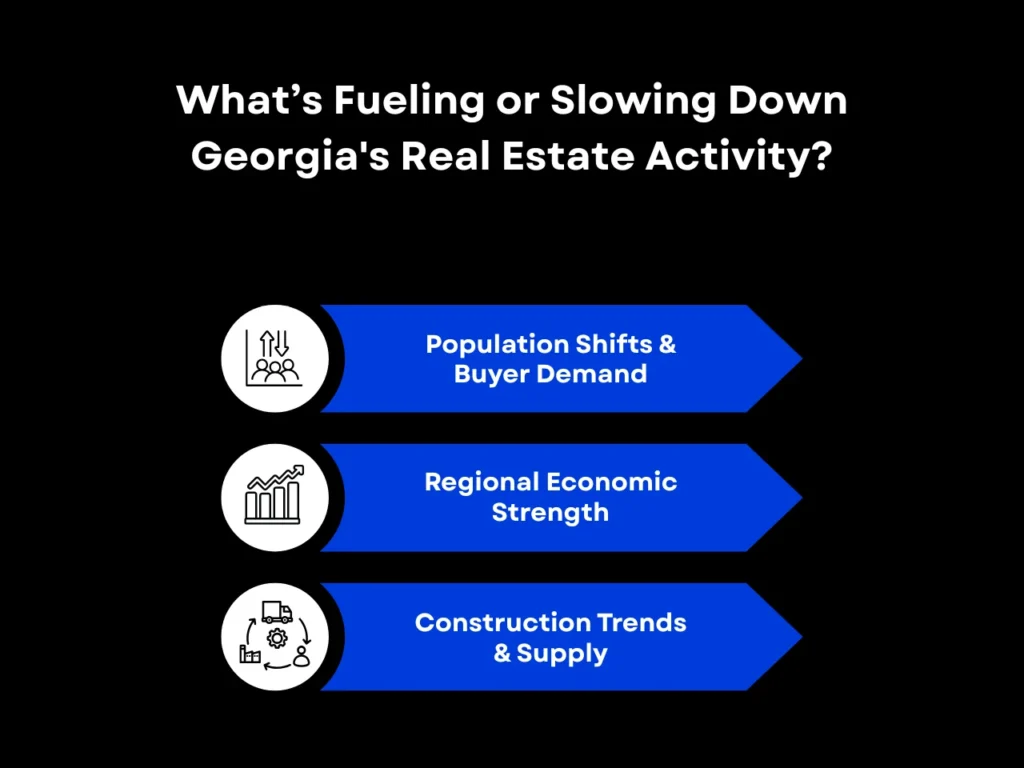
What’s Fueling or Slowing Down Georgia’s Real Estate Activity?
The current state of the Georgia housing market can be attributed to several factors. Let’s explore some of the most significant ones:
Population Shifts & Buyer Demand
Georgia continues to be a popular domestic migration destination, particularly from states with higher living costs such as Washington, California, New York, Illinois, and Florida. Between July 2023 and July 2024, Georgia added 116,646 new residents, most of which were due to international and domestic migration. Lower taxes and more affordable housing are the main factors driving buyer behavior.
Large urban markets such as Metro Atlanta remain highly popular, with the city’s population growing by 62,700 in 2024, bringing the total to 5.2 million. However, several up-and-coming cities are also getting recognized for their quality of life and affordability, such as Augusta, Roswell, and Athens.
Remote work also contributes to the upward trends. In a study for the Federal Reserve Bank of San Francisco, it was found that for every percentage-point increase in remote work, home prices rise by 1.5 percent. Remote workers make up over a quarter of the workforce in two of Georgia’s major cities: Sandy Springs and Atlanta.
Regional Economic Strength
Georgia’s core cities, such as Atlanta, Augusta, and Columbus, continue to experience accelerated job market growth. These cities have high concentrations of advanced tech and service-producing industries, including aerospace, automotive manufacturing, cybersecurity, distribution, and life sciences. Atlanta built one of the country’s fastest-growing life sciences clusters, posting 20% job growth from 2019 to 2022 against a national average of 13.7%.
Georgia’s highly diverse economy gives its real estate market more resilience. A thriving job market attracts businesses and sustains healthy real estate appreciation. This is similar to San Diego, California, whose strong economy is supported by its military, biotech, and international trade sectors.
Construction Trends & Supply
Georgia saw the total number of housing units grow by 12.2% over the preceding decade – the 13th fastest growth in the US. However, despite more houses being put up for sale in GA every year, experts still consider the state to be in a housing shortage due to pent-up demand. Challenges such as labor shortages and increased material costs have also slowed the pace of new housing developments.
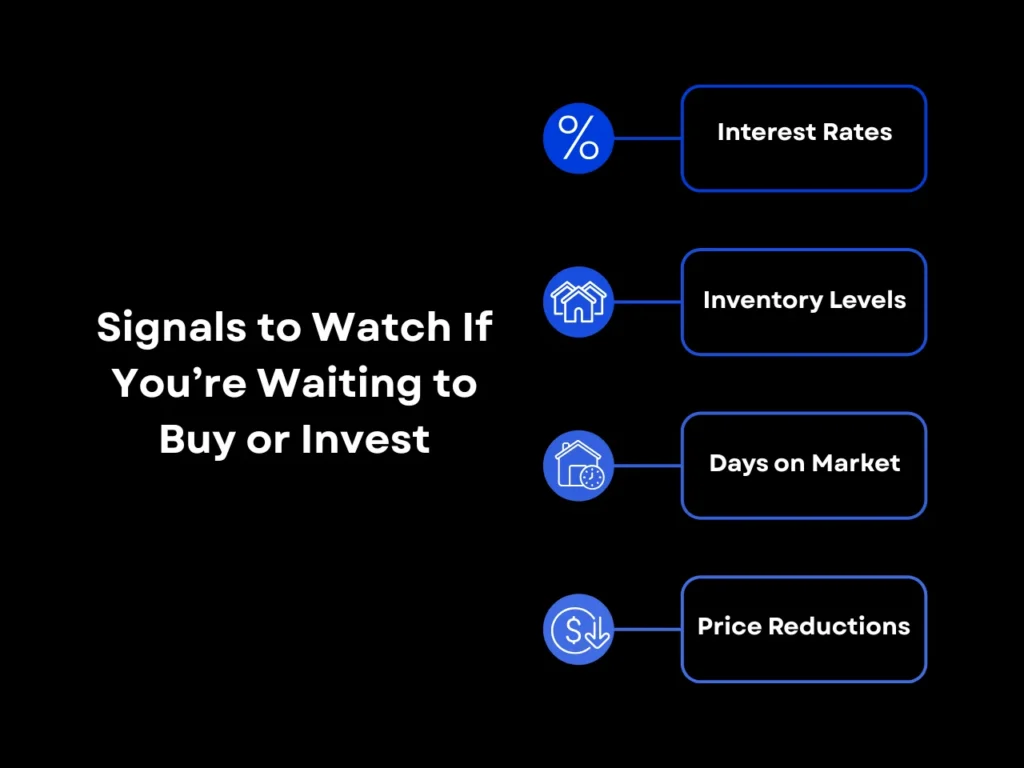
Signals to Watch If You’re Waiting to Buy or Invest
If you’re looking to enter the housing market in Georgia, staying informed about key market indicators can provide valuable insights into optimal timing and investment strategies. Here are the primary signals to monitor:
Interest Rates
Mortgage rates in Georgia for a 30-year fixed mortgage on a single-family home track the national average closely, and pricing moves week to week rather than settling at a published figure. Current Defy pricing is listed on our non-QM rates page.
Monitoring macroeconomic factors such as inflation, employment, stock market prices –and to a certain extent, Federal Reserve policies such as changes to the Federal funds rate–can give you vital clues as to the direction that mortgage rates can potentially go in the future.
Inventory Levels
Statewide inventory has rebuilt substantially from the scarcity of the early decade, and that is the single clearest shift in Georgia’s market. Rising inventory signals a move toward a buyer’s market as more options open up. However, keep in mind that prices tend to vary on a more local level, and regions with more housing construction are more likely to have potentially lower prices.
Although higher housing inventory is good for homebuyers, it can be detrimental to investors due to increased competition, both for flippers and rental owners. However, it may not directly affect those who favor long-term holding strategies, particularly in neighborhoods that are in higher demand. If you’re seeking high-value regions with limited supply, Defy offers options such as jumbo loans to secure such properties for long-term holding.
Days on Market
Median days on market across Georgia have lengthened from the compressed timelines of the early decade, which means buyers are gaining more breathing room to make decisions.
For investors, longer time on market can indicate increased difficulty in selling a home, but if you’re a rental owner, it can be a sign that prospective homebuyers are starting to leave the market in favor of renting.
Price Reductions
Monitoring pricing fluctuations on listed properties is like monitoring the health of your local market. Price drops can imply that local buyers are gaining leverage, which means you may be able to close on a home for a more affordable price. Price hikes in the same neighborhood as your current investments, on the other hand, could indicate that profits are increasing for your current investment properties.
Periods of steady price decline followed by large price recoveries, for example, are advantageous for fix-and-flip strategies. Fix-and-flips involve purchasing an undervalued property, refurbishing it to be more appealing, and selling it at a profit. You can capitalize on price fluctuations by determining the optimal times for buying and selling.
Decreased home prices may benefit rental investors by providing a way to hedge against risk. As long as the rental demand remains high in an area, you are likely to earn the same amount of rental income even if the selling price decreases.
Loan Options for Buyers and Investors in Georgia
There are several loan options that stand out as excellent choices for both buyers and investors in Georgia’s housing market. Here’s a brief overview of each one:

DSCR Loans
Debt Service Coverage Ratio (DSCR) loans are ideal for investors focusing on income-generating Georgia properties. DSCR loans let you qualify with your selected property’s income potential rather than provide comprehensive personal information such as W-2 income or tax returns. Defy Mortgage offers DSCR purchase loans and DSCR refinance, with interest-only options and availability to foreign nationals without a US-based SSN or FICO score as well. However, we do not originate construction loans of any kind, including DSCR construction loans.
Editor’s note: the loan types described in this section are covered for comparison only. Defy Mortgage does not originate FHA, VA, or USDA loans. Defy Mortgage does not originate construction loans of any kind — ground-up, renovation, or owner-builder — for any occupancy type. Defy originates DSCR, bank statement, P&L, asset depletion, interest-only, foreign national, Full Doc, jumbo, cash-out refinance, and Smart Equity (HELOAN) loans.

Home Equity Loans and HELOCs
If you’re a homeowner or property owner with substantial home equity, you can potentially finance a home or investment purchase using a home equity loan or home equity line of credit (HELOC). Both are second mortgages that are based on how much equity you have on your home, with home equity loans providing you with a lump sum and HELOCs allowing you to withdraw funds as needed.
Jumbo Loans
Georgia has a growing luxury property market, supported by its robust economy and steadily increasing population. Lucrative holding prospects are appearing in areas like coastal Georgia and Buckhead, with prices exceeding conforming loan limits. In cases in which renting these properties out is unfeasible, or if you simply prefer not to do so, jumbo loans become necessary to sidestep the conforming loan limit restriction of conventional mortgages.
Bank Statement Loans
if you’re a self-employed individual, such as a freelancer, business owner, or 1099 contract worker, a bank statement loan is an alternative to traditional mortgage loans and offers more flexibility. Instead of W-2s, pay stubs, or tax returns, these loans allow borrowers to demonstrate their income using bank statements. For those with unconventional income streams, this can be a much more accurate way to represent their income than standard methods.
Housing Market in Georgia FAQ
Is Georgia’s housing market expected to drop significantly in 2026?
No, the Georgia housing market is expected to remain relatively stable; however, some parts are currently experiencing a cooling trend. That said, prices have yet to drop significantly, and demand is still sufficient to support high amounts of real estate activity. Whether this cooling effect will continue remains to be seen.
Which areas of Georgia are still experiencing price growth?
Most areas in Georgia are still experiencing home price growth. However certain places, such as Atlanta are currently in a period of home price decline, likely due to elevated mortgage rates and increased home prices.
Does Defy offer DSCR or construction loans in Georgia?
No. Defy does not originate construction loans of any kind — ground-up, renovation, or owner-builder — for any occupancy type. This includes DSCR construction loans for properties intended to be rentals once completed. Defy Mortgage specializes in DSCR purchase loans and refinance for existing properties.
Can I use a HELOC in Georgia to finance a new property purchase?
Yes, provided you have sufficient equity. Defy’s home equity product is Smart Equity, a closed-end fixed-rate second mortgage: you receive the full amount as a lump sum at closing and repay it on a fixed schedule at a locked rate, rather than drawing against a revolving line as you would with a traditional HELOC. That structure gives you a predictable payment and a known payoff date, which suits a defined use such as funding the down payment on your next Georgia property.
What’s the best loan option for buyers in Georgia through Defy?
The best loan option for you depends on your specific financial situation. If you’re a self-employed individual, it may be more beneficial to seek a bank statement loan in Georgia. If you’re buying an investment property, a DSCR loan can qualify you on the property’s rental income rather than your tax returns. We are familiar with the market in Georgia and our experts can point you in the right direction for your unique situation.

Key Takeaway
Heading into 2026, the Georgia housing market is still working through the national cooling in real estate, and it is showing real resilience while it does. Many regions retain a steady growth rate, while metros such as Atlanta are presenting unique opportunities to buyers with a downturn in market activity.
If you’re waiting for the average home price in Georgia to fall before committing to a mortgage, keep in mind that prices are more likely to stabilize or even increase modestly throughout the year. It’s often a good idea to consult experts with access to Georgia MLS services to refine your property research.
Ready to explore your mortgage options in the Peach State? Defy Mortgage can assist you with custom-tailored mortgage solutions for your exact lending scenario. Whether you’re looking for DSCR, asset depletion, bank statement, jumbo, or HELOC, we can customize a loan option to address your needs.